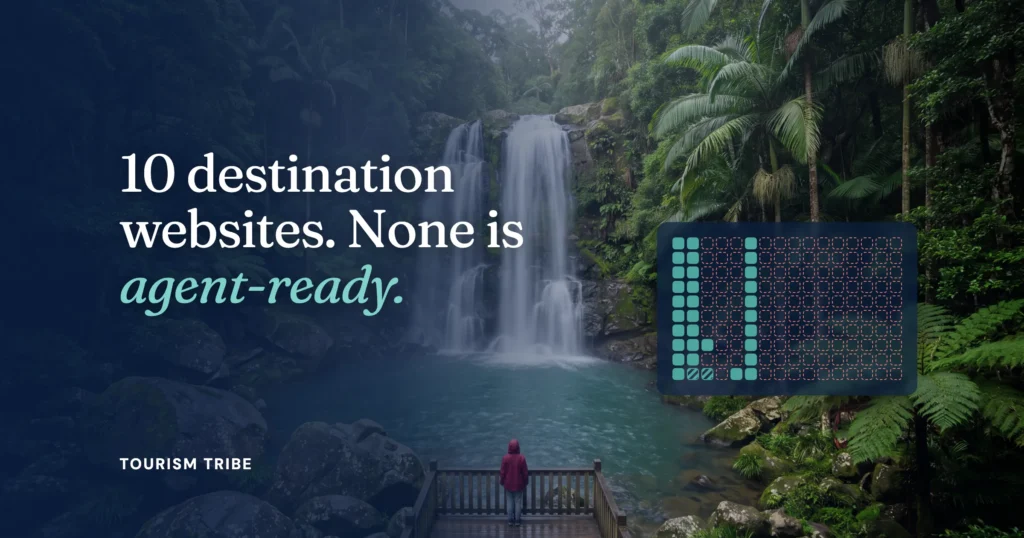
How ready are the world’s best-known destination websites for AI agents? On 20 November 2026 we checked the agent readiness of ten of them with Cloudflare’s free scanner. Nine sat at level 1 of 5 in every scan. Visit The USA moved between level 0 and level 1. None of the ten lets an AI agent connect, sign in or act.
- What we tested, and how
- The result: level 1 out of 5, across the board
- What these ten sites get right
- What every site is missing: the agent layer
- Why agent readiness matters for a destination
- What a DMO does first
What we tested, and how
We tested ten destination websites with Cloudflare’s agent readiness scanner at isitagentready.com. Cloudflare launched it on 17 April 2026. We used it without an account or payment.
The scanner reads the page you give it, plus the files that apply to the whole site. It checks 23 standards in five groups: finding the site, reading the content, bot rules, connecting and acting, and commerce. It then gives a readiness level from 0 to 5.
For a site that does not sell directly, the commerce checks do not count. Neither do two checks the scanner marks as information only. That leaves 16 checks that set the level.
We picked ten destination marketing organisations (DMOs). They come up again and again in the articles we read on AI and tourism:
- Travel Manitoba
- Destination Toronto
- Visit The USA (Brand USA)
- Discover Puerto Rico
- Visit Greece
- Vienna Tourist Board
- VisitOSLO
- Visit California
- Visit Denver
- Visit Florida
We scanned each home page at least twice on the same day. A few results changed between runs, so we report what held.
Several of these organisations are rightly held up as AI leaders. Travel Manitoba’s AI travel assistant, GuideGeek, answered 13,900 visitor questions in its first year. Destination Toronto’s AI assistant, 6ix, took more than 7,500 messages in its first two months. We covered both organisations in How Destination Toronto and Brand USA already run on AI.
The result: level 1 out of 5, across the board
Nine of the ten sites sat at level 1 of 5 in every scan. The scanner calls that level “Basic Web Presence”. Eight of them pass 3 of the 16 checks that count. Visit Greece passes 4.
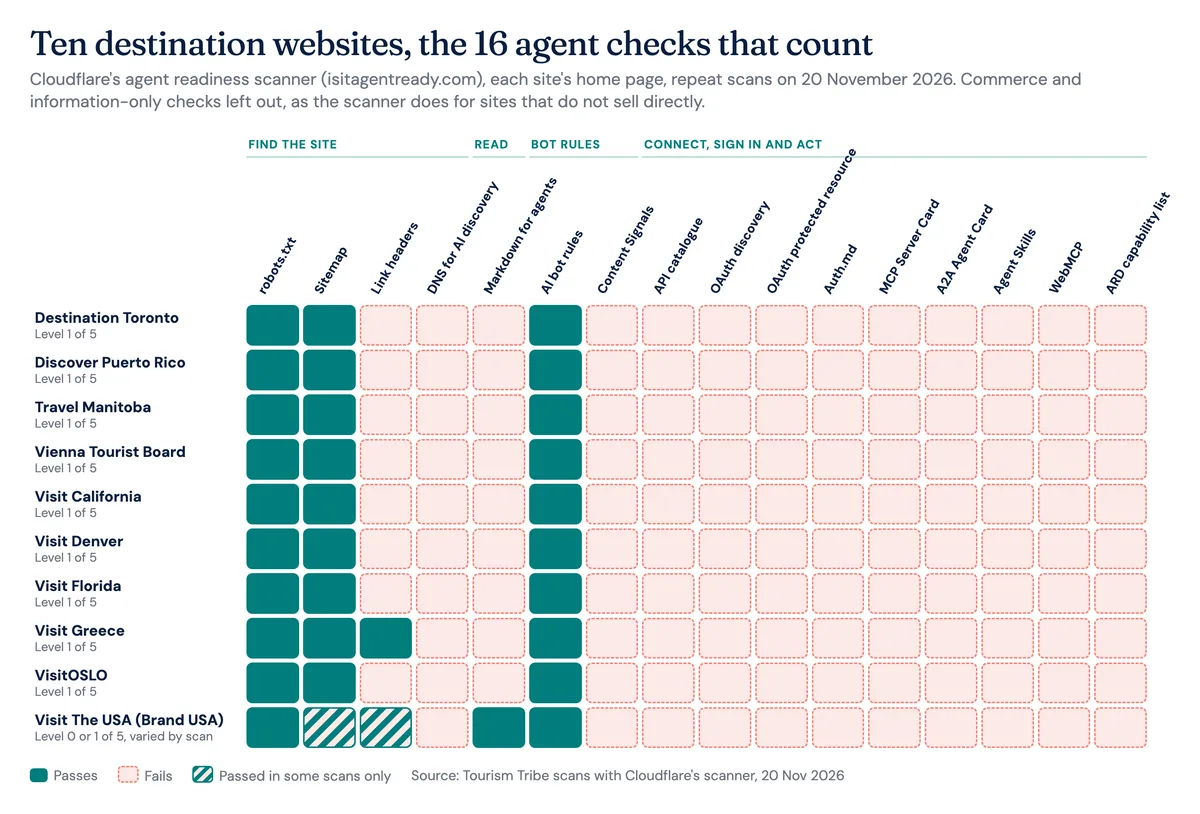
Visit The USA scored level 0, “Not Ready”, in two of our four complete scans. It scored level 1 in the other two. Its site turned away many of the scanner’s requests with a “too many requests” error. Its sitemap and link header checks passed in some scans and failed in others.
The pattern is the same everywhere. The basics pass. The agent layer fails.
These are national, state and city tourism bodies, and several are the ones the industry points to as AI leaders. Our view: if they sit at level 1, most regional destinations sit there too.
What these ten sites get right
All ten sites pass the first checks an AI crawler makes. Each has a valid robots.txt file, the file that tells crawlers where they are allowed to go.
Each one lets AI bots in. Nine do it through the general rules that apply to every crawler. Visit California names the AI bots in its robots.txt and allows them. We explained the different kinds of AI bot in Three types of AI bot. One decides if AI recommends you.
All ten have a sitemap the scanner found. For Visit The USA, it found the sitemap only in some scans.
Two sites pass a check the others miss:
- Visit Greece sends link headers, a small signal in each page response. Its headers point machines to the other language versions of the page.
- Visit The USA serves a Markdown version of its home page when a machine asks for one. Markdown is plain text with simple formatting that AI tools read with ease.
Markdown support is rare. In April 2026 Cloudflare scanned the 200,000 most visited domains, leaving out categories such as ad servers and redirects. Only 3.9% of those sites served Markdown.
These are crawlable basics. They mean AI tools find and read the site. They do not mean an AI agent does anything with it.
What every site is missing: the agent layer
None of the ten sites passes any of the nine checks for connecting, signing in and acting. These are the files and endpoints an AI agent looks for before it uses a site on a traveller’s behalf:
- MCP Server Card. Model Context Protocol (MCP) is an open standard. It lets AI tools plug straight into a data source. The card tells an agent where to connect.
- A2A Agent Card. Agent2Agent (A2A) is an open protocol for one AI agent to talk to another. Think of a traveller’s AI talking to a destination’s own AI. The card says what the destination’s agent does.
- Agent Skills index. A list of tasks an agent completes on the site.
- WebMCP. Tools a site offers to an AI agent working inside the traveller’s browser.
- API catalogue. A machine-readable list of the site’s application programming interfaces (APIs).
- OAuth discovery and protected resource details. Two checks that tell an agent how to sign in safely.
- Auth.md. How an agent registers to use the site.
- Agentic Resource Discovery (ARD) manifest. A summary of everything an agent uses on the site.
None of the ten declares Content Signals either. Content Signals is a line in robots.txt. It states whether your content is open to AI training, search and AI answers. In Cloudflare’s April 2026 scan, 4% of sites declared them.
This is early. Cloudflare found MCP Server Cards and API catalogues together on fewer than 15 sites in that whole set. None of the ten tourism leaders we checked has started. That is the opening.
Why agent readiness matters for a destination
Booking is moving into the AI conversation. In May 2026, at its I/O conference, Google announced its Universal Cart. The cart runs on the Universal Commerce Protocol (UCP). UCP is a shared language that lets AI agents handle a cart and a checkout. Google co-developed UCP with retailers earlier in 2026.
Google says the brand stays the merchant of record. It also says UCP is coming to hotel booking, and that its UCP checkout is coming to Australia and Canada. We explained what that means for tourism in Google’s Universal Cart: The Booking Button Is Moving Into Search.
An AI agent works best with sources it plugs into directly. A destination with no agent layer is a website the agent reads, at best. It is not a source the agent asks. A directory listing does not fix that on its own. We set out why in A directory listing won’t get your members booked by AI.
Our COMPASS playbook for tourism organisations sets out seven moves. Together they make a DMO the source AI cites for its region. Agent readiness is where those moves end up.
What a DMO does first
Start with what costs almost nothing. Then plan the agent layer with your website provider.
This month
- Run your own site through isitagentready.com twice and save the result as your baseline.
- Add Content Signals to robots.txt. It is one line, and it states your choice on AI training, search and AI answers.
- Check that robots.txt names your sitemap.
- Check the scanner gets through. If it reports “too many requests”, ask your website provider whether your bot protection turns away AI agents too. Our view: some of it does.
Next quarter
- Make your knowledge queryable first: checked answers to the questions visitors ask, events with dates, places with their facts. An agent needs something worth asking for.
- Ask your website provider which agent standards your platform supports. Ask what an MCP Server Card or A2A Agent Card would take.
- Decide what an agent should be able to ask you for: events, opening hours, itineraries, operator listings.
Your operators need the same basics. Our Free AI Readiness Score shows each of them how well AI reads their own website.
A hypothetical example. A regional DMO with a team of seven runs the scan in December and records level 1. In January it adds Content Signals and fixes its sitemap. Its digital manager then asks the website provider for a quote on an MCP connection to the events calendar. The CEO takes the quote and the baseline to the Board in March. A person still approves every change before it goes live.
Our AI Glossary for Tourism Organisations explains the terms in this post in plain words.
Frequently Asked Questions
What does agent-ready mean for a destination website?
An agent-ready destination website lets an AI agent find it, read it and act on it for a traveller. Acting means asking for events or availability, or handing over a booking. It needs machine-readable files such as an MCP Server Card or an A2A Agent Card, on top of good pages.
How do I check if my destination website is agent-ready?
Enter your home page address at isitagentready.com, Cloudflare’s free agent readiness scanner. It returns a level from 0 to 5 and a fix for every failing check. Run it more than once. A site that turns away busy traffic gives different results from scan to scan.
Is agent readiness the same as AI search visibility?
No. AI search visibility is about whether ChatGPT, Gemini or Google cite your site in their answers. Agent readiness is about whether an AI agent uses your site directly. A destination needs both, and visibility comes first.
Why did these leading destination websites score so low on agent readiness?
The agent standards are new. In April 2026 Cloudflare checked the most visited domains. It found MCP Server Cards and API catalogues together on fewer than 15 sites. The ten sites pass the basics that matter for search. None has started on the agent layer yet.
What should a regional DMO do first about agent readiness?
Run the scan and keep the result as a baseline. Add Content Signals to robots.txt and check your sitemap. Then make your region’s knowledge queryable, and ask your website provider what the agent standards would take on your platform.
Conclusion
Nine of the best-known destination websites in the world sit at level 1 of 5 for agent readiness. The tenth moves between 0 and 1. None of them has the agent layer yet, so a regional DMO that starts now is not behind. Run the scan this week, fix the basics, and put the agent layer on next year’s website plan.
- C
- O
- M
- P
- A
- S
- S
Convince the board · Out of heads · Make it queryable · Prime operators · Activate AI · Safeguard · Show the value
COMPASS: AI Playbook for DMOs
Turn this into your region’s AI strategy
COMPASS is the seven-move AI playbook for DMOs and tourism organisations.