
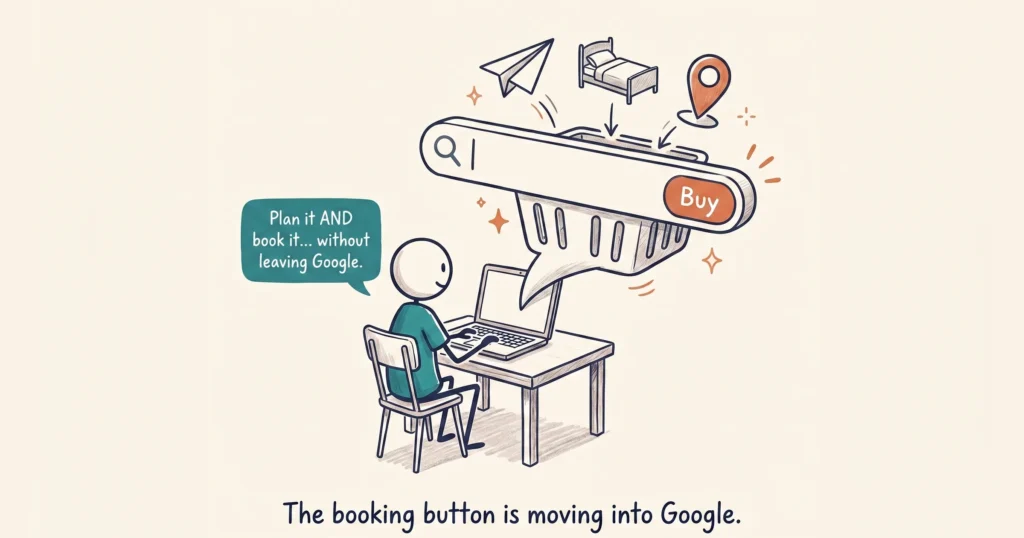
Last week we wrote about Google’s first official guide on AI search, the one that tells you what actually helps your tourism business get found and what is just noise. That post was about discovery: how a traveller’s AI finds you. This one is about the other end of the journey. Google has just announced the part that finishes the sale.
It is called the Universal Cart, and it landed at Google’s I/O event in May 2026. Strip away the jargon and it is one idea: the checkout is moving inside Google. Not your website. Not an online travel agent. Google itself. For an industry that has spent twenty years fighting over who owns the booking button, this is the biggest move yet.
What Google actually announced
Three pieces matter for tourism, and they fit together.
The Universal Cart
A single shopping cart that follows you across Google: regular Search, the Gemini app, YouTube, even Gmail. The clever part for travel is that it holds items from different businesses at once. A traveller plans a trip in a conversation with Google’s AI, and the flight, the room and your tour all drop into the same basket. One checkout. Several businesses. Including, potentially, yours.
The Universal Commerce Protocol
The cart needs plumbing, and that is the Universal Commerce Protocol, or UCP. It is an open standard that lets AI agents talk to retailers, payment systems and loyalty programs across the whole shopping journey, from the first question to the final receipt. In plain terms, it is the agreed language that lets Google’s AI add your product to a cart and take payment without a custom integration built from scratch for every business.
Two details are worth holding onto. The checkout happens on Google’s own surface, using payment details already stored in Google Pay and Google Wallet. And in Google’s own words, “no matter which way you buy, the brand stays the merchant of record.” Google is not buying your tour and reselling it. It is owning the conversation, the interface and the moment of payment, while you remain the merchant. This sits inside what Google calls the biggest upgrade to its Search box in over twenty-five years: a new AI-powered search box, running on its Gemini 3.5 Flash model.
The Business Agent
Alongside the cart, Google is rolling out a Business Agent: a way for travellers to chat with your brand directly inside Search. Think of it as a virtual sales associate that answers product questions in your business’s voice, at the exact moment someone is deciding. It keeps that conversation inside Google rather than sending the traveller off to build their own tools, and it is one more surface where your information either shows up well or does not show up at all.
A dedicated hotels integration through UCP has been flagged as coming next. So this is not a finished, travel-ready system today. It is the foundation being poured, in public, by the company that already sits closest to where travellers start.
Why this is bigger than another Google feature
For years we have described the new traveller journey in four stages: discovery, trust, validation, booking. AI changed the first three almost overnight. Discovery moved upstream into AI Mode and ChatGPT. Trust and validation moved into reviews, structured facts and whether a machine could read your site. But booking, the actual transaction, stayed where it always was: on a website or an OTA, one or two clicks away from the AI conversation.
The Universal Cart closes that last gap. Booking moves upstream too, into the same conversation where discovery happens. The traveller never has to leave Google to pay. We have been telling operators in our tech sessions that within a few years an AI agent would plan and book a whole trip in one sitting. Google just pulled that timeline forward. Our podcast episode The Trip Planner That Actually Books walks through what that shift feels like from the traveller’s side.
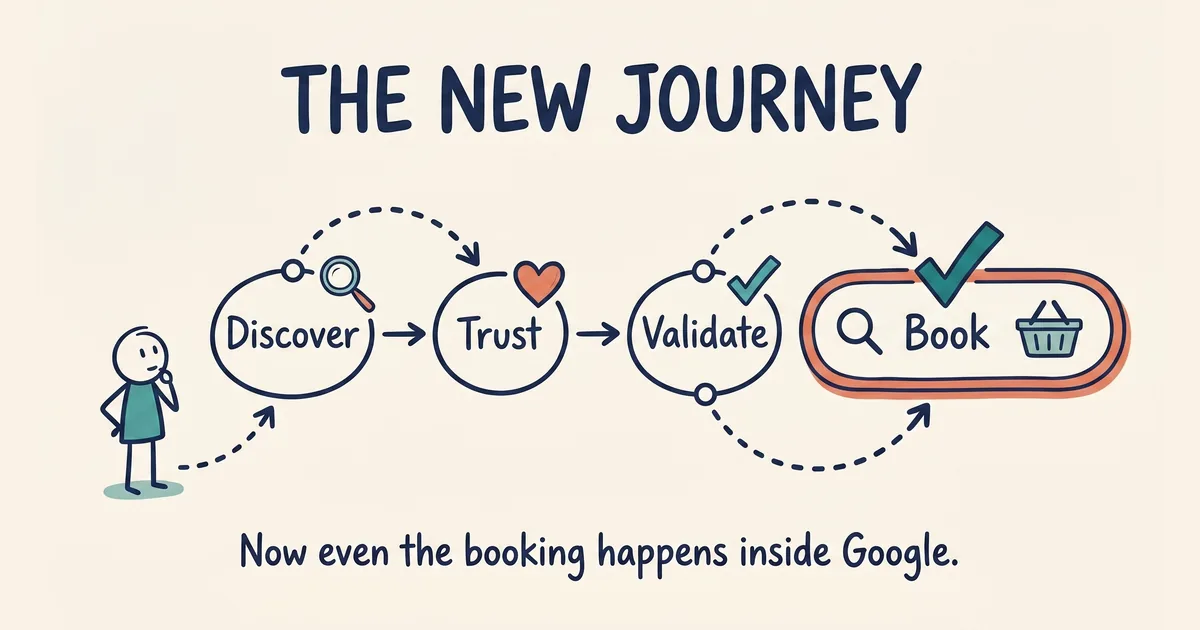
Here is the part to sit with. When the cart lives inside Google, the question is no longer “does my website rank?” It is “is my product in the basket when the traveller hits Buy?” If you are not in the cart, you are not in the sale. It does not matter how good your website is if the transaction completes somewhere your business was never added.
The threat, and the opportunity
The threat is obvious. Google moves another step closer to standing between you and your customer. If the cart and the agent become how people book, then Google sets the rules for who gets seen and who gets sold. Whoever controls the agent and the protocol controls discovery and who captures the value.
But there is a real opportunity hiding inside it, and it is one that favours small operators more than you might expect. Today most operators hand 20 to 30 percent of every booking to an OTA in commission. The Universal Cart, with you as the merchant of record, is a path where the booking can complete against your own business and your own payment account. No 25 percent clip to a middleman, and the customer is buying from you, not from a reseller.
And this is not a distant, United States only story. Hotel booking is named as one of the first new categories Google is adding to the system, and Google has said the checkout experience is expanding to Australia in the coming months. The travel rails are being laid now, for our market, not just America’s. The window to prepare is while it is still being built. The operators who get ready will be in the basket on day one. The ones who wait will be invisible at exactly the moment the sale happens.
What decides whether you end up in the cart
You cannot integrate with UCP directly yet, and you do not need to. What you can do is make sure that when the system is travel-ready, you are the kind of business it can find, trust and transact with. That comes down to three things, and they are the same foundations we covered last week.
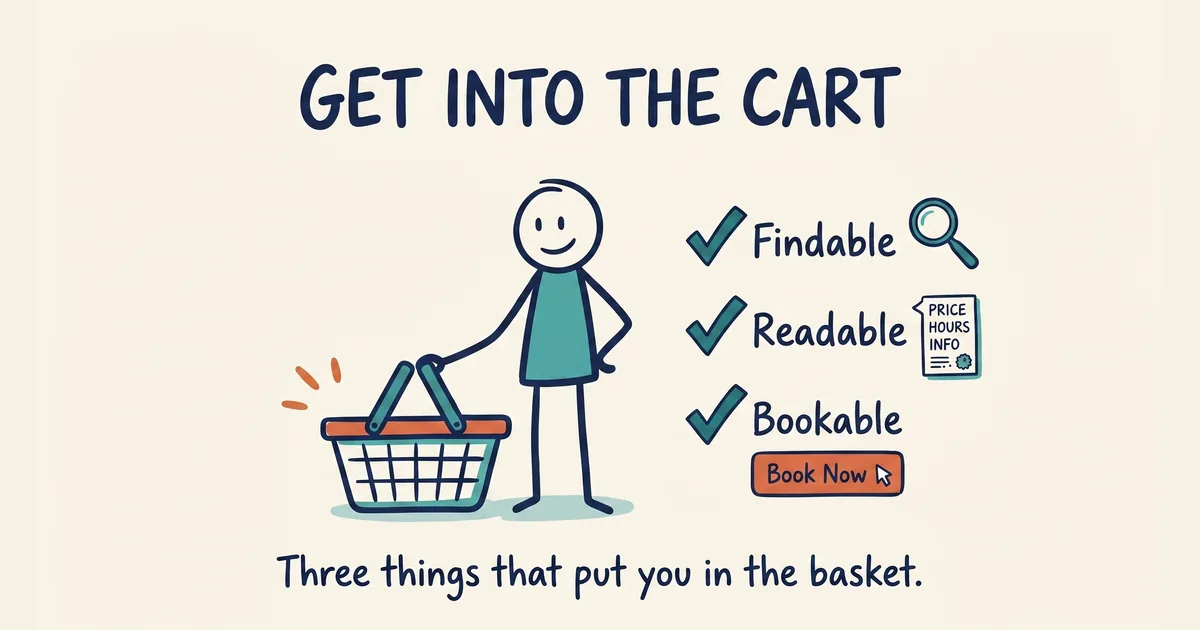
Be findable
The cart can only add what the AI recommends first. Discovery still runs on the basics: an indexed, crawlable website, a complete and accurate Google Business Profile, and content only you could write. If the AI does not shortlist you, you are never in the basket. Everything in our breakdown of Google’s AI guide applies here first.
Be readable by machines
An agent does not see your beautiful homepage. It reads structured facts: your prices, your departure times, your location, what is included, whether you have availability. The old question was “how do people find us?” The new one is “why would AI recommend us?” Swap adjectives for evidence. “Breathtaking sunset cruise” means nothing to an agent. “90-minute cruise, departs 5pm daily, $65 adult, includes drink, wheelchair accessible” is exactly what it needs. Our guide on making your business visible to AI agents with schema markup covers how to put those facts in a form machines trust. Keep your website, your Google Business Profile and your ATDW listing saying the same thing.
Be bookable
This is the one most likely to catch operators out. A cart needs something to transact against. If your only booking method is “call us” or “email to enquire”, there is nothing for an agent to add and nothing for it to pay. You need a real online booking path with live availability, through a system like Rezdy, FareHarbor or a channel manager for accommodation. The businesses that already take instant online bookings are the ones the agentic layer can plug into. Phone-and-email operators will be skipped, politely and automatically.
One more, because the cart abstracts the customer away from you: own the relationship. Collect first-party data, ask for the review, give people a reason to book direct next time. When Google sits in the middle of the transaction, your email list and your repeat guests are the part no platform can take.
What you do not need to worry about yet
In the spirit of last week’s post, here is what to ignore. You do not need to chase a UCP integration or pay anyone to “connect you to the Universal Cart”. The travel rails are not open, and when they are, they will come through the booking platforms and listing systems you already use. Do not buy a fix for a system that has not shipped.
You also do not need to fear a robot spending your customers’ money by accident. Google has built a separate Agent Payments Protocol for exactly this. The traveller sets the rules first: which brands, which products, and how much the agent is allowed to spend. The agent only buys inside those limits, and for a larger purchase like a trip the person still approves it. The agent does the legwork. The traveller stays in control.
What to do this week
- Check you have a real online booking path with live availability, not just a phone number and an enquiry form.
- Make sure your prices, hours, inclusions and location are stated as clear facts on your site, not buried in marketing copy.
- Confirm your website, Google Business Profile and ATDW listing all match.
- Start one direct-booking habit: a review request, a list sign-up, a reason to come back to you instead of a platform.
- Ignore anyone selling a “Universal Cart integration”. It does not exist for small tourism operators yet.
The booking button is moving into Google. That sounds like something only the big platforms get to react to, but the work that gets you into the cart is work you can start today, on your own site, for free. Be findable, be readable, be bookable. Our AI Foundations course and Google Business Profile course cover the groundwork, and our AI Playbook tracks where this is heading next.
Sources: Google’s official announcement, “Google Shopping introduces Universal Cart” (The Keyword, blog.google, May 2026); Google’s “Search’s I/O 2026 updates” post; and the Google Merchant Center help guide to the Universal Commerce Protocol.
Frequently asked questions
What is Google’s Universal Cart?
The Universal Cart is a shopping cart that follows a user across Google’s surfaces: Search, the Gemini app, YouTube and Gmail. It can hold items from several different businesses at once, so a traveller can add a flight, a hotel and a tour to one basket and check out in a single step, without leaving Google. It was announced at Google’s I/O event in May 2026.
What does the Universal Cart mean for small tourism operators?
It means the booking, not just the discovery, is moving inside Google. If your product is recommended and bookable, it can be added to a traveller’s cart and paid for on Google’s own surface, with you staying the merchant of record. That is a potential path to commission-light direct bookings. But if your business is not findable, machine-readable and bookable online, there will be nothing for the system to add. Operators who only take phone or email bookings risk being skipped automatically.
Do I need to integrate with the Universal Commerce Protocol now?
No. Hotel booking is named as one of the first new categories being added, but it is not open to small operators yet. When the rails do open, they will most likely come through the booking platforms and listing systems you already use, such as your booking engine or ATDW. Do not pay anyone claiming to connect your business to the Universal Cart today, as that capability does not exist for small tourism operators.
Will an AI agent be able to spend my customers’ money without permission?
No. Google has built a separate Agent Payments Protocol so the traveller sets the guardrails first: which brands, which products, and a spending limit. The agent only buys within those limits, and for a high-value purchase like a trip the person approves the final payment. Card details are kept protected throughout, so the customer stays in control.
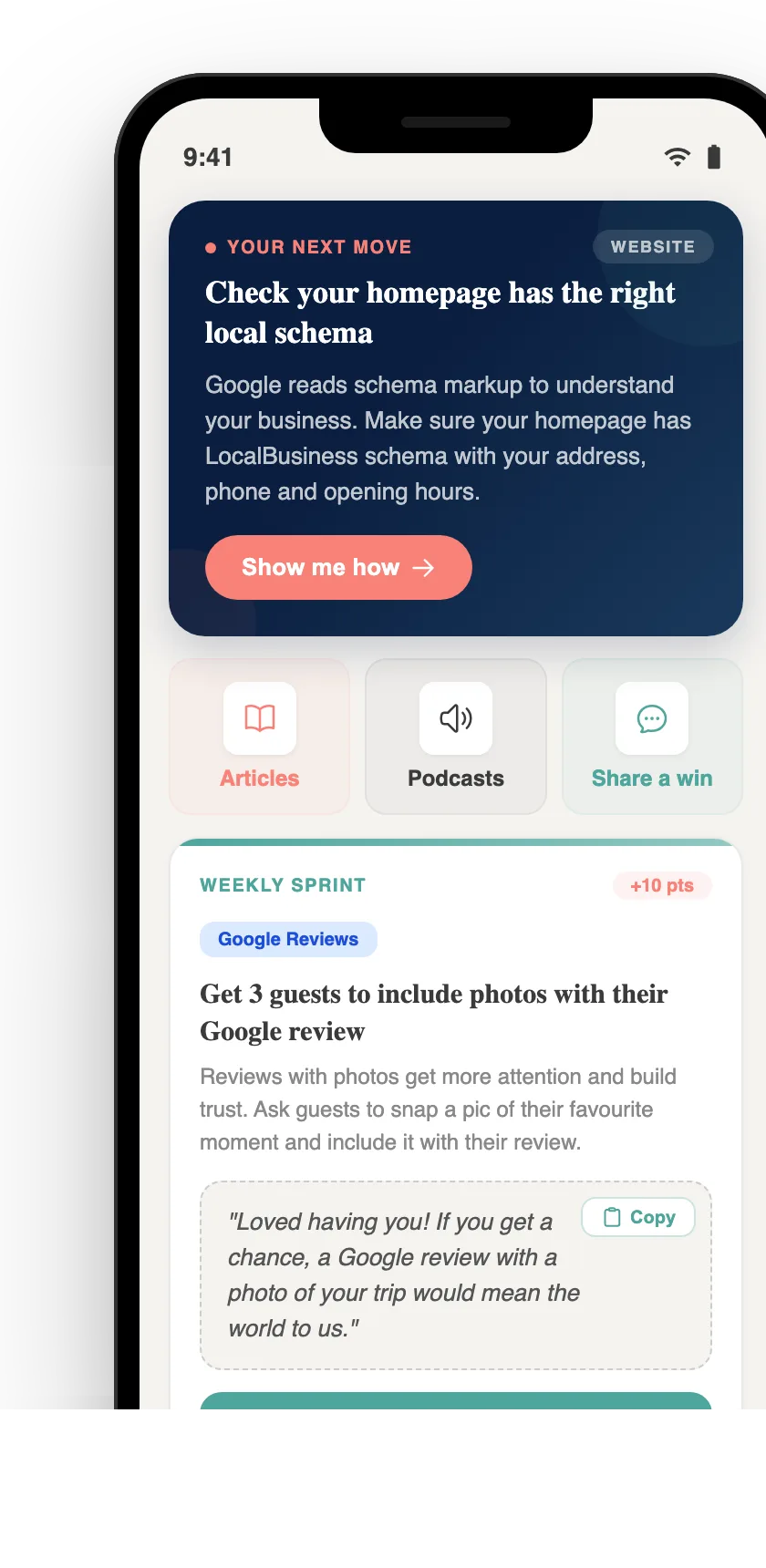
Your free AI marketing coach, right in your pocket
The free Pocket Rocket app gives you a personal AI marketing coach, website audit, weekly action plans and 5-minute tips. Built for tourism operators.