

For DMOs, RTOs, councils, associations & peak bodies
COMPASS: The AI-Ready Playbook for DMOs and Tourism Organisations
This is the AI strategy for tourism organisations: a staged, practical plan to stay visible, valuable and funded as AI reshapes how travellers find, plan and book.
The Choice
The invisible surge
For fifteen years the DMO website was the holy grail. It showcased the destination as a whole, dominated the search results, and drove the visits you reported to the board. Not any more.
In one eight-day window, ChatGPT made nearly two million live requests to destination websites. Not one showed up in Google Analytics. AI is reading your region’s content and answering travellers on its own screen, without sending them to you. Organic traffic is down around 30 per cent, and your dashboard cannot see where it went. Read more: Why your traffic is down and your analytics can’t see it.
SEO won’t fix this. The way travellers find and book has changed for good, and it changes what your organisation is for. Your funders may be slow to notice. Your members will not, and they will start asking what their fee buys when AI, not your website, is where travellers plan and book. The value you brought your region for fifteen years is not the value it needs from you now.
Every tourism organisation is now on one of two paths. Keep running the old playbook and watch the decline lock in. Or do the work to become the source AI cites for your region: the trusted, queryable second brain that agents read when they plan and book a trip. This playbook is the roadmap for the work. Seven moves, starting with the one that unlocks the rest.
Are you new to how AI is reshaping what a DMO is for?
Start with the three short reads behind this playbook:
- why your traffic is down and your analytics can’t see it,
- why a directory listing won’t get your members booked, and
- how Toronto and Brand USA already work. Then the seven moves below will resonate.
Part 2
The two paths
Every tourism organisation is already on one of these paths. Most organisations are still running on metrics that do not yet show the shift. That is not a failure of attention. It is a failure of instrumentation.
Here is the real choice: do nothing different, or change before the decline locks in. We borrow The Matrix for it, blue pill and red pill.
- The blue pill is the do-nothing-different path. Keep running the playbook that worked for fifteen years. Rely on centralised listing directories for member discoverability. Create on brand destination content, and run your awareness campaigns. Report your reach to the board. Treat the traffic drop as an SEO problem you tune your way out of.
- The red pill is change. You accept the operating model has shifted, and you do the work to lead it. Take it, and we show you how deep this goes.
We are going to argue for the red pill. Make change now, before the decline locks in. But we will give you the evidence for both, because if you pick the blue pill we want you to do it with your eyes open. Plenty of tourism organisations are picking it right now. Many are still running on dashboards that do not yet show the shift.

COMPASS
Two paths, one choice.
Every tourism organisation is already on one of them. Most have not noticed they chose.
Blue pill
Do nothing different
Keep running the playbook that worked for fifteen years.
What you keep doing
- Treat the operator listing as the finish line
- Run awareness campaigns
- Report reach to the board
- Treat the traffic drop as an SEO problem
Where it ends
Traffic keeps sliding, your metrics go quiet, and you walk into the funding review explaining a decline you saw coming. The organisations that cannot show a new, defensible form of value will struggle to hold funding through the next twelve to twenty-four months.
Red pill
Do the work
Accept the operating model has shifted, and lead your region or sector through it.
What you do
- Become the region or sector’s queryable knowledge layer
- Lift every operator to AI-ready
- Govern AI use, and disclose it
- Measure AI citations and conversion, not reach
Where it leads
The trusted, queryable source AI cites for your region or sector. Higher-intent visitors converting at 4.4 times the rate of traditional search. A funding story no traditional tourism organisation can match.
What this is not
Two things get confused with AI readiness. This is neither.
Destination intelligence tells you what visitors think. Sentiment, demand, visitor flows, benchmarking. Useful work. It does not decide whether AI mentions your region when a traveller asks. That is a different job.
- SEO tunes you for the blue links travellers have stopped clicking. AI Overviews answer at the top of the page. You can rank first and still be missing from the answer.
- AI readiness, or AI search readiness, is being read, trusted and quoted by the machine that now plans and books the trip. It comes in two rungs.
- Crawlable is your destination’s discoverability: being found by AI at all (schema, Google Business Profile, FAQs). Necessary, not enough.
- Queryable is deeper: your whole organisation readable enough that AI can work from it, the second brain behind your members, events and local knowledge.
Crawlable gets you found this year. Queryable keeps you in the answer next year. Most tourism organisations chase the first and miss the second.

Part 3
The COMPASS framework: seven moves
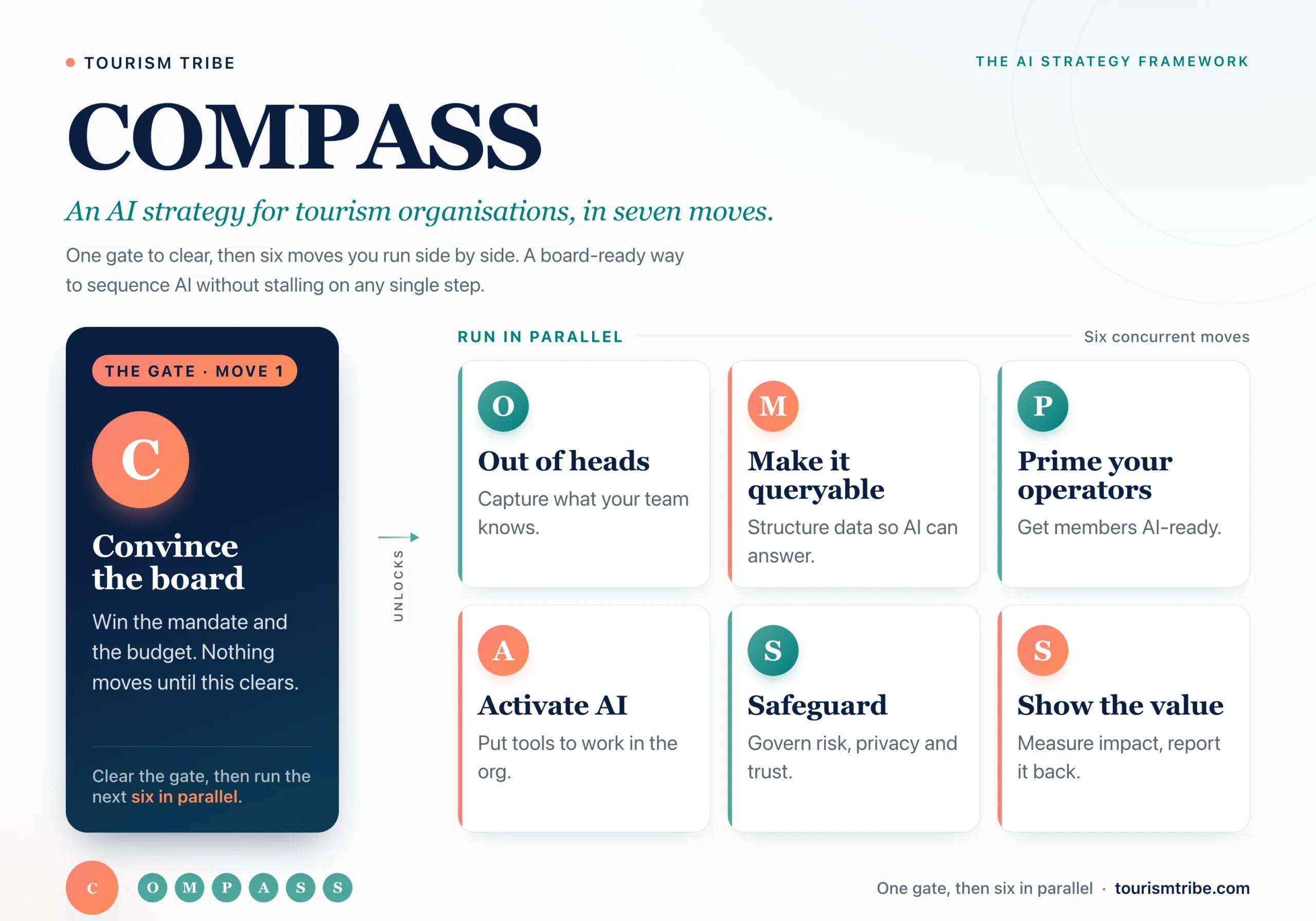
Everything in the red pill splits into seven moves: your AI strategy, in order. A team can hold them, take them to a board, and score itself against them. No strategy, roadmap or guidelines yet? COMPASS is all three. C is the gate and comes first. The rest run in parallel.
COMPASS: The AI-Ready Playbook
COMPASS
The gate · Move 1
C
Convince the board the gate
Leadership and execs have to understand this is a structural shift, not a marketing dip. Nothing below gets funded or permitted until they do. The hardest move, and it goes first.
Start here: Take them the server-log number and the funding-cycle timeline. One page.
Clear the gate, then run the next six in parallel.
In parallel
Six concurrent moves
O
Out of heads
Capture the proprietary knowledge your team holds before it walks out at five o’clock. Get the itineraries out of the email threads. Sit your VIC staff down and record what they know about the region or sector.
Start here: Record one VIC staffer for an hour on the questions they answer most.
M
Make it queryable
Turn your whole organisation’s knowledge into a structured second brain AI can read, trust and cite. Not just web pages: your member directory, events, bookings, accessibility and seasonal detail, and the local know-how in your team’s heads and famil itineraries.
Start here: pick one knowledge source (your member directory or events calendar) and structure it so an AI tool can answer a traveller’s question straight from it.
P
Prime your operators
Help the members and operators you represent make their own content rich, specific, and machine-readable. A directory listing is the floor, not the finish line.
Start here: Audit ten member sites for schema, pricing and FAQ. (Pocket Rocket does this at scale.)
A
Activate AI
Put AI to work on the repeatable jobs: newsletters, content, social monitoring, member updates, the same enquiries. Free those hours for the conversations only your team can have.
Start here: Pick the task that eats the most staff hours this week. Hand it to AI.
S
Safeguard
Govern it. Disclose AI use, handle visitor data under the Privacy Act, and you protect a publicly funded organisation while everyone else improvises.
Start here: Write a one-page AI use policy.
S
Show the value
Pull your server logs and find the AI activity your analytics never reported. Track AI citations (tools like Profound do this) and member discoverability. Walk into the funding room with a number no traditional tourism organisation can produce.
Start here: pull your server logs and filter for AI bots (GPTBot, ClaudeBot, PerplexityBot). Google Analytics only shows the traffic that comes to your website; the logs show what is querying it.
The two that decide it are the bookends. Convince the board, because a board still counting bed nights resists every other move. And Show the value, because a value you cannot evidence is a value under review. Get those two and the rest of COMPASS follows.
Part 4
How to start: you do not have to do it alone
You do not need a dedicated digital team, and you are not as far behind as it feels. You do not have to do everything at once. Each of these is a single COMPASS move, scoped to your region, that you can start now. Pick the one that fits.
Show the value
Regional GBP Audit
We crawl every Google Business Profile across your region and hand you a claim-and-fix list: who is unclaimed, what is stale, which natural assets are invisible to AI. The evidence to take to a board, and the data that seeds your knowledge layer.
Convince the board
Board & Team AI Briefings
A board session, a full team workshop, and a member Crawlable and Queryable webinar. The fastest way to get leadership across the shift, and the language to fund the rest.
Make it queryable
DMO GEO Assessment
Your destination’s AI-readiness, audited: your flagship site, a benchmark against comparable destinations, and a sample of your member listings, with a prioritised action plan.
Out of heads
AI Discovery and Scoping Sprint
We map your knowledge sources, systems and integration points and hand you a costed, phased roadmap to a queryable knowledge layer, so you can move the moment the tools are ready.
Where this leads: itinerary builders and a destination assistant for your whole region, built on your queryable knowledge layer. We build toward it as the tools mature.
FAQ
Common questions about AI and tourism organisations
What does the 2 million ChatGPT requests finding actually mean for a tourism organisation?
A major DMO platform provider tracked server requests across roughly 500 destination sites over an 8-day window. ChatGPT made nearly 2 million requests: live retrieval, not indexing, pulling content in real time to answer traveller questions. None of those requests appeared in any site’s Google Analytics. It means AI is already reading your content at scale, and your organisation has no visibility into it. The question is whether the content AI is reading is good enough to quote.
Why is AI retrieval not showing up in my Google Analytics?
AI tools like ChatGPT, Perplexity, and Google’s AI Overviews retrieve your content server-side. They send a request to your server, read the response, and use it to build an answer. They do not load your page in a browser, so no JavaScript tracking fires, no GA4 session is created, and no pageview is recorded. The visit is invisible to your analytics but very real to your server logs. Pulling those logs is the first step in Show the value: the final COMPASS move.
Is ATDW still worth investing in for our members and operators?
ATDW is a floor, not a finish line. A listing is still worth having. It syndicates to the official tourism sites, which carry genuine domain authority that AI search respects. But an ATDW listing alone is not enough. It carries no schema markup, no structured booking facts, and no FAQ content. AI consistently walks past official sites with thin listings to find the operator’s own pages or third-party booking platforms. The advice to give members and operators now: maintain the listing, but invest the same time in their own website content, schema markup, and FAQ pages. Those are what AI quotes.
What is the COMPASS framework and where does our organisation start?
COMPASS is a seven-move framework: Convince the board, Out of heads, Make it queryable, Prime your operators, Activate AI, Safeguard, and Show the value. C is the gate. Nothing else gets funded or permitted until leadership understands this is a structural shift, not a marketing dip. The rest run in parallel. The two that decide everything are the bookends: Convince the board (because a board still counting bed nights resists every other move) and Show the value (because a value you cannot evidence is a value under review). Start with your board. Then pull your server logs.
How can Tourism Tribe help, and where do we start?
You can engage us for any single COMPASS move, scoped to your region, and start small. Most DMOs begin with one of four: a Regional GBP Audit (we crawl every Google Business Profile across your region and report what is claimed, stale, or invisible to AI); Board and Team AI Briefings (a board session, team workshop and member webinar to get leadership across the shift); a DMO GEO Assessment (your destination’s AI-readiness audited, with a prioritised action plan); and an AI Discovery and Scoping Sprint (a costed, phased roadmap to a queryable knowledge layer). Most start with the GBP Audit or the Board Briefing. Book a call and we will scope the one that fits.
What happens to our funding if we cannot show value in AI terms?
This is the most urgent version of the question. Several regional tourism organisations in Australia have already lost funding or sit under review. Government funders base their decisions on demonstrated economic benefit. For decades, sessions, reach, and referrals told that story. AI retrieval is invisible to those metrics. Two million ChatGPT visits leave no trace in your dashboard. The organisations walking into their next funding review with AI citation data, member discoverability numbers, and tracked bookings from AI-referred visitors will hold their ground. The ones presenting the same reach-and-impressions deck will not. The timeline the funding cycles set is twelve to twenty-four months.
What is Model Context Protocol (MCP) and should our organisation care?
MCP (Model Context Protocol) is an open standard that lets AI tools plug directly into external data sources (your member directory, your event calendar, your booking data) without a custom API build. For a tourism organisation, MCP means you can make your region or sector’s knowledge live and queryable for any AI tool that supports the protocol, in weeks rather than a six-month engineering project. Destination Toronto and Brand USA both name it as the near-term opportunity for tourism bodies. The organisations that publish an MCP server become the queryable knowledge layer AI agents read when they plan trips to their region. Those that do not remain invisible to agentic booking flows.
What is an information agent and how does it affect destination marketing?
From the northern summer of 2026, Google is rolling out information agents. AI systems a traveller sets up to monitor the web around the clock on their behalf. The traveller describes what they want to watch (beach destinations, family-friendly, school holiday availability) and the agent runs continuously, building a picture from whatever it reads. By the time the traveller makes a booking decision, their AI already has a view of your region or sector built from weeks of monitoring. If your content is fresh, structured, and machine-readable, that view is built from you. If not, it is built from TripAdvisor, a booking platform, and a blogger’s post from 2023. The decision moment moved upstream from the query to the weeks before it.
How do visitors from AI search compare to traditional search visitors?
SEMrush found AI search visitors convert at 4.4 times the rate of traditional search visitors. Noble Studios, working from separate data, puts them at approximately 4.5 times more valuable. Two independent studies, the same finding. The explanation is intent: a traveller who arrived at your member’s page after an AI recommended it already has a high-confidence answer. They are not browsing. They are deciding. Fewer visits, far higher conversion. The economics of AI referral are better than traditional search even accounting for the volume drop.
How do we measure AI citations and member discoverability?
Three methods. First, server logs: pull raw access logs and filter for AI user agents (GPTBot, ClaudeBot, Applebot, PerplexityBot). This shows you which pages AI is reading and how often. Second, direct queries: ask ChatGPT, Gemini, and Perplexity the top questions travellers ask about your region or sector. See whether your organisation or your members appear in the answers, and whether the information is accurate. Third, member discoverability audits: run a structured AI readiness check across your member base before and after any capability program. The before-and-after data is what you take into a funding review. Tourism Tribe’s Pocket Rocket app automates the per-member audit at scale.
Sources
Tourism Tribe State of AI in Tourism 2025; Granicus and SimpleView ChatGPT retrieval analysis, reported by PhocusWire, “DMOs shift toward destination-as-a-service model in AI era”, May 2026; Google I/O announcements May 2026; TechCrunch, “Google Search As You Know It Is Over”, 19 May 2026; SEMrush AI Search Conversion Study 2025; Noble Studios AI search visitor value analysis 2025; Accenture Travel Consumer Survey 2025 (18,214 respondents across 14 countries, January 2025); Ahrefs AI Overview Citation Study 2025; McKinsey & Company and Skift, “Remapping Travel with Agentic AI”, 2025; Skift Data + AI Summit, “The AI Advantage: How Destination Marketing Must Evolve” (Janette Roush, Brand USA; Paula Port, Destination Toronto), 2025. Session agenda: https://skift.com/2025/05/08/full-agenda-overview-for-the-skift-data-ai-summit-next-month/; Mark Fancourt, “The One We’ve All Been Waiting For: Google’s Agentic Shift and the Reality of Distribution”, HospitalityNet, May 2026. Listing analysis based on a live audit of the Kakadu and Katherine Gorge full-day tour, northernterritory.com, conducted June 2026. The Matrix (1999), Warner Bros, for the red pill and blue pill.
Ready?
Which pill are you taking?
The tourism organisations that move now own the most valuable seat in the sector for the next decade. The trusted knowledge layer AI cannot work without.
For DMOs, RTOs, STOs, councils, associations, and peak bodies across Australia.