
Featured image: AI-generated illustration.
A visitor rarely comes home talking about a booking system. They talk about the person they met, the story they heard and how an experience made them feel.
But before that memory can happen, they need to discover the experience, understand whether it suits them and feel confident enough to book.
That connection was at the heart of my workshop at the Australian Regional Tourism Convention in Busselton, Western Australia: how we help good local businesses create visitor-centred experiences, and how AI can support the process without replacing human vision.
Quick links
- The opportunity is often already there
- Start with the need beneath the trend
- AI needs a clear promise too
- Our six-stage Experience by Design framework
- What this looks like in real businesses
- The destination role is practical
- Use AI to ask better questions
- Take one useful next step
- Frequently asked questions
The opportunity is often already there
At Tourism Tribe, we work with destination organisations and operators to identify potential that is already sitting within a business. It might be local produce, a passionate host, a distinctive setting or a service that visitors would love if it were packaged and explained differently.
The work is about more than promotion. It means shaping a clear promise, checking that the business can deliver it, making it bookable and putting it on a pathway towards market and, where appropriate, trade readiness.
AI belongs in this conversation for two reasons. It can help us think through each stage of experience design. It is also changing how travellers research and choose what to do.
Start with the need beneath the trend
Travel trends are useful prompts, but they are not a product brief.
Booking.com’s Travel Predictions 2026 research found that 43% of respondents would holiday specifically to feel closer to nature. That is a global statement of intention, not proof of demand for a particular regional experience. The useful question is: what could we offer that genuinely meets that need?
The same thinking applies to Expedia’s “Readaways” and “Farm Charm” themes. Beneath the labels, I see needs for rest, quality time, nature and participation. That interpretation needs testing locally.
Translate those needs into choices: a knowledgeable host, a meaningful local story, specific sustainability practices, factual access information and a booking process that makes the decision easy. Cultural connection needs appropriate local leadership and permission. Inclusion needs practical information, not a blanket claim that an experience is “for everyone”.
AI needs a clear promise too
In Booking.com’s 2025 Global AI Sentiment Report, 67% of respondents said they had used AI in some aspect of travel, while 89% wanted to use it in future travel planning. Those are different measures, and neither means that most people are booking holidays autonomously through a chatbot.
The practical change is that a visitor can describe a very specific situation: “We have three hours, want something local and there are only two of us. What could we do?”
Can your information answer that?
Duration, location, suitability, inclusions, availability, price and booking terms matter. So does consistency across your website, tourism listings and partner information. Hannah Statham from Media Mortar reinforced the importance of useful, factual content in her presentation earlier that day.
Clear information helps people and search-based assistants understand an offer. It does not guarantee an AI recommendation. The experience still has to fulfil the promise.
Our six-stage Experience by Design framework
The marketing fundamentals still matter: product, price, place and promotion. Our framework turns them into a practical, repeating process, with human vision leading and AI supporting every stage.
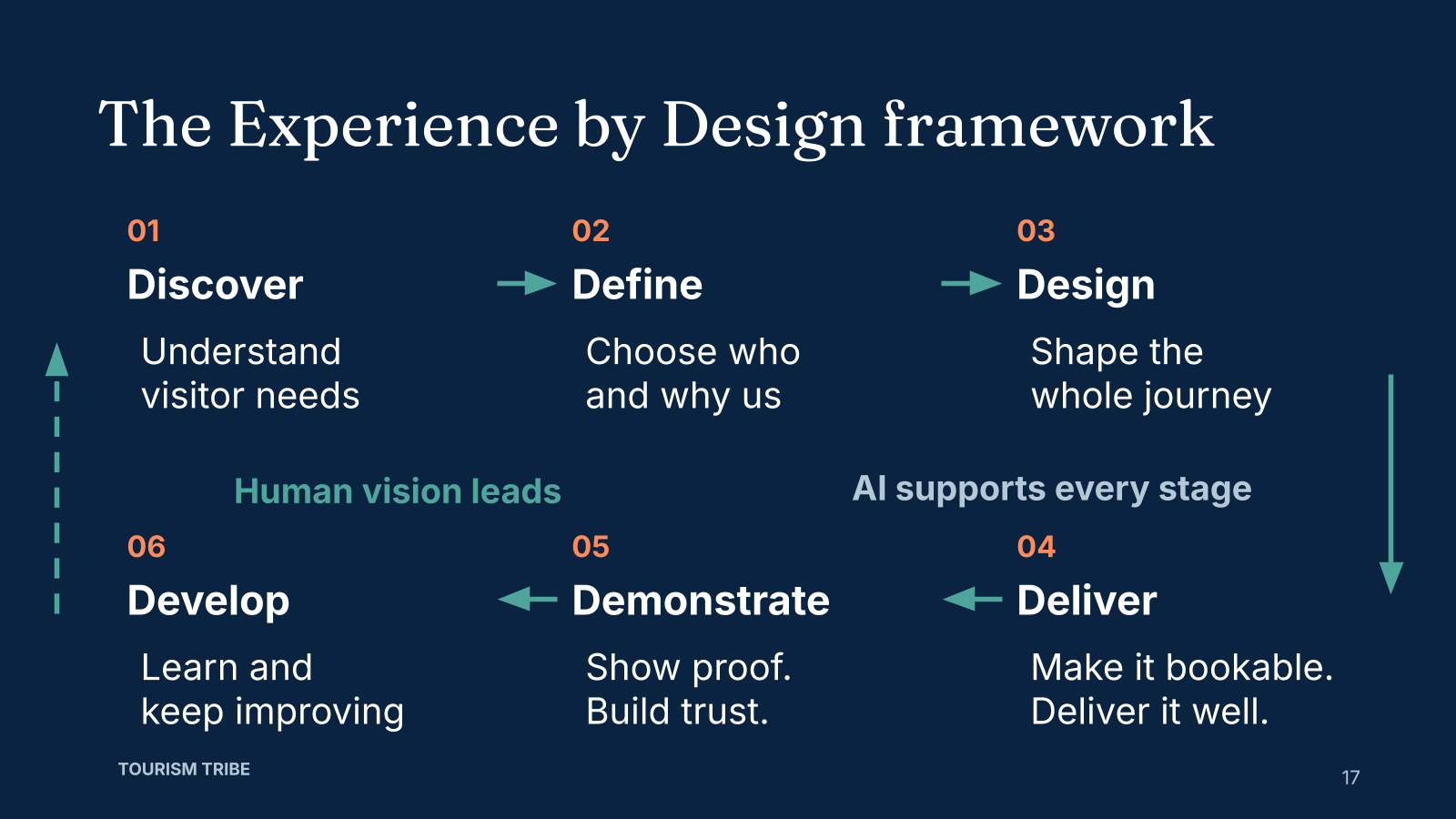
1. Discover: What are visitors trying to achieve?
Listen to enquiries, reviews and frontline staff. Look for recurring questions and gaps in an itinerary. AI can help group de-identified feedback, but we need to distinguish evidence from assumptions.
2. Define: Who will love this, and why us?
Choose a visitor situation and a promise the business can credibly fulfil. AI can help compare possibilities. The owner decides what fits their strengths and values.
3. Design: What happens before, during and after?
Think beyond the activity. Consider expectations, arrival, the welcome, pacing and the memory guests take away. AI can help map that journey; people check the detail.
4. Deliver: Can guests buy it, and can we fulfil it?
Check staffing, partners, costs, pricing, minimum numbers and the complete booking pathway. A compelling description is not enough if the operating model does not work.
5. Demonstrate: Can visitors trust our promise?
Use genuine images, useful FAQs, clear practical details and real visitor evidence. Make it easy to understand who the experience suits and what to expect.
6. Develop: What should we improve next?
Review feedback, bookings, delivery and actual costs. Refine the offer and update its information. Develop means ongoing improvement, with learning feeding back into the next decision.
What this looks like in real businesses
Three mentoring stories showed how different the answer can be for each operator.
A local hospitality venue was reconsidering its model as evening trade came under pressure. The direction was to retain the daily café as its anchor and build more planned, pre-booked occasions around local food, drink and connection. A forward calendar, clear inclusions and booking terms were part of that development. The opportunity was not simply to advertise the restaurant harder, but to create occasions visitors could plan into their stay.
An established indoor adventure attraction already had a working booking system and distribution channels. The gap was in who could picture themselves participating. We looked at the whole journey: “Could I do this?” before booking, “What should I expect?” before arrival and the sense of achievement afterwards. Clearer visitor information and reassurance mattered more than replacing the technology. Accurate eligibility information remained essential.
A wellness business began looking at its services through a traveller’s eyes. That led to shorter visitor-focused offers, clearer pricing and booking information, accommodation relationships and Australian-made and local retail products. The operator reported international visitors using its services, then returning to buy products before flying home. That is an encouraging story, rather than evidence of a measured increase in AI recommendations. Package development and learning were still continuing.

The destination role is practical
Destination teams can make a significant difference without taking over the operator’s business.
Share the questions visitors are asking at the visitor centre or in email enquiries. Make useful introductions between experience providers, accommodation businesses, producers and transport operators. Test the full purchase journey on a phone. Support a manageable pilot and follow up on what actually happened.
Use AI to ask better questions
During the workshop, I called Meg, my personal AI assistant, and described a fictional regional café considering a hosted tasting. It had great local produce, a passionate owner and limited staff.
The point was not to ask AI to declare the idea profitable. It was to challenge our thinking: what evidence would support it, what would distinguish the tasting from ordering lunch, and what could the team reliably deliver?
We also used an interactive Experience Opportunity Planner, built with AI assistance before the workshop. Participants answered five questions, could request AI input and downloaded a PDF plan. One participant read their plan to the room.
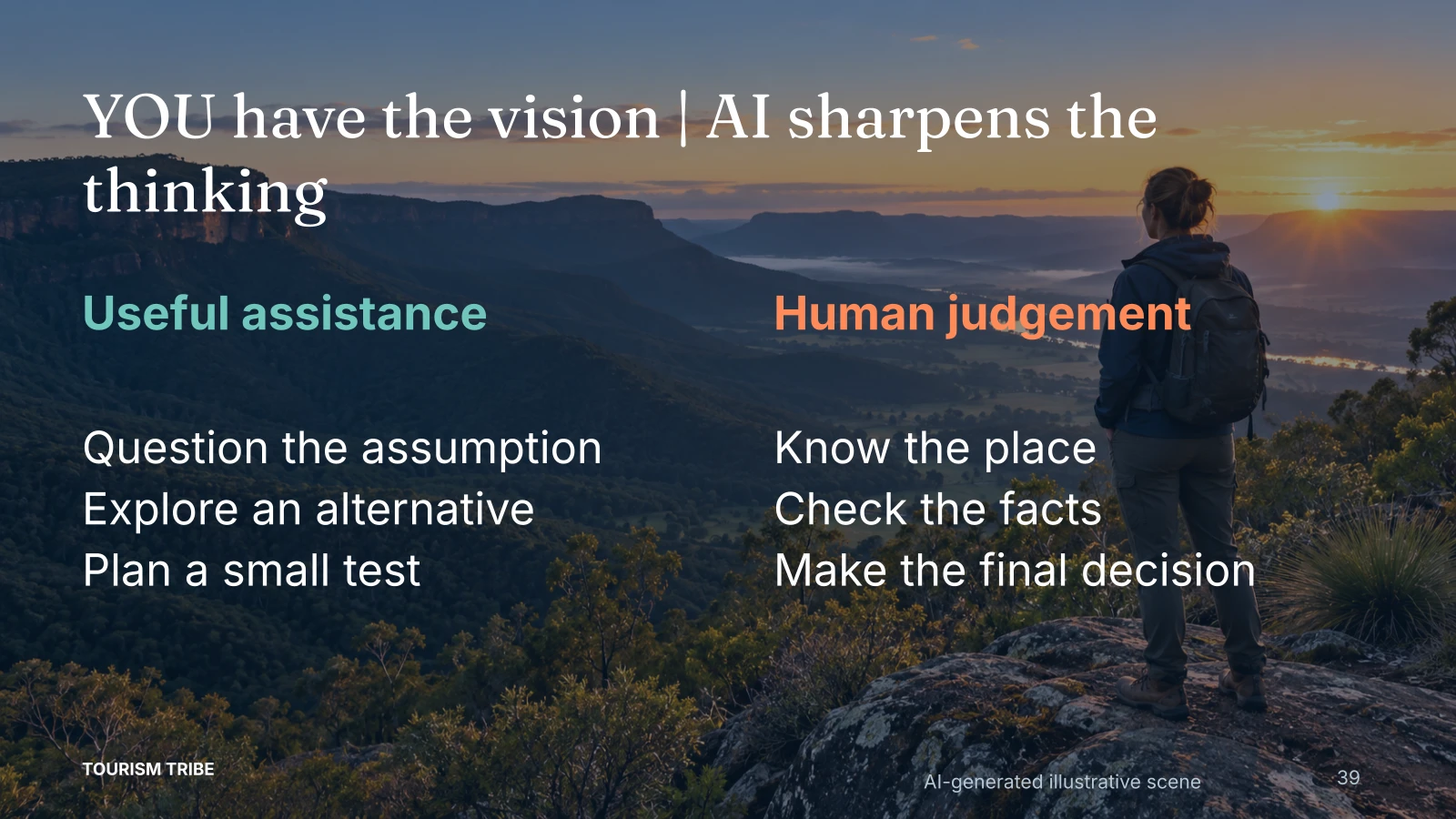
Human judgement still checks the facts, understands the people and makes the final decision.
Take one useful next step
Our follow-on roundtables returned to a simple message: keep learning. Start with a low-risk task that matters to you, build confidence and keep going. If workplace rules limit your tools, respect those boundaries and practise with personal or non-confidential material instead.
For an operator or destination team, the next step could be one experience idea, one useful conversation and one small test.
Start with the feeling visitors are looking for. Shape a promise that people and AI can understand. Then make sure the business can deliver it.
That is experience by design. Happy to speak through the framework and discuss the potential your local businesses. Book a meeting with Liz.
Frequently asked questions
Do we need a completely new tourism product?
Not always. Existing services, people and local connections may become a stronger visitor offer through clearer positioning, packaging and booking.
Does AI-friendly content guarantee recommendations?
No. Accurate, accessible information helps explain the offer, but recommendations vary by platform, question and time.
Where should a regional operator start?
Choose one visitor need, check the evidence with your destination team and design a small test that fits your capacity.
- C
- O
- M
- P
- A
- S
- S
Convince the board · Out of heads · Make it queryable · Prime operators · Activate AI · Safeguard · Show the value
COMPASS: AI Playbook for DMOs
Turn this into your region’s AI strategy
COMPASS is the seven-move AI playbook for DMOs and tourism organisations.