
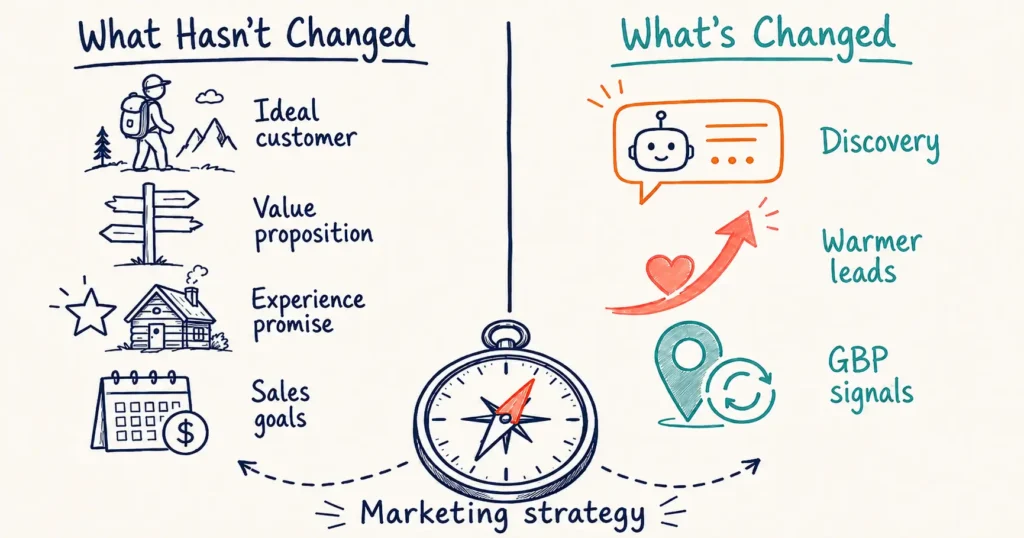
This Tourism Tech Session revisited marketing strategy at a moment when AI has changed how travellers find businesses, but not what makes them choose one. The session covered which core marketing fundamentals still drive sustainable tourism businesses, what AI has actually shifted in consumer discovery, how to use AI to research competitors and validate pricing, and why members using these approaches are seeing better conversion even when overall traffic is down.
Quick links
- Watch the recording
- What are Tourism Tech Sessions?
- The marketing fundamentals that haven’t changed
- What AI has actually changed in tourism discovery
- Using AI for competitor research and pricing
- Where to focus right now
- Things to try this week
Download the presentation slides
Members will see a download link for the slides when logged in. Log in here.
What are Tourism Tech Sessions?
Our Tourism Tech Sessions are twice monthly group coaching calls designed to support AI Enablement Plan members, whether you’re a direct member or a participant of one of our tourism digital capability programs. These sessions provide a space to:
- Learn the latest developments in tourism tech
- Ask questions in a safe, supportive environment
- Hear real-life examples and get practical demos
- Get the confidence to implement what you’ve learned
If you’re not a member, this article will walk you through the key takeaways. Join an AI Enablement Plan to access future Tourism Tech Sessions and have an expert at your fingertips to ask your business-specific questions.
The marketing fundamentals that haven’t changed
We’ve found a pattern in our consulting work recently: as AI tools absorb attention and training budgets, the foundational marketing questions are quietly getting skipped. In this session we face them again head on, because they are still relevant today.
These are the questions a sustainable small tourism business still needs clear answers to, regardless of what AI is doing to discovery:
- Who is the ideal customer? Not a demographic range. A specific person: what they want, what stops them booking, what finally triggers them to act.
- Why should they choose you? Your value proposition, stated clearly enough that you could put it in one sentence without using the word “unique”.
- What are you actually trying to achieve? There’s a difference between a sales goal (fill November, improve profitability by 5% through value-add packages) and a marketing goal (get into the consideration set of travellers planning six months out). Both matter. Most small business marketing plans only track one.
- Did the experience match the promise? This is still the most important one. For most small tourism businesses, the next inquiry comes from a review or a word-of-mouth recommendation. No AI optimisation substitutes for an experience that delivers on what you’ve said.
The reason to go back to these foundational questions isn’t nostalgia. It’s that AI tools now help you answer them faster and at lower cost. You can define your ideal customer in a conversation with ChatGPT in 20 minutes. You can get a first-pass marketing plan from Claude in an afternoon. But the strategic thinking still needs to come from you. AI can accelerate it, not substitute for it.
What AI has actually changed in tourism discovery
The mechanical shift in discovery is fact. Travellers increasingly ask AI tools for recommendations rather than searching for lists of options to compare. When someone asks ChatGPT for a holiday cabin in the Hunter Valley with a fireplace, they receive named recommendations. They do not get ten links. For tourism businesses, this changes two things worth paying attention to.
First, traffic patterns are changing. Regional tourism organisation websites are seeing volume fall as travellers get answers directly from AI rather than clicking through to search results. This is happening across the industry. If you’ve noticed a dip in referral traffic from aggregators, this is part of the explanation.
Second – and this is the part that is often missed – the leads that do arrive from AI recommendations convert at a higher rate. The traveller has already been told your business is the right fit. They arrive warmer than a cold search click. Fewer visits with higher conversions is a pattern many operators are seeing. It changes how you read your analytics: flat or declining traffic doesn’t automatically mean worse outcomes.
The technical side of how AI finds and validates your business, schema, crawlability, Google Business Profile consistency, is covered in detail in How to Track AI Traffic and Improve Your Google Business Profile and Three Types of AI Bot. One Decides If AI Recommends You. The short version: consistent, current information across your website, Google Business Profile, and social presence is what gets you validated, mentioned and cited by AI tools.
Using AI for competitor research and pricing
One of the most immediately useful things to come out of the session: AI tools can cut a half-day of competitor research down to 20 minutes, and the pricing decisions that come from it are measurable.
The process: open ChatGPT or Gemini and ask it to list comparable businesses in your area, same accommodation type, similar location, similar price bracket. Ask what they offer, what their rates look like publicly, and how they describe themselves. Then compare that against your own listing and pricing.
One member in the group ran this process and found their rates were consistently below comparable businesses in their area. They adjusted pricing. Within a week, they had five new bookings after a quiet spell. The research didn’t produce a magic number, it confirmed they had been undercharging relative to what the market was already accepting.
The same research is also useful for positioning. If every comparable business in your area describes itself in similar terms, you can see exactly where the gap is. What nobody else is saying is often what your ideal customer most needs to hear.
Where to focus right now
Given the above, here’s a practical order of priority for a small tourism business in the second half of 2026:
- Get clear on your ideal customer before touching any tech. If you can’t describe in one sentence who you’re trying to attract and why they choose you, AI tools will give you generic output that doesn’t move the needle. This is the work to do first.
- Run a competitor research session with AI. One hour with ChatGPT or Gemini looking at comparable businesses in your area. Note their pricing, how they describe themselves, and what they’re not saying. Adjust your own positioning and rates where the gap is clear.
- Check your AI visibility. Run the free audit at my.tourismtribe.com. It shows your score out of 100 and the specific areas AI tools can’t read properly. Fix the low-hanging issues. They’re usually content structure, not a website rebuild.
- Keep your Google Business Profile current. Regular posts, fresh photos, a description that names your location and nearby attractions. This is where AI validation starts. A full walkthrough of what to update is in this earlier session recap.
We will move from diagnosis to plan at the next session, which will focus on building a simple AI-assisted marketing plan. Come ready to talk about your ideal customer, because that’s the input everything else depends on.
Things to try this week
- Write one sentence describing your ideal customer. Who they are, what they want, and why they choose you over alternatives. If it takes more than one sentence, the positioning isn’t clear yet.
- Separate your sales goal from your marketing goal. Write down one of each. The sales goal is specific and short-term (fill these dates, hit this occupancy rate). The marketing goal is longer-term (become the known option for a specific type of traveller in your area).
- Run a competitor research session. Ask ChatGPT or Gemini to list comparable businesses in your area. Look at what they charge and how they describe themselves. Note where the gap is.
- Check your conversion, not just your traffic. If your enquiry-to-booking rate has improved even as traffic has stayed flat or fallen, that’s the AI-lead effect. Know your numbers so you can read them correctly.
- Run the free AI visibility check at my.tourismtribe.com and note your content clarity score. That’s the most common reason businesses don’t appear in AI recommendations.
Want to get your tourism business more visible online?
AI has changed where travellers make their decisions, but the marketing strategy work that earns those decisions is the same as it’s always been. Tourism Tribe offers three ways to help you get both right:
- GEO Assessment: find out how visible your business is to AI tools right now
- Digital Direction Plan: a personalised roadmap for your digital and AI strategy
- AI Enablement Plans: ongoing access to Tourism Tech Sessions, tools, and hands-on support
Has AI changed the core marketing strategy for tourism businesses?
The mechanics have changed significantly, AI tools now make direct recommendations to travellers rather than showing them a list of search results to browse, but the strategic fundamentals haven’t moved: who your ideal customer is, why they should choose you, whether your experience matches your promise. AI can help you work through those questions faster, but it can’t answer them for you.
Why are my website enquiries improving even though traffic is down?
This is a pattern several tourism operators are seeing as AI search becomes more common. Travellers who arrive via an AI recommendation are warmer leads. They’ve already been told your business is the right fit so they convert at a higher rate than cold search traffic. Flat or declining traffic doesn’t automatically mean worse outcomes if your enquiry-to-booking rate is improving.
How do I use AI to research my competitors and improve my pricing?
Open ChatGPT or Gemini and ask it to list comparable tourism businesses in your area, same type, similar location, similar price range. Ask what they offer and what their rates look like. Compare that against your own listing. Look for gaps in how businesses describe themselves, and check whether your pricing sits within the range the market is already accepting. One operator adjusted their rates after this exercise and picked up five new bookings in a week.
What is the difference between a sales goal and a marketing goal for a tourism business?
A sales goal is short-term and specific: fill these dates, hit this occupancy rate, sell this many gift vouchers before Christmas. A marketing goal is longer-term: become the known option for a specific type of traveller in your area, build an email list of past guests to market future seasons to. Both matter, and most small tourism marketing plans only track one. AI can help you build a plan that covers both.
How do I work out who my ideal customer is?
Start by describing your best recent guests, the ones who loved what you offered, left great reviews, and you would happily host again. What did they have in common? Where did they come from, what were they looking for, and what made them choose you over alternatives? Once you have that picture, you can use ChatGPT or Claude to sharpen it into a customer profile and start testing messaging against it.
What should I do first to improve my tourism marketing in the AI era?
Get clear on your ideal customer before touching any technology. If you can not describe in one sentence who you are trying to attract and why they choose you, AI tools will give you generic output that will not move the needle. Once that is clear, run a competitor research session with ChatGPT or Gemini, check your AI visibility at my.tourismtribe.com, and keep your Google Business Profile current. Those four steps, in that order, will do more than any single platform optimisation.
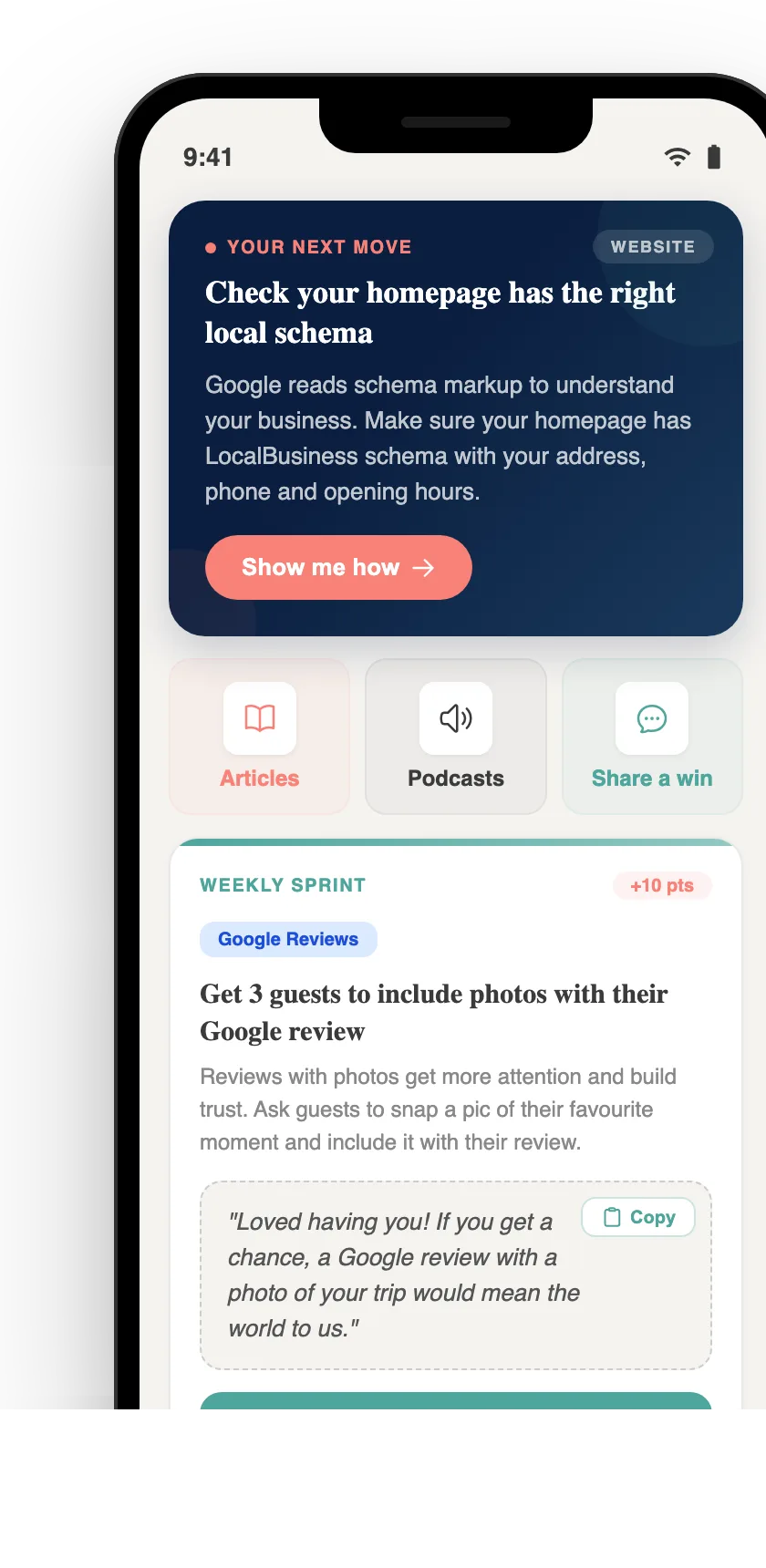
Your free AI marketing coach, right in your pocket
The free Pocket Rocket app gives you a personal AI marketing coach, website audit, weekly action plans and 5-minute tips. Built for tourism operators.