
Listen on your favourite platform




On 3 September, OpenAI released GPT-6 Astra, the first Agent-like model: Astra takes a goal, works out the steps, and can use your computer to get them done. The mouse moves. The forms fill in. You can sit and watch it, or walk away. Basically, the equivalent of a self-driving car.
In Episode 22 of Untangling Tourism Tech, Fabienne Wintle and Liz Ward unpack what that means for tourism operators and destination marketing organisations: what computer use is, what Astra costs and why that price is cheap, the setup potholes that stop it before it starts, why “we’re on Microsoft 365 so we use Copilot” is holding council tourism teams back, and the safeguards that have to be in place first.
AI 2.0: the AI that uses your computer
Everyone is talking about AI and plenty of people are bored of hearing it. Fabienne’s view is blunt: this release is as big as the arrival of AI itself. Until now, getting AI to act inside your business systems needed a bit of coding, or at least someone comfortable with the technical side. Astra removes that. It takes control of your screen and is smart enough to decide how to go about the work. If you can do a job on your computer, it can do that job on your computer. AI for admin.
You train it the way you would train a new staff member. Record yourself doing the task, the way you would record a Loom, and it learns the workflow. No skills to write, no prompt sequences. Right now it takes over your screen while it works, so you cannot touch Chrome while it is in Chrome. Background processing is coming, and this is the first version. Think of a self-driving car with the steering wheel turning on its own. That is where we are.
Where the market sits
ChatGPT got to consumers first and is still the tool most business people use, at 1.1 billion monthly users, up from the 1 billion we quoted a month ago. Gemini sits at 662 million and is the one taking share: ChatGPT’s slice of AI traffic dropped 23.7 points in 12 months while Gemini climbed to 27.3 per cent. Expect the ups and downs to continue. What does not change is the direction: DMO website traffic keeps sliding because the questions travellers used to bring to a destination site are now being answered inside AI conversations and Google’s AI summaries.
Tiers, modes and the senior-lawyer rule
Think of the models the way you think of people in an organisation: juniors and seniors. Astra is the senior. You brief it the way you would brief a trusted head of staff: here is what I need, I trust you to work it out, come back to me if you have questions. It can run for days if the job needs it. Prompting was the old way of getting a junior to do bits of work back and forth. This is briefing a manager.
That is also why you do not use Astra for everything. You would not pay the senior lawyer to write a pro forma letter. ChatGPT now ships several model tiers, and matching the tier to the job is part of the business acumen the tool demands. Send everything to Astra and your $300 a month may not stretch to the end of the month.
Three modes matter. Chat is the quick interaction you already know. Work is where you connect apps, so you can say “go into my email and do this”, or plug in your own knowledge base and ask it what was discussed last week. Codex is the programming interface for more technical work. To see Astra and the model options at all, you need to be in Work or Codex, not plain chat. And you need the desktop app, not the browser, because the app is what can run your computer.
A restaurant, a $300 licence and the return on investment
Liz spent the morning with a restaurant in South Australia. Someone is doing their social media, the posts are going up, and engagement is low. The owner asked whether he could use Astra to create the social media instead. Yes. With a voice file, an instruction file, and a workflow where he checks the drafts before they go out, it is a textbook use case. He has already done the marketing plan and knows what his audience wants. A $300-a-month licence against the cost of a social media person is not a hard sum.
Fabienne went further. If $300 a month sounds expensive, you do not yet understand what the tool is. That is 2023 thinking. What you are paying for behaves like ten, twenty, thirty new staff members. And Astra will not stop at writing the posts. Tell it what you truly want, and because it already knows your business from everything you have done in ChatGPT since 2023, it will read your files, build the plan, and connect Buffer and whatever else the workflow needs.
The potholes: your setup is the limit, not Astra
That is where most people hit their first pothole. Astra asks for your password manager credentials and you realise you do not have a password manager. You ask it to work with your calendar and discover the whole team shares one calendar and one email address. The tool is fine. The setup is not. If you feel Astra cannot do something, it is nearly always your digital workspace that cannot do it. One person, one calendar, one email address. Everything in order technically. You are playing with the big boys and girls now.
You do not have to design the outcome step by step. You have to know what you want. As Fabienne put it, borrowing from the television show Lucifer: what is it that you truly desire? Tell it that. You do not have to tell it how to cook.
“We’re on Microsoft 365 so we can’t use ChatGPT”
Liz hears this constantly from committed, capable people in councils, regional tourism organisations and not-for-profit DMOs. They are on Microsoft 365, so they have Copilot, so they believe they cannot, or are not allowed to, use ChatGPT. Fabienne’s answer: driving a manual does not mean you should never learn an automatic.
Copilot is Microsoft’s AI, attached to Microsoft 365. Government prefers it because it is rigid in the ways a system administrator likes: strong permissions, strong security, easy to limit. It has not grown anywhere near as fast as the other models and does not perform anywhere near as well. If Copilot is the only AI you have used, it feels fantastic, because you have never seen the rest of what is possible. There is nothing like Astra inside Microsoft. On the standard Copilot most councils run, a tourism officer is limited to internal data analysis. It cannot reach out and audit the Google Business Profiles of the region’s operators. And when Fabienne asks a tourism organisation which Copilot plan they are on, most have no idea.
Meanwhile the operators those teams support have been on ChatGPT for years, and the DMO’s old job has gone. The directory the destination website was built around is no longer how travellers find things, so a DMO has to prove its value differently, and it cannot do that without knowing the tools its industry uses. It was the same when Fabienne started at Gold Coast Tourism and Facebook was blocked because social media was “just for fun”. Councils are only now letting staff use TikTok, years after their visitors moved there. Restricting a marketing team to Copilot is giving a creative team Microsoft Word and banning Canva, Photoshop and the web browser.
Models are temporary, your content is not
Whichever model you pick today is a temporary choice. Fabienne moves between Claude and Codex plans depending on where the value per dollar sits that month, and the vendors have made switching easy because they are chasing each other’s customers. Another player, possibly one nobody has heard of yet, will turn up with something better. Be adaptive. What stays yours is your own content and your own digitised assets, and that is where the effort belongs.
Safeguards first: policy, prompt injection and the passports in your inbox
The first S in Tourism Tribe’s Compass model stands for safeguards, and it is there for a reason. Any organisation stretching how it uses AI needs a workable, published AI policy and needs to be transparent about it. Nobody should be running these tools without thinking that through.
Security has never mattered more. The desktop apps now triple-check before they act and ask permission properly, which is an improvement. But picture this. You ask Astra to scan the internet for business opportunities in your region and give it access to your email so it can follow up. On one of those web pages it gets prompt injected: hidden instructions that tell it, since it has your inbox, to find every password in there and email them to a random Gmail address. You gave it the access. It will do it. So what is in your inbox? Passwords someone sent you years ago. Copies of other people’s passports. It is no longer only about what you send. It is about what other people have sent you, and whether a new team member could reach it. Tightening that up is an absolute prerequisite for any business using AI.
Compass move O: get the knowledge out of heads
The O in Compass is about getting regional knowledge out of people’s heads and digitised, and Astra makes that step urgent. These models want to sound smart. If there is no digitised knowledge about a region or a destination, an agent may simply make it up, and it will sound convincing enough that you will not notice. Everything your team knows about the region needs to be captured and made available to AI before you hand an agent the job.
Next time: agent-to-agent commerce
Schema and a machine-readable website were the last step. The next one is bigger: the website has to become a database that other agents can talk to. Fabienne is adding six or seven new checks to the AI Digital Health Check covering the connectors that let agents read everything. The reason is simple. It will not be you buying your next holiday. It will be the agent in your phone, which knows what you want, buying it on your behalf. Those agents do not read websites. They talk to databases. Google’s universal cart is coming to Australia, accommodation booking inside Google AI is being tested, and AI Mode’s maps picked up new layers this week. It is at the doorstep, and it is the subject of the next episode.
If you are a destination marketing organisation working out where to start, the Compass AI Playbook for DMOs is the roadmap for moving through this safely and proactively, rather than waiting for the world to pass you by.
What is GPT-6 Astra?
GPT-6 Astra is OpenAI’s model released on 3 September 2026, built to work as an agent rather than a chatbot. You give it a goal, it works out the steps, checks its own work and asks questions only when it needs to. With the ChatGPT desktop app it can use your computer directly, clicking and typing the way a staff member would.
What does computer use mean in ChatGPT?
Computer use means the AI operates your desktop through the same screens and buttons you use, rather than through a programming connection. If you can do a task on your computer, it can do that task on your computer. You can train it by recording yourself doing the task once. It needs the ChatGPT desktop app, not the browser version, and at the moment it takes over your screen while it works.
How much does GPT-6 Astra cost and is it worth it for a small tourism business?
Astra needs a paid plan of roughly $300 a month in Australia (or cheaper but you will run out of credits quickly). The $20 plan does not include it. Measured against a staff member or a social media contractor doing the same work, the return is clear, provided the business has a voice file, an instruction file and a workflow where a human checks the drafts. Using a cheaper model tier for routine tasks keeps the cost in check.
Can a council or DMO on Microsoft 365 use ChatGPT instead of Copilot?
Yes. Copilot is Microsoft’s AI attached to Microsoft 365, and it is strong on permissions and security, which is why government prefers it. It has not developed as fast as ChatGPT or Gemini, has no equivalent of Astra, and on standard plans limits a tourism officer to internal data work. A DMO supporting operators who use ChatGPT needs to know those tools too. Use ChatGPT on a Business plan, where data is not used for training, under a published AI policy.
What should be in place before switching on an AI agent like Astra?
A password manager, one calendar and one email address per person, a restricted account for the agent rather than admin access, and a published AI policy. Clean out your inbox of anything an agent should never reach, such as passwords and copies of passports, because a prompt-injected agent with email access will act on whatever it is told. And digitise your regional or business knowledge first, otherwise the agent may invent it.
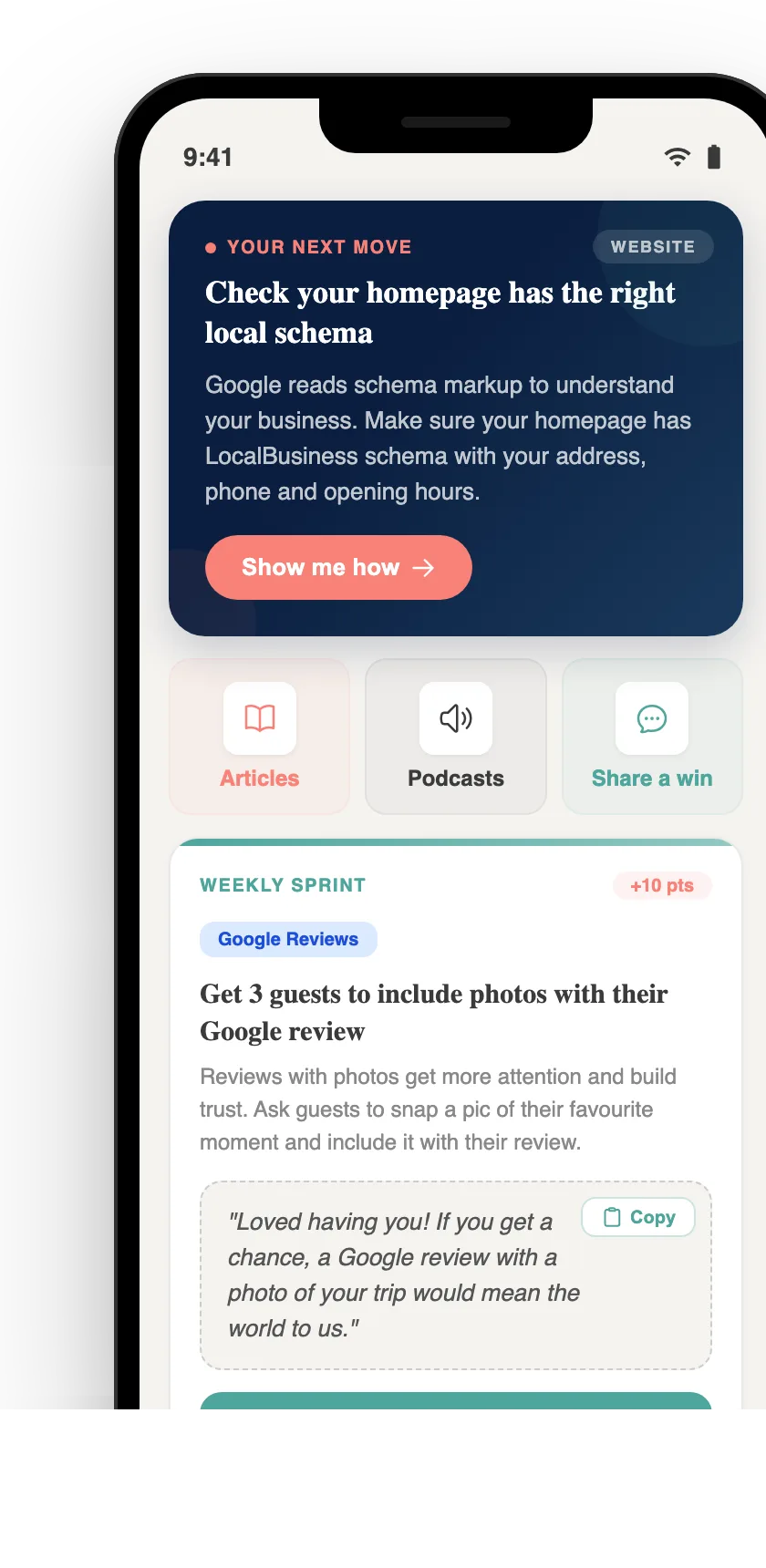
Your free AI marketing coach, right in your pocket
The free Pocket Rocket app gives you a personal AI marketing coach, website audit, weekly action plans and 5-minute tips. Built for tourism operators.