
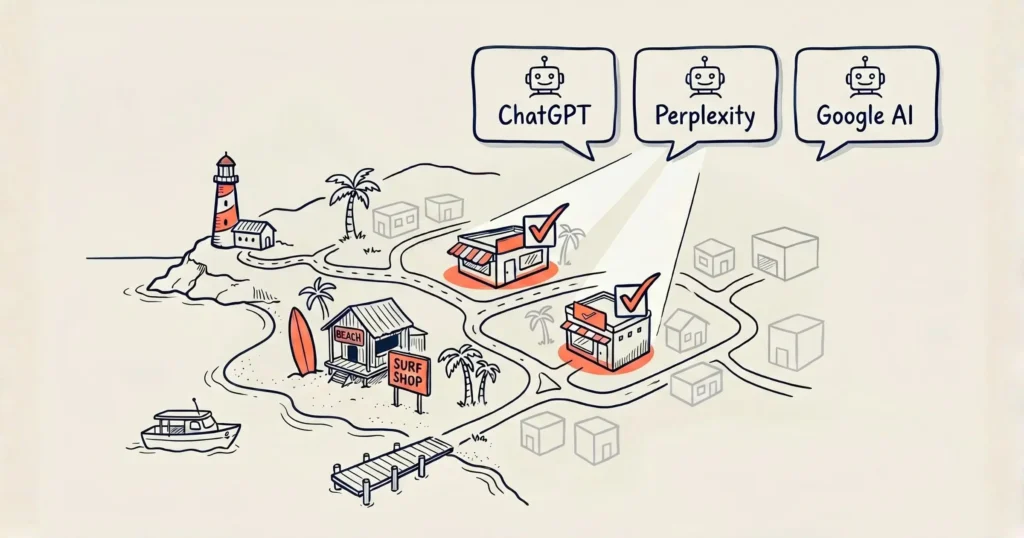
In this Tourism Tech Session, Fabienne Wintle walked through the major shift happening in Google Search and what it means for your tourism business right now. The session covered AI Engine Optimisation (AEO), building a business knowledge base, getting your Google Business Profile ready for AI, and how to use guest reviews to create content that AI tools choose over your competitors.
Jump to: Watch the recording | What are Tourism Tech Sessions? | The Google AI shift | Your Google Business Profile | AEO: turning reviews into content | Building your business knowledge base | Atlas: your AI assistant | Things to try this week
Watch the recording
Members will see the replay when logged in. Log in here.
What are Tourism Tech Sessions?
Our Tourism Tech Sessions are twice monthly group coaching calls designed to support AI Enablement Plan members, whether you’re a direct member or a participant of one of our tourism digital capability programs. These sessions provide a space to:
- Learn the latest developments in tourism tech
- Ask questions in a safe, supportive environment
- Hear real-life examples and get practical demos
- Get the confidence to implement what you’ve learned
If you’re not a member, this article will walk you through the key takeaways. Join an AI Enablement Plan to access future Tourism Tech Sessions and have an expert at your fingertips to ask your business-specific questions.
Google Search has changed, and it changes everything
Following Google I/O 2026, Google Search moved fully to an AI-driven interface. Traditional keyword results are being replaced by conversational answers. Google can now build personalised itineraries, answer complex travel questions in one response, and let users add bookings directly within the search interface, bypassing Online Travel Agencies and listing aggregators entirely.
For tourism operators, this means the question is no longer “Can people find my website on Google?” The question is: “When someone asks an AI what to do in my region, does my business come up? And does the AI have accurate, specific information about me?”
Fabienne used Agnes Water as an example during the session. When she asked Gemini for things to do there, it returned outdated and incomplete information. That gap exists for most regional tourism businesses right now, and it’s an opportunity. The operators who fill it first get picked. The ones who don’t, get skipped.
Tourism organisations used to act as regional knowledge custodians, managing listings and pushing information to travellers. That role hasn’t disappeared, but the way AI accesses information has shifted it. AI pulls directly from your website, your Google Business Profile, and your schema. Your own digital presence is now the primary signal.
Your Google Business Profile is now your most critical asset
Fabienne was direct about this in the session: of everything you can do for AI search visibility, your Google Business Profile has the highest impact. It needs to be accurate, detailed, and actively maintained.
One of the session participants used a good maintenance model. They respond to every guest review using a custom GPT, specifically highlighting features the guest mentioned: waterfalls, fireplaces, wildlife. Those detailed responses feed back into Google’s understanding of the business. They also maintain a current photo gallery and keep their map pin accurate so guests can actually find the property.
One practical action from the session: add your Google Maps URL to the “sameAs” schema on your website, alongside your social media links. This creates a direct connection between your business’s website and its physical location in Google’s systems, strengthening both local search and AI search results.
If you use a channel manager, connecting it to Google Hotels is becoming essential. Google is rolling out the ability for travellers to book directly within search results. That “add to cart” functionality only works if your rates are live in the Google Hotels system. It’s launching in the US first, but Australian operators should set this up now.
AEO: turning guest reviews into content that AI picks
SEO gets clicks. AEO (AI Engine Optimisation) gets picked. The distinction matters. In AI search, your goal is not to rank on page one. Your goal is to be the specific answer the AI selects when someone asks a relevant question.
The practical way to do this is to treat your guest reviews as a content brief. Fabienne demonstrated this live a member’s website and reviews in Claude. The AI analysed the reviews, clustered them into themes (nature and wildlife, peaceful escape, family experience), and suggested specific content assets for each theme. The output was a list of articles and FAQs like “What wildlife will I see?” Those are exactly the kind of conversational queries an AI answers.
The key rule: don’t copy your reviews word-for-word onto your website. Google treats the original review on its platform as the source. Copy it directly and you risk a duplicate content flag. Instead, use the review as a “proof line”: the evidence that shapes what you write, not the text itself. Write original articles using the theme the review surfaces.
Fabienne also walked through using reviews to find new market segments. One participant mentioned a group of nurses who had stayed at her property and left a review. Fabienne suggested building on that: find out if the group has an internal message board or Facebook group, draft a targeted email to professional group segments (nurses, doctors, beauty therapists, teachers), and create a webpage specifically for professional group retreats. The review gives you the signal. AEO turns it into a scalable content strategy.
“Write each answer as a clear, self-contained paragraph in visible text. That is what AI quotes. Then add FAQPage schema on top so Google and AI Overviews understand the structure. Format answers as complete, self-contained paragraphs rather than bullet lists. That’s the format AI tools pull from when generating answers.
Building your business knowledge base
AI tools are only as useful as the information you give them. Right now, most tourism businesses brief AI with a few sentences and get generic output. The fix is a structured knowledge base (what Fabienne calls your “business brain”).
A knowledge base is a collection of your operational knowledge in a format AI can read and use. A Retrieval Augmented Generation (RAG) system breaks information into small, searchable chunks (binary segments), so the AI can pull the exact piece it needs instantly.
Do not save this information as PDFs or Word documents as they are heavy for AIs to read and thus costs you more tokens. Save your business knowledge as Markdown files which are lightweight and AI-readable. If you have nine years of business data in Google Drive (as one session participant does), you don’t need to reformat it all immediately. But you do need to think about where to start. Fabienne’s recommendation: begin with the documents that describe what your business does, who it’s for, what it costs, and what makes it different. These are documents like itineraries, pricing guides, property descriptions, frequently asked questions.
One often-overlooked source of information for AI: your sent email folder. How you naturally respond to guest enquiries contains some of your most valuable operational knowledge: your voice, your reasoning, your policies. Fabienne mentioned a tool in development specifically to ingest sent items and turn them into structured knowledge.
The other critical habit: capture transcripts. Any time you have a face-to-face conversation with a guest, a staff briefing, or a supplier call, record it and get the transcript. Voice recordings can be processed by AI agents to extract structured information. Several session participants already use Otter AI for meeting transcripts. The same logic applies to any spoken knowledge in your business.
One rule to program in from the start: when new information replaces old information, the system needs to know if it should replace the old information completely, replace only what has changed or simply add to it. You’ll need different rules for different types of information. If you update your pricing, the AI must serve the new price, not both. This is a logic decision to make before you build, not after.
Atlas: an AI assistant built for tourism operators
The session also introduced Atlas, a custom AI assistant built by Tourism Tribe, available via Telegram. Atlas has been trained on the Tourism Tribe team’s collective knowledge, courses, blogs, 580 marketing videos, and credible tourism data. It’s designed to work like an embedded employee: one that already knows your business context and can give personalised recommendations on tourism, AI and tech strategy without you having to re-explain yourself every time.
Session participants who had already connected to Atlas noted that it was aware of their previous conversations and Zoom recordings. It provided context-aware assistance without being asked to recap. That’s the difference between a generic AI tool and one that has been given memory and context.
The session also covered the underlying infrastructure: Atlas runs on Telegram because Telegram’s Botfather allows free bot creation (WhatsApp charges for equivalent services). The system currently runs on Tourism Tribe’s servers using Claude and Gemini APIs. The long-term goal is for operators to have their own business-specific versions: bots that can read their emails, answer guest enquiries, and write blog posts directly from their own knowledge base.
Atlas will become available to all of our AI Enablement Plan members soon so you too can have your own AI assistant.
Things to try this week
- Audit your Google Business Profile: check that your map pin is accurate, your photo gallery is current, and your business description is specific. Add your Google Maps URL to your website’s sameAs schema alongside your social links.
- Read your last 10 reviews and cluster them into themes: what do guests mention most? Nature, relaxation, food, family, location? Each theme is a content brief for an article or FAQ page that targets a specific AI search query.
- Write one FAQ answer in full paragraph format: pick a question you get asked regularly, write a 100-150 word answer as a complete paragraph, and add it to your website with FAQ schema. That’s AEO in its simplest form.
- Start a business brain document: open a new Google Doc and write down what your business does, who it’s for, what it costs, and what makes it different. This is the first chunk of your knowledge base. Keep it in plain language, not marketing copy.
- Check if your channel manager connects to Google Hotels: log into your channel manager account and look for a Google Hotels or Google Vacation Rentals integration. If it’s there, activate it. If it’s not, ask your provider when it’s coming.
Want to get your tourism business more visible online?
AI search is changing how travellers find tourism businesses. Getting visible now, before your competitors do, takes the right structure and strategy. Tourism Tribe offers three ways to help:
- GEO Assessment: find out how visible your business is to AI tools right now
- Digital Direction Plan: a personalised roadmap for your digital and AI strategy
- AI Enablement Plans: ongoing access to Tourism Tech Sessions, tools, and hands-on support
What is AI Engine Optimisation (AEO) for tourism businesses?
AI Engine Optimisation (AEO) is the practice of structuring your online content so AI tools choose your business when answering a traveller’s question. Unlike traditional SEO, which aims for a high position in a list of search results, AEO aims to be the specific answer the AI selects. This means writing original, complete-paragraph content that addresses the questions real travellers ask, using FAQ schema markup, and clustering your content around the themes your guests already mention in their reviews.
How does Google’s AI search change things for tourism operators?
Google Search now generates conversational AI answers rather than a list of blue links. It can build personalised itineraries, answer complex travel questions in one response, and let travellers book directly within the search interface. For tourism operators, this means the traditional path of ‘rank on page one, get a click’ is less reliable. AI pulls information directly from your Google Business Profile, your website content, and your schema markup. If those sources are accurate and detailed, your business gets included in AI-generated answers. If they are not, you get skipped.
Should I copy my guest reviews onto my website?
No. Google treats the original review on its platform as the source. If you copy it word-for-word onto your website, you risk a duplicate content flag. Instead, use your reviews as a content brief. Read the themes your guests mention (wildlife, relaxation, family, location) and write original articles and FAQs based on those themes. The review gives you the signal; your original content is the asset that AI tools can pick from when answering a traveller’s question.
What is a business knowledge base and how do I start building one?
A business knowledge base is a structured collection of your operational knowledge in a format AI tools can read and use. It replaces the habit of pasting a few sentences into an AI tool and getting generic output. To start, open a Google Doc and write what your business does, who it is for, what it costs, and what makes it different. Add itineraries, pricing guides, property descriptions, and answers to common guest questions. Keep files in Google Docs or Markdown rather than PDFs, as lightweight text files are much easier for AI systems to search and retrieve from.
What is Atlas and how does it help tourism operators?
Atlas is a custom AI assistant built by Tourism Tribe, available through the Telegram app. It has been trained on Tourism Tribe’s collective AI, tourism and marketing expertise, 580 tourism marketing videos, and regional tourism data. Because it has memory of previous conversations, it can give context-aware advice without you having to re-explain your business each time. The long-term goal is for operators to have their own business-specific versions of Atlas: AI assistants that know your property, your rates, your voice, and your guest history.
How do I get my tourism business bookable through Google?
Connect your channel manager to Google Hotels. Most major channel managers now support a Google Hotels or Google Vacation Rentals integration. When this is active, your live rates and availability appear in Google search results, and travellers can book directly without leaving Google. The feature is rolling out in the United States first but will reach Australia. Setting up the integration now means you are ready when it does, rather than scrambling to catch up when your competitors are already taking bookings through it.
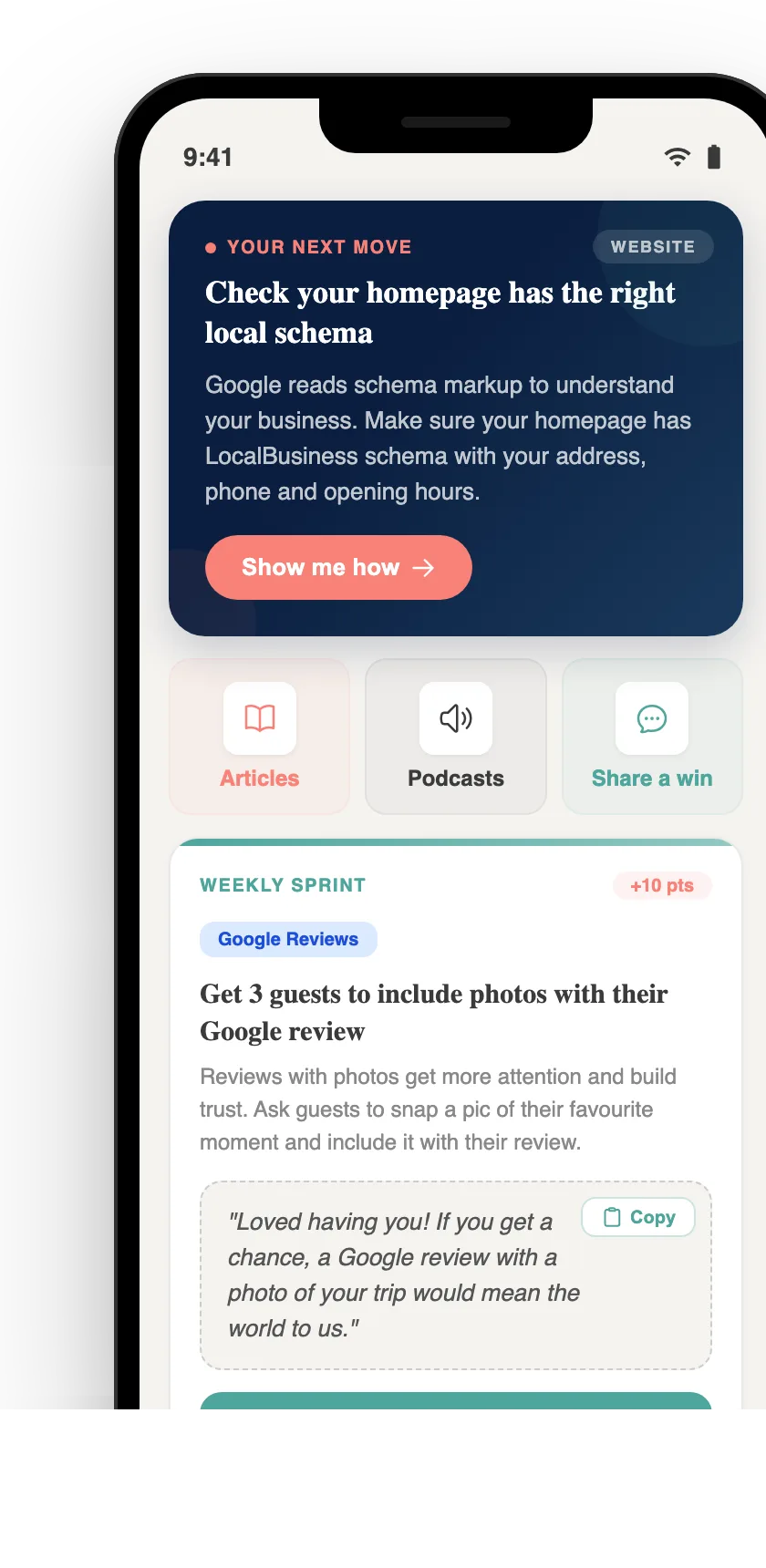
Your free AI marketing coach, right in your pocket
The free Pocket Rocket app gives you a personal AI marketing coach, website audit, weekly action plans and 5-minute tips. Built for tourism operators.