

At its big annual developer conference in May 2026 (an event called Google I/O), Google’s Head of Search Liz Reid said the quiet part out loud: “Google Search is AI search through and through.”
That is the company with around 90% of search traffic telling us the product we have built our marketing around since 2002 has changed shape. Not a feature bolted on the side. The core of search is now a conversation that finds, plans, books and pays.
The numbers are already moving. AI Overviews now appear in 39% of searches. Click-through on the top organic result fell from 27% to 11% over the past year (SISTRIX, March 2026). Across our own clients, as much as 20% of website traffic now comes from named AI tools like ChatGPT and Perplexity, and our DMO clients are seeing traffic down around 30%. Ranking first no longer means getting the click.
Four things changed at that conference. Here is each one, and what it means for your business. For the wider picture, see our guide to AI Search for Operators and DMOs.
Here is the moment, live on stage at Google I/O:
1. Search became a conversation
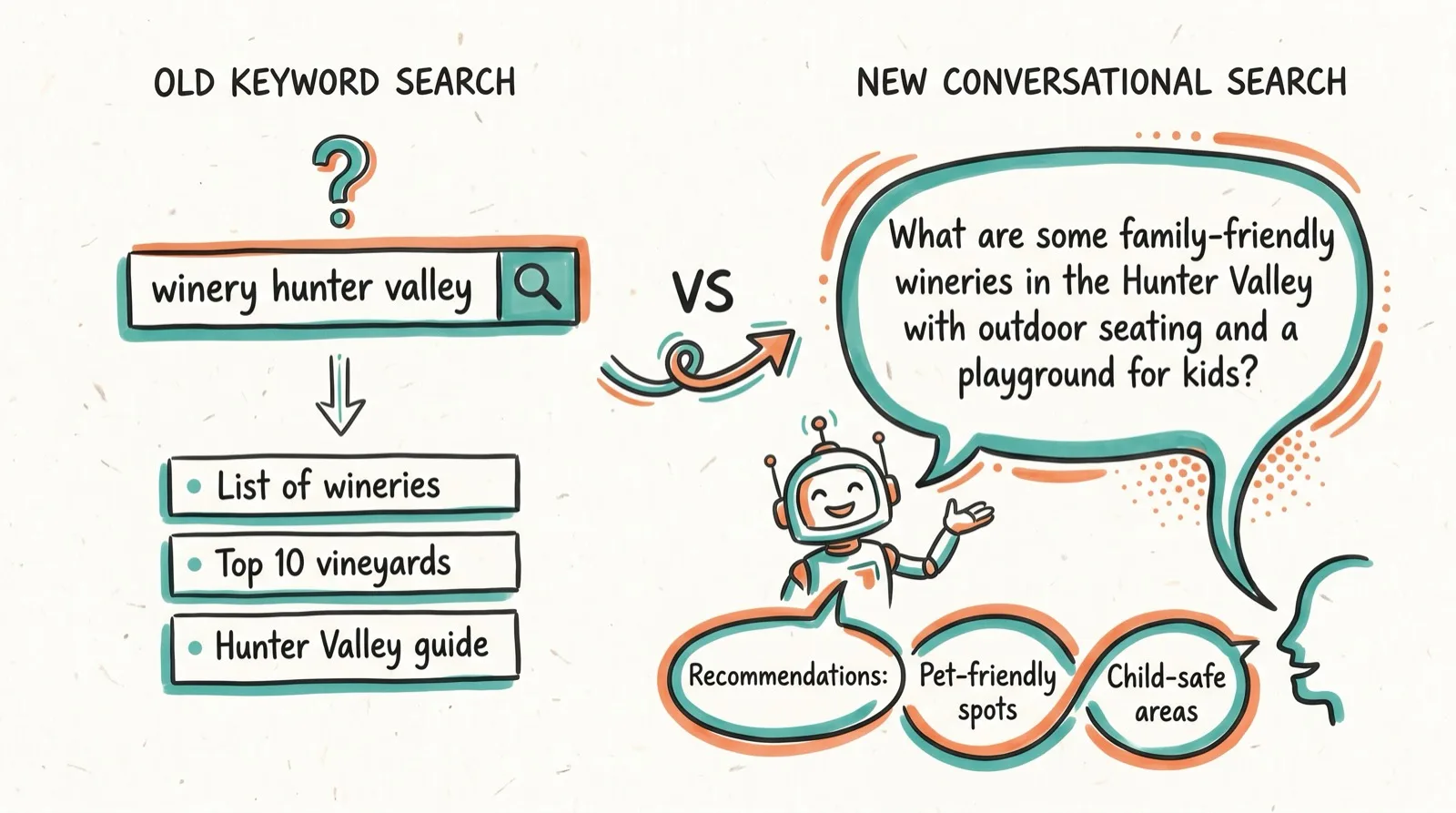
Google rebuilt the search box and called it the biggest change in over 25 years. You now type a long, specific question, drop in an image or a video, and keep the conversation going with follow-ups. Google’s own demo: “Can you build an itinerary for a hiking day trip near me with great views and dog-friendly trails and a lunch spot with convenient parking?”
People stop typing “best winery Hunter Valley.” They ask the whole thing, the way they would ask a local. AI Mode, Google’s chat-style search, has passed a billion users a month and queries have more than doubled every quarter. Two in three travellers already use AI to plan a trip (Arival, 2026).
What it means for you: stop writing for keywords. Write for the question and the person.
The old game was to find a phrase, rank for it, collect the clicks. That game is closing. Search answers conversational questions now, and with personalisation there is no fixed ranking left to chase. Write the way your guests ask. Answer the real questions. Is it suitable for kids. Does it run in the rain. Can we bring the dog. What is there to do nearby in winter. AI writes generic. Only you write yours.
Watch Liz Reid unveil the redesigned search box, built for long, natural questions:
2. Search now builds and books on the fly
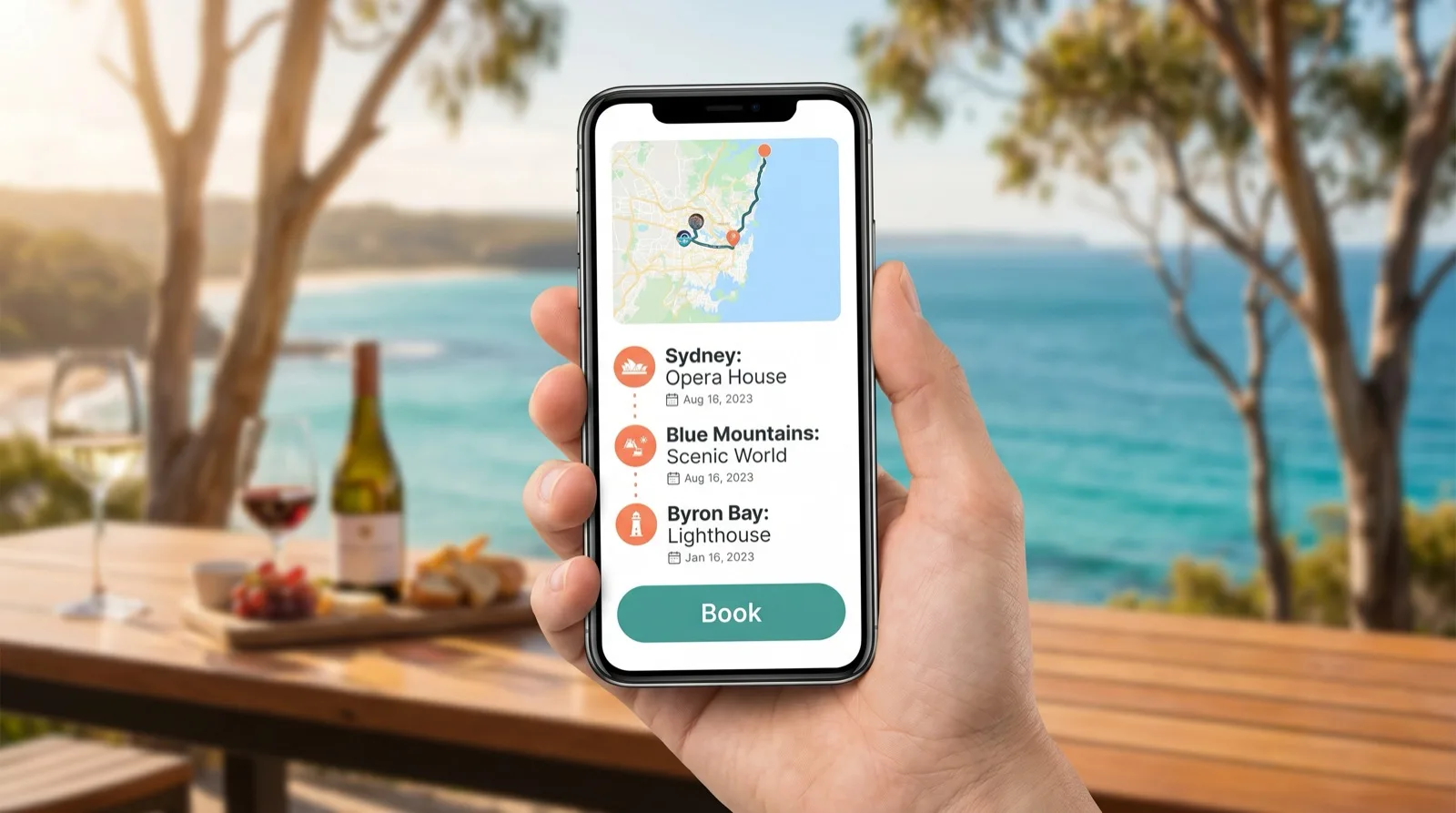
On stage, Google typed a loose brief for a family weekend. Search built the whole plan in seconds: a day at the zoo, a Friday date night, restaurant reservations laid out on a map, synced to the family calendar and shared to a partner’s phone. One conversation, one plan, ready to book.
In its written announcement Google went further. Ask for “a private karaoke room for six on a Friday night that serves food late,” and Search returns live pricing and availability with a link to book. For categories like home repair, beauty and pet care, Google will phone the business on your behalf. Search no longer hands you a list. It does the task.
What it means for you: your Google Business Profile is now the storefront.
When Search books on the fly, it picks the operators it trusts: complete profiles, live availability, recent reviews, clear product detail. Our own testing in Tourism Tech Sessions showed AI Mode leaning hard on the Google Business Profile and routing travellers straight there, often skipping the website at the point of decision. A half-finished profile used to cost you a bit of polish. Now it costs you the booking. A profile with no new reviews in 18 months reads as stale to AI (Arival, 2026).
Watch Google build a full family weekend plan from a single request, live on stage:
Then, in the same demo, Search lays the restaurant bookings out on a map, ready to book:
3. Google builds the answer from everything it knows about you
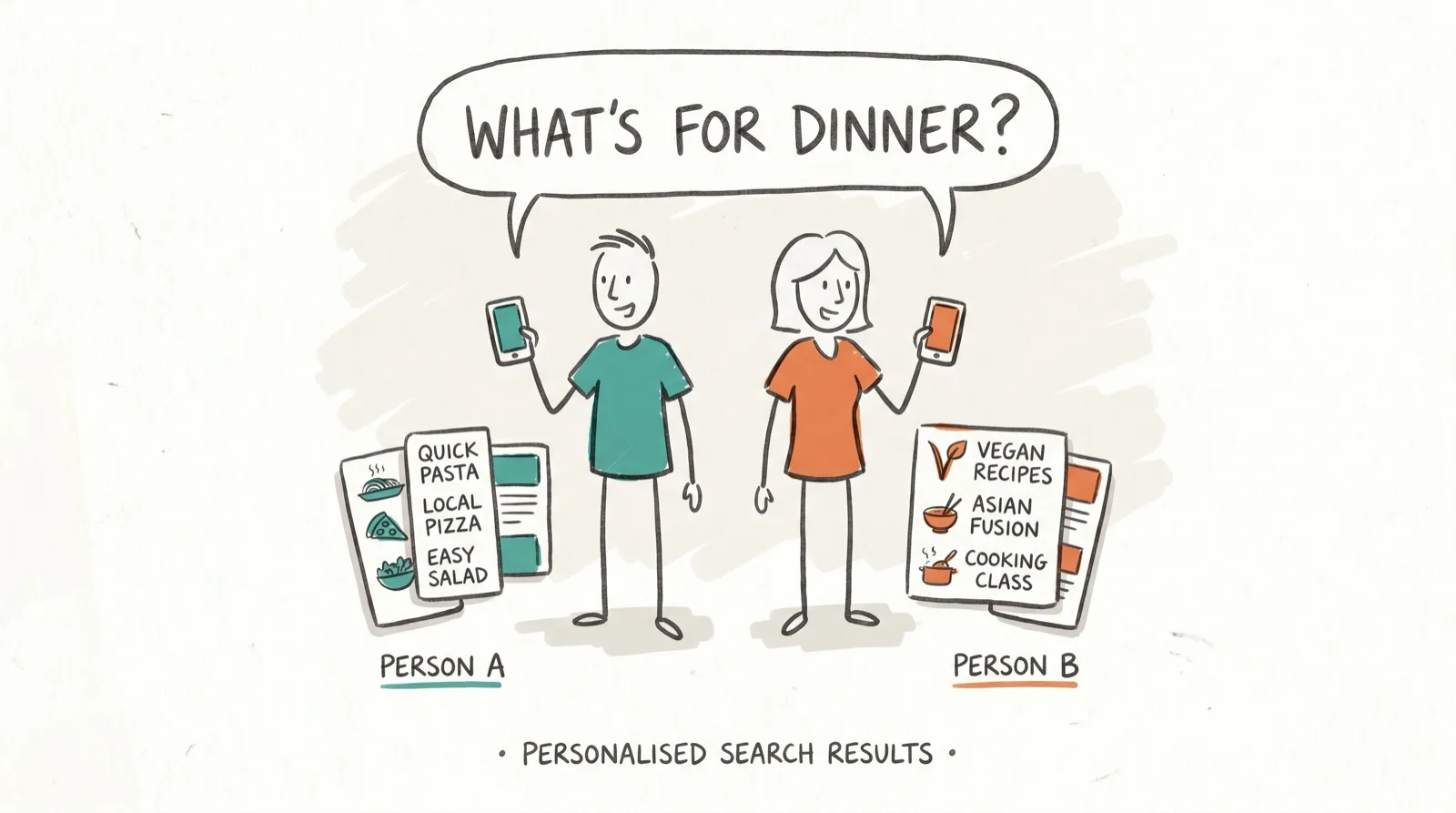
Google calls this Personal Intelligence. With your permission it connects your Gmail, Photos, Calendar and search history, then uses all of it to shape the answer. In the demo, Search already knew the presenter had two kids who love animals and an eldest learning chess, and built the plan around them. It rolled out to almost 200 countries.
Two people asking the exact same question now get different answers. There is no single list of ten results, and no single ranking to win. Google builds a fresh, personal answer on the fly, every time.
What it means for you: relevance and trust beat tricks.
You cannot game a personalised answer. You earn it. Google’s AI picks businesses it understands and trusts for that specific person: clear product detail, real reviews, genuine local knowledge, content that matches how a real traveller would ask. The operators who show up are the ones who are easy to understand and obviously trustworthy. Everyone else gets averaged out.
Watch Search use what it already knows about the traveller, two kids who love animals, one learning chess, to shape the plan:
4. The booking and the payment now happen inside Google
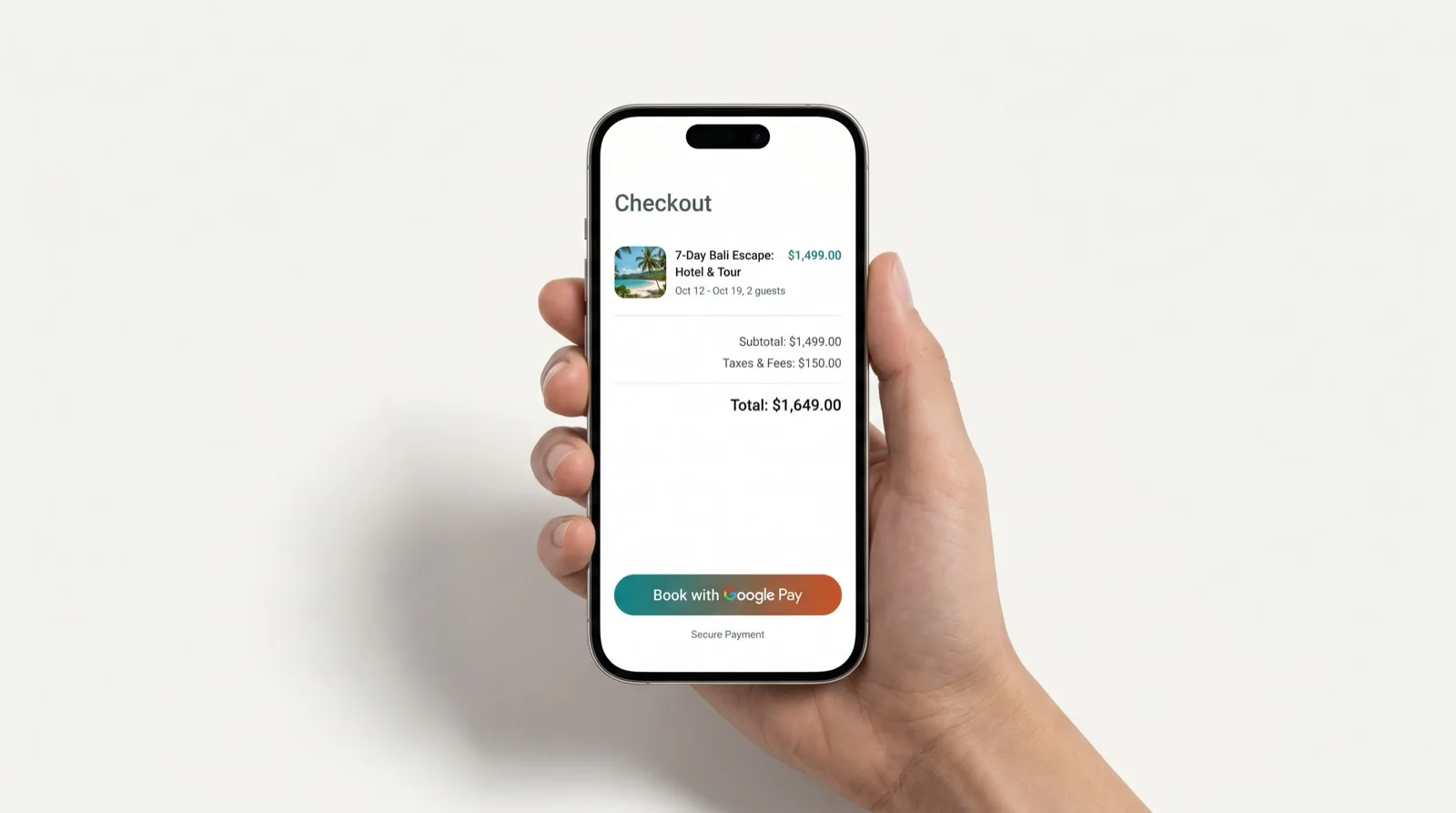
This is the one most operators have not heard about yet. Google launched the Universal Cart, a shopping cart that works across Search, Gemini, YouTube and Gmail. Add something and it works in the background, tracking price, stock and deals, and you check out in a few taps with Google Pay or get sent to the provider to finish.
Two things make this matter for tourism. Google is extending the underlying commerce standard to hotels and local food providers, and rolling it out to Australia in the coming months. And a new agent payments system lets Google complete a purchase for you once you set the rules. The transaction is moving inside Google.
What it means for you: get bookable inside Google, or lose the sale to someone who is.
Being found is no longer enough. If a traveller can complete the booking without leaving Google, the operator who is set up to transact there wins, and the one who is not gets skipped at the final step. Get your products bookable through the channels Google can read and transact with, such as Google Business Profile and Google Things to Do via an authorised provider. And because price and availability now sit side by side in the cart, you compete on experience, reviews and what makes you different, not only on price.
Watch Google unveil the Universal Cart, one cart that works across Search, Gemini, YouTube and Gmail:
Then watch Google extend that commerce to hotels and local food providers, rolling out to Australia in the coming months:
Get in the front seat
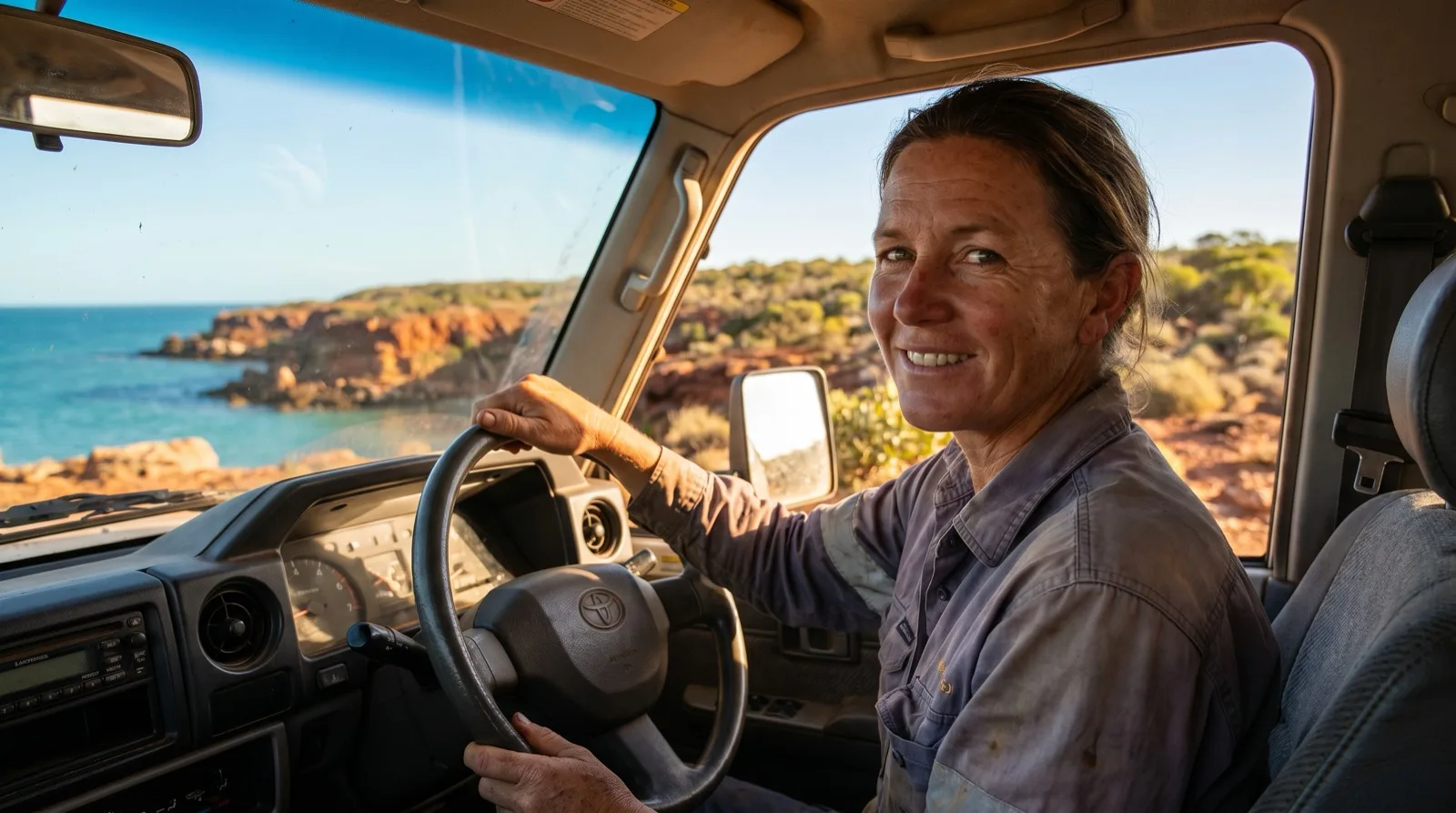
Here is the mindset shift. For 20 years, tourism businesses were passengers. You wrote for the algorithm, you waited for the ranking, you hoped for the click. Those days are ending.
AI does not show ten options. It picks. The businesses that get picked are the ones that took control of their own information: a complete Google Business Profile, products that can be booked, fresh reviews, and first-hand content only they could write. That is the front seat. It is available to any operator willing to do the work, and it does not take a big budget. It takes a decision.
Do nothing and the choice gets made for you, by an AI recommending the competitor who did the work.
The shock for DMOs and OTAs
If this is uncomfortable for operators, it is a genuine shock for the middle of the industry.
Destination marketing organisations. DMO websites owned the inspiration and research stage. That is exactly the stage AI has absorbed. And the trap is more subtle than disappearing from results. We searched “things to do in Agnes Water 1770”, and the DMO website still ranked first. It was right there at the top. The catch is the traveller no longer needs to click it. AI had already pulled the answer together and served it on a silver platter: the things to do, the highlights, a plan. Ranking first means less and less when nobody needs to open the page. And soon the booking will complete inside the AI layer too. Our DMO clients are already seeing traffic down around 30%.
Here is the bigger problem, and the bigger opportunity. The silver platter is often wrong. Agnes Water has plenty of cafes and restaurants that are open and serving food. AI skipped them. Under Food and Drink it served up two picks. The first was 1770 Distillery, a venue that pours locally made liqueurs and does not serve food, listed as a place to eat. The second was the Getaway Garden Cafe, presented as a $20 to $40 restaurant for breakfast or lunch in a Bali-style garden. That cafe shut more than two years ago.
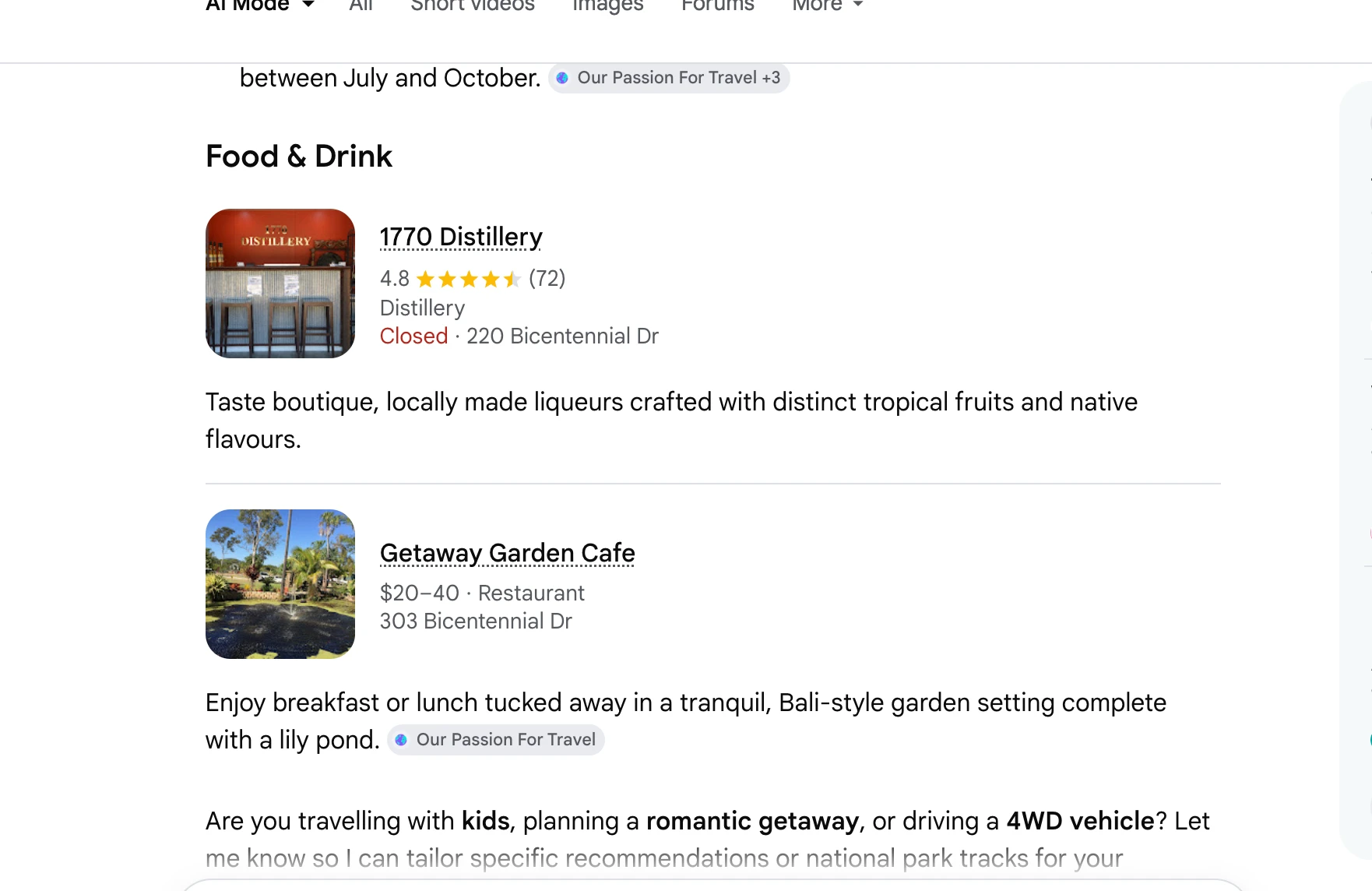
So why these two, out of all the places to eat in town? Not because they are the best. AI surfaced them because their data was strong enough to be picked. A well-kept profile with dozens of reviews in one case, old listings nobody ever cleaned up in the other. AI does not check whether a place serves food or still exists. It assembles the answer from whatever data it can find and serves it with total confidence. A traveller turns up to a cafe that closed two years ago and blames the town, not the algorithm. Meanwhile the genuine cafes down the road, open and serving lunch, stay invisible because their data is thin. AI does not reward the best business. It rewards the best-documented one.
This is the new role for DMOs, and it is a powerful one. Not chasing clicks. Becoming the custodian of the region’s knowledge: the keeper of accurate operator listings, Google Business Profiles, opening hours, what has closed, and what each business actually offers. The destination that keeps its data clean is the destination AI describes correctly. The one that does nothing watches AI send travellers to closed cafes in its name, because the experience that follows is the region’s reputation, not Google’s. Make your operators findable, bookable and accurate, feed AI the local first-hand content it reaches for, and the whole region comes to rely on you as the trusted source.
Online travel agents. Right now AI often favours the big OTAs, because it treats Viator, GetYourGuide and Booking as authoritative sources and cites them. That looks like an advantage. It is also a target. With the Universal Cart and Google taking bookings and payments directly, for hotels and local providers, Google can become the booking layer itself, the exact job OTAs do. Do nothing and the cut an OTA takes for sitting in the middle is the cut Google is now positioned to take instead. For operators, the lesson from Arival holds: the first booking may come through an OTA, but the repeat relationship is yours to build. Capture the guest, bring them direct.
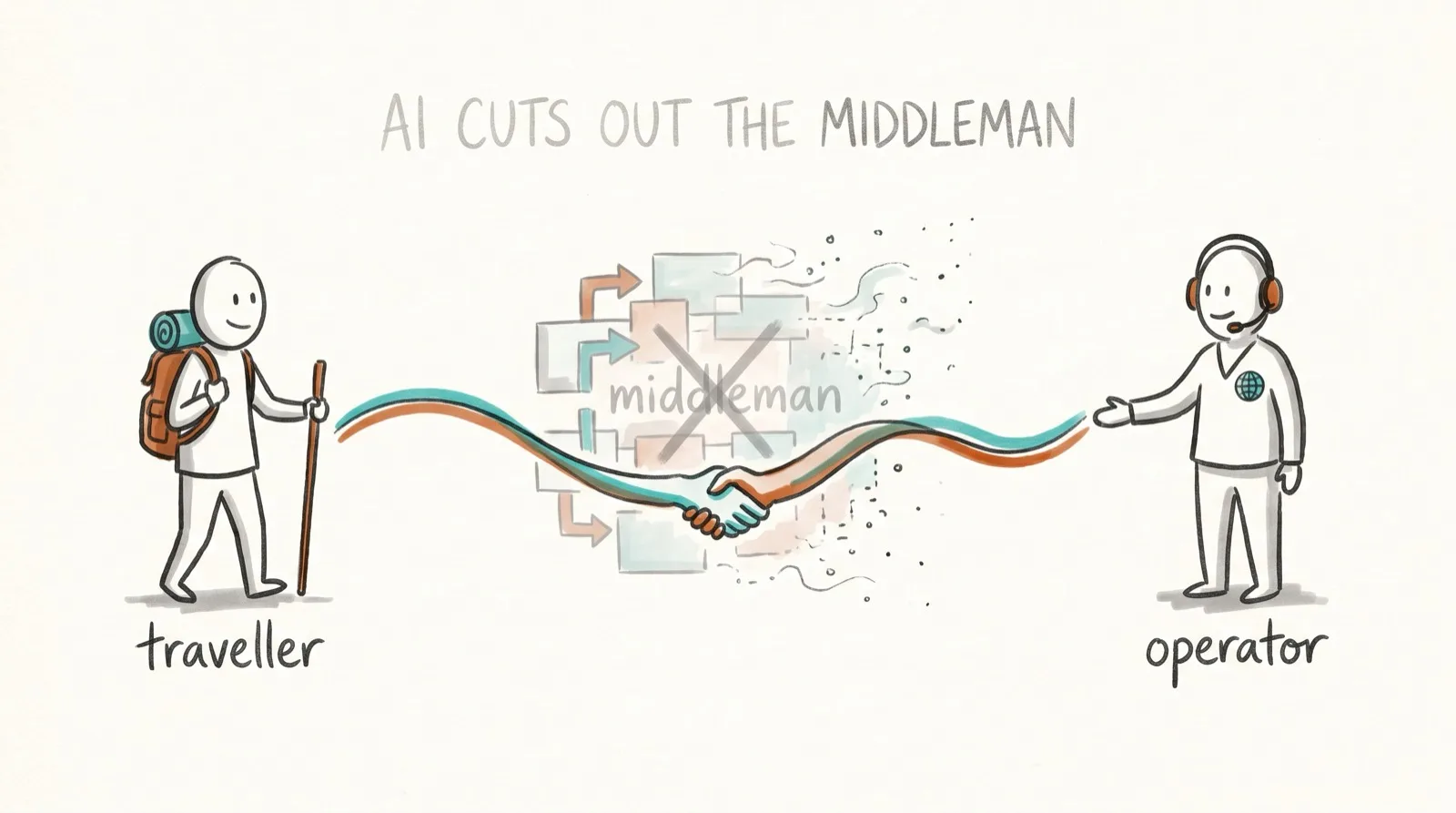
The pattern is the same for everyone. AI rewards the business closest to the real product and the real customer. It squeezes the middle.
Watch the moment Google brings booking and payment to hotels and local providers, the very layer DMOs and OTAs have sat in:
What to do this week
- Test it. Ask Google’s AI Mode “best [your experience] near [your region]” and see if you show up.
- Complete your Google Business Profile. Photos, product detail, hours, the lot.
- Get your products bookable. Look at Google Things to Do via an authorised provider.
- Ask happy guests for reviews, with photos, and reply to them.
- Rewrite one key page to answer real guest questions in plain language. Our guide to what Google’s AI Optimisation guide actually says walks through how.
The pivot
The hard part is not the checklist. It is the pivot. The whole content-marketing industry was built on gaming the algorithm. Building around real expertise and a real point of view is a decision about what your business stands for and what your customers actually care about.
The fastest way to know where you stand is to find out whether AI recommends you right now. Our GEO Readiness Assessment tests exactly that. Does your business show up when travellers ask AI about your region. Is your site and your Profile readable by AI. How do you compare with the competitors AI is recommending instead of you.
When is Google fully switching to AI Mode?
There is no announced “full switch” date, and Google has been careful not to promise one. At its May 2026 conference, Google began rolling out a new AI-powered search box in every country where AI Mode is available, and made its Gemini 3.5 model the default inside AI Mode. But Liz Reid, Google’s Head of Search, said clearly that this “does not mean you’ll only get AI responses”. Classic links are still there. The practical answer for operators: treat AI search as the default direction already, and do not wait for a switch-off date that may never come.
What did Google change about search in 2026?
Google rebuilt the search box for long, conversational questions, made its chat-style AI Mode central, added agents that book and complete tasks, began using your Gmail, Calendar and search history to personalise answers, and launched a Universal Cart that books and pays inside Google. Liz Reid summed it up: “Google Search is AI search through and through.”
Will AI really book my tours and tables for travellers?
It is heading that way fast. Google demonstrated search building a weekend plan with restaurant reservations, launched a cart that checks out inside Google, and in some categories it will phone businesses on a customer’s behalf. To be the business it picks, keep your booking details live and accurate on your website, your Google Business Profile and your listings, and get your products bookable through a channel Google can read.
What does this mean for DMOs?
Your destination website may still rank first, but travellers no longer need to click it. AI absorbs the inspiration and research stage that destination sites used to own, serves the answer directly, and soon will complete the booking too. The move is to stop chasing clicks and become the trusted data layer for the region: make operators findable and bookable, and publish the local, first-hand content AI draws on.
Is SEO dead for tourism businesses?
No, but the goal changed. Old SEO chased a ranking. Now the goal is to be the answer AI gives and the business it books. The groundwork is the same: a clean, well-structured site, a complete Google Business Profile, real reviews, and content that answers real questions. The difference is you write for people and questions, not keywords.
- C
- O
- M
- P
- A
- S
- S
Convince the board · Out of heads · Make it queryable · Prime operators · Activate AI · Safeguard · Show the value
COMPASS: AI Playbook for DMOs
Turn this into your region’s AI strategy
COMPASS is the seven-move AI playbook for DMOs and tourism organisations.