
Yes, you do. An enquiry form is not the same thing as online booking. Real-time booking means a traveller can check your availability, pick a date, and pay without waiting for you to reply. This matters for human travellers and increasingly for the AI tools that are now making booking decisions on their behalf.
What counts as real-time booking, and why does an enquiry form not qualify?
An enquiry form sends a message. Real-time booking closes a sale.
On a genuine booking system, a traveller can see what dates or spots you have available right now, select one, and complete the payment. On an enquiry form, they type a message and wait. Many do not wait.
This is not a new problem. Travellers have preferred instant booking for years. What has changed is that AI tools are now making the same assessment. When ChatGPT, Google’s AI, or Perplexity tries to recommend your tour or accommodation, it looks for whether a booking can actually be completed. An enquiry form is a dead end at that moment. A live booking system is not.
That high-intent moment, when a traveller or an AI acting on their behalf has decided to book, is exactly the wrong moment to ask them to wait.
Which booking system should I use?
There is no single right answer, but there is a useful shortcut: choose a platform that can also connect to Google so the same live availability shows on your Google listing, not only on your website.
For tours, activities and experiences, tourism-specific booking platforms like Rezdy, FareHarbor, and Bokun are built for this purpose. Each has a Google integration you can turn on. If you sell products rather than experiences, an online shop with proper checkout, not just a contact form labelled “Buy,” does the same job.
For accommodation, your channel manager or booking engine (SiteMinder, Little Hotelier, and similar) handles the connection to Google separately through Google Hotel Center.
Once you have a booking system in place, the next step is connecting it to your Google Business Profile so the booking option appears directly in search and Maps.
How do I connect my booking system to Google?
The connection works differently depending on what type of business you run. The right program differs for tours versus accommodation, and asking your provider for the wrong one leads nowhere.
If you run tours, activities or experiences: the program is called Google Things to Do. It puts a “Book online” link on your Google listing, fed live from your booking system. You do not set this up in Google directly. You turn it on inside your booking platform. Log into Rezdy, FareHarbor, Bokun, or whichever system you use, find the Google Things to Do integration in the settings or app marketplace, and switch it on. If you cannot find it, email your provider and ask them to “enable the Google Things to Do connection.” Confirm the link appears on your live Google listing after it is active.
If you take appointment-style bookings (classes, some wellness activities, dining): the program is Reserve with Google (google.com/maps/reserve). This only works if your scheduling platform is a Reserve with Google partner. Check the partner list at that address.
If you run accommodation: the program is Google Hotel Center (support.google.com/hotelprices/answer/11949903). Room booking links appear on your listing when they are set up through your channel manager or booking engine. Ask them to “enable free booking links via Google Hotel Center.” Their support team will know exactly what that means.
In every case, the work goes to your provider, not to Google directly. And in every case, confirm the booking button shows on your live listing once it is connected.
Why is Google pushing booking into search results?
Google announced its Universal Cart at Google I/O in May 2026. The short version: the checkout is moving inside Google. A traveller can plan a trip in a conversation with Google’s AI and add your tour or room to a basket alongside a flight, completing one checkout across several businesses. We covered what this means for tourism operators in detail here.
This is not fully live across all markets yet. Some features rolled out first in the United States, and a dedicated travel integration has been flagged as coming. But the direction is clear, and the plumbing underneath it, the live pricing and availability data that feeds Google’s systems, is exactly what you are setting up when you connect your booking system today. Operators who are already connected when Google’s agentic booking surfaces mature will be the ones who benefit. Operators whose rates and availability are not in the system cannot be included, no matter how good the experience.
Does this affect my AI visibility generally?
Yes. A bookable listing is one of the practical signals AI tools use when deciding whether to recommend a business. Being findable in AI search is partly about your content and structure. Being bookable, meaning a booking can be completed without human intervention, is increasingly part of whether an AI recommendation is useful enough to surface.
If you want to understand how your full online presence looks through an AI lens, not just the booking question, a GEO Assessment checks your site against the signals that ChatGPT, Gemini, Perplexity, and Google AI Overviews use to find and recommend tourism businesses.
How do I check whether my site and Google listing already have this set up?
Your website:
Open your site in a private browser window so you see exactly what a visitor sees. Try to book something. Can you see live availability? Can you select a date and pay online without sending an email? If the answer is no, you have an enquiry form, not a booking system. While you are there, check that every page has a clear “Book now” or “Buy now” button. A menu link to a general contact page does not count, and a link labelled “Wines” is not obviously a shop.
Your Google Business Profile:
Search for your business name on Google. On the panel showing your listing, look for a “Book online” button or booking links. If you run accommodation, look for room pricing and a booking option. If nothing is there, follow the steps above to connect through your booking platform or channel manager.
Frequently asked questions
What is the difference between Reserve with Google and Google Things to Do?
These are two different programs for different business types. Things to Do is for tours, activities and experiences. Reserve with Google is for appointment-style bookings such as classes and dining. Accommodation uses neither: it connects through Google Hotel Center. Using the right name when you contact your provider is the fastest way to get this set up without going back and forth.
Do I need to set this up inside Google Business Profile directly?
No. The connection is managed through your booking platform or channel manager. Google does not give operators a way to add a booking link manually through the standard Profile interface. The setup happens inside your booking system’s settings, then feeds through to Google automatically.
What if my booking system is not supported?
If your current platform does not have a Google integration, it may be worth switching to one that does. The providers mentioned above (Rezdy, FareHarbor, Bokun for tours; SiteMinder, Little Hotelier for accommodation) all support these connections. Your provider’s support team can confirm what is available for your account.
Is the Google Universal Cart live in Australia yet?
Not fully. Google announced it at I/O in May 2026 and it has been rolling out in the United States first, with a dedicated travel integration flagged as coming. Setting up your booking system’s Google connection now means you are positioned when these surfaces reach Australia. Operators who are not connected will not be included when they do.
What if I only take phone or email bookings?
That is a genuine gap. Travellers expect to book online, and AI tools cannot complete a booking that requires a phone call or an email exchange. Many booking platforms run on a per-booking commission with no upfront cost, so a practical starting point is to pick one platform and get a single product live and bookable before expanding.
Will this help my TripAdvisor and other listings too?
Not directly. The Google connection described here applies to your Google Business Profile. TripAdvisor, Expedia, and other platforms have their own booking integrations. The principle is the same across all of them: wherever travellers find you, the booking should be completable from that point.
What to do next
If your site still relies on an enquiry form, getting a real booking system in place is one of the highest-return changes you can make. Once you have one, connecting it to Google takes a single email to your provider with the right program name.
Not sure where your whole online presence stands? A GEO Assessment covers everything through the lens of AI search, including your Google listing, your schema, and whether your business appears when a traveller asks an AI assistant to recommend something. If you want ongoing support as the booking landscape keeps shifting, our AI Enablement Plans include fortnightly training sessions and AI tools built for tourism. Or if you want someone to look at your specific situation with you, a Digital Direction Plan gives you quarterly strategy sessions and monthly monitoring of your digital presence.
The travellers planning their next trip right now are not all using search the way they did five years ago. Some are asking AI. Some of those AI tools are beginning to book. Set up now so that when they find you, the booking can be completed.
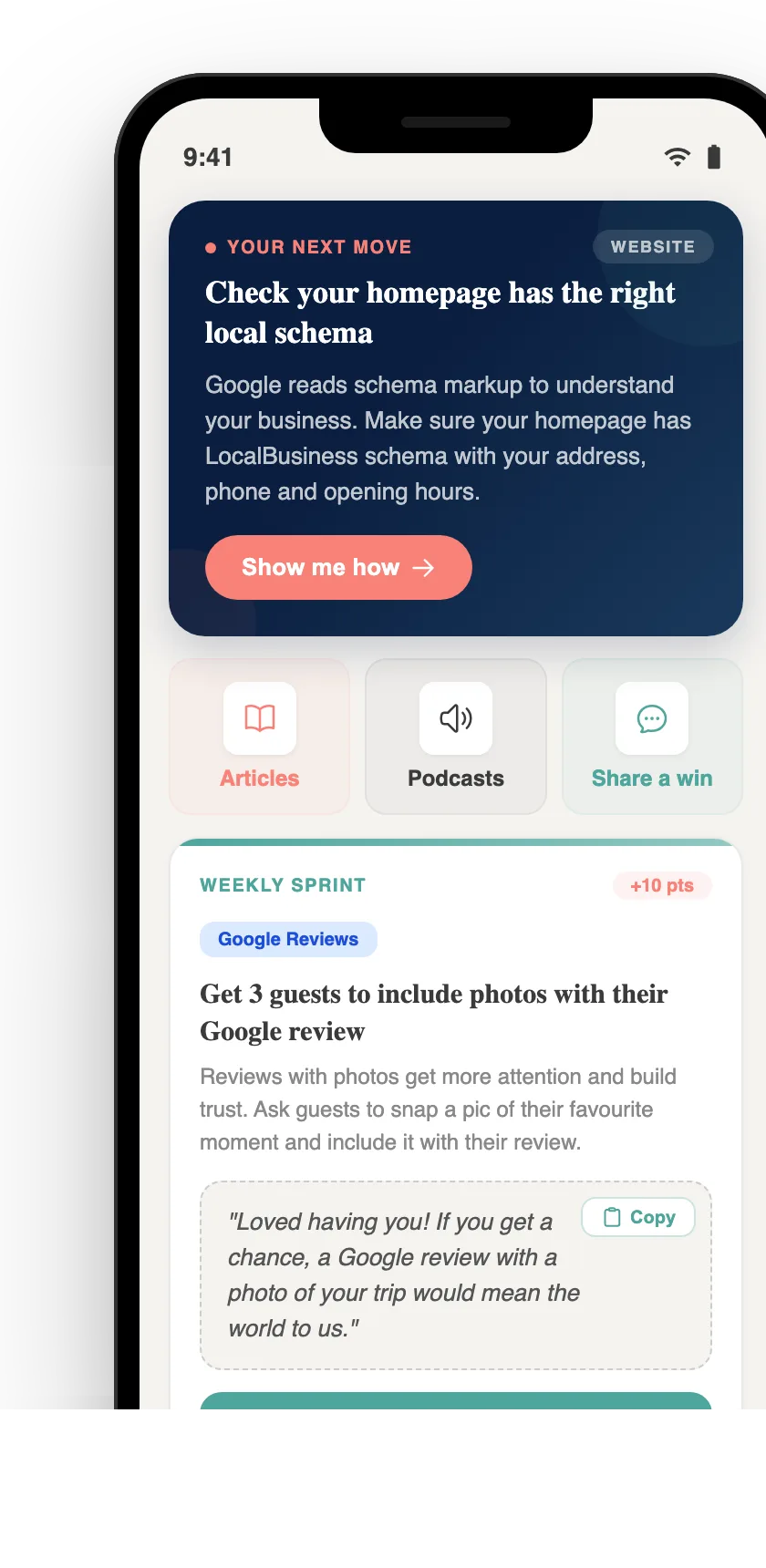
Your free AI marketing coach, right in your pocket
The free Pocket Rocket app gives you a personal AI marketing coach, website audit, weekly action plans and 5-minute tips. Built for tourism operators.