

An event website has to answer a run of quick, practical questions before someone commits to coming: how much, what time, where, what to know, and how to take part. Assistants answer all of these from readable text on your page. If the detail lives in a poster image, a ticketing widget, or scattered social posts, AI cannot read it, so it leaves your event out or guesses.
Show every ticket price as text
List every ticket type on your event page as readable text: adult, child, concession, family, early-bird, single-day versus season, and any add-ons. Prices locked inside a poster image, or a ticketing widget the assistant cannot open, are invisible to it. If you use a ticketing widget, write the prices as text on the page as well.
Put your start and finish times in text
“What time does it start” and “is it still on Sunday afternoon” are among the first things people ask. Type the schedule as plain text: the date, the gates-open or start time, and the finish time. For a multi-day or multi-session event, list each session time. Do not leave the times only inside a poster, a video, or a social post.
Show the location, a map, and how to get there
Embed a Google Map on the event page for your visitors, and write the venue name and full address as plain text beside it, worded the same as the venue’s Google listing. AI crawlers skip the interactive map frame; what they read is the written address and the travel detail. Spell out driving directions, where to park, shuttle routes, and the nearest public transport. For a festival ground or multi-venue event, add a downloadable site map too.
Cover the conditions in an FAQ
Events come with conditions a first-timer cannot guess: road closures, no street parking, no EFTPOS, no pets, what to bring, and the wet-weather plan. Answer these in a signposted FAQ, each question as a heading with a plain-text answer. Assistants pull these specifics straight from a written FAQ and reassure an attendee before they leave home. Link the FAQ from your electronic tickets.
Add a “get involved” page
An event has a second audience: performers, food vans, market stallholders, sponsors, and volunteers. Explain each path in text, and pair each with a form that captures the person’s contact details. When someone asks an assistant “how do I get a stall at this festival” or “can I volunteer”, it can route them straight to the right form.
Frequently asked questions
Can I just put my event details on a poster image?
Not on its own. An assistant cannot read text inside an image, so the prices, times, and location stay invisible to it. Write them out as text on the page; keep the poster as decoration.
Where should ticket prices go?
On the event page or a linked tickets page, as text, covering every ticket type. If you use a ticketing widget, repeat the prices as text on the page rather than leaving them only inside the widget.
My venue is a paddock with no street address. How do I show the location?
Embed a map for visitors, then write the clearest address or landmark you can as text, plus driving directions from the main approaches, parking, and any shuttle. AI reads the written directions, not the map.
What conditions should my event FAQ cover?
Road closures, parking, accessibility, what to bring, the wet-weather or cancellation plan, and entry conditions (age, pets, BYO, EFTPOS). Answer each as a plain-text question and answer.
Why add a “get involved” page?
Performers, stallholders, sponsors, and volunteers make your event run, and they are easier to recruit when the way in is written down. A form captures their details so you keep a list, and an assistant can point applicants to it.
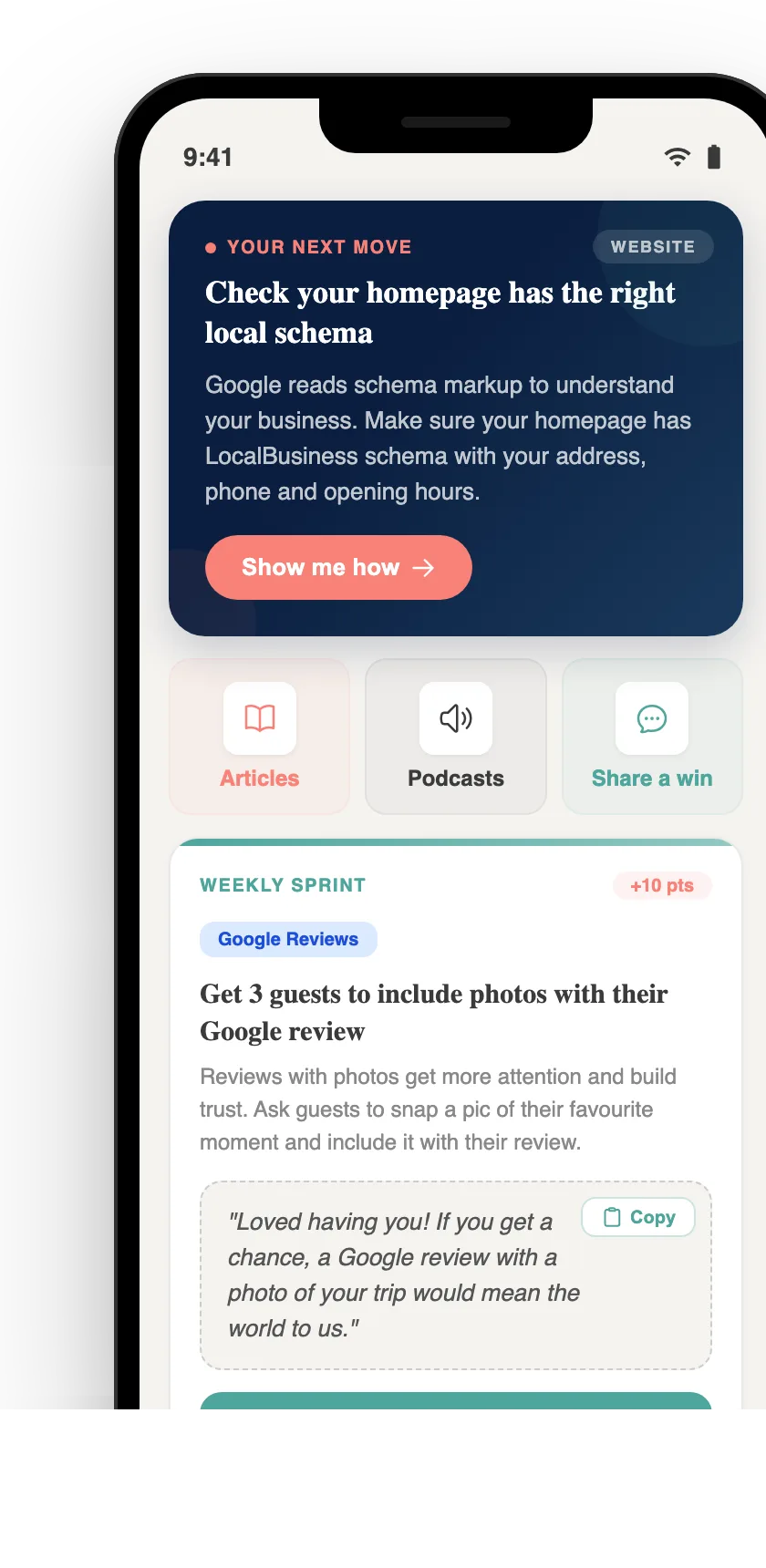
Your free AI marketing coach, right in your pocket
The free Pocket Rocket app gives you a personal AI marketing coach, website audit, weekly action plans and 5-minute tips. Built for tourism operators.