Untangling Tourism Tech — Podcast
3 July 2026
Destination marketing organisations are watching their website traffic fall by an average of 30%, and Google Analytics can’t tell them why. The content is still working. Travellers are still finding it. They just aren’t clicking through anymore, because an AI tool has already given them the answer.
In episode 20 of Untangling Tourism Tech, Fabienne Wintle and Liz Ward unpack what AI search means for DMOs: why the old measures of traffic no longer tell the whole story, what server logs show that Google Analytics doesn’t, and the practical framework in Tourism Tribe’s DMO AI Playbook for rebuilding value in this new search environment.
When someone asks ChatGPT or Gemini what to do in a region for a weekend, the answer comes straight back inside the chat. There’s often no link to click, no list of ten options like a Google search would return. The traveller gets served an answer built from a DMO’s content, and the DMO never sees it in their analytics.
That’s the “zero-click surge,” and it’s flipping how DMOs have always proven their worth. Visits, page views, and time on site have long been the numbers DMOs report to boards and funding bodies. When a visitor never lands on the page, none of that shows up, even though the DMO’s content did the work.
To see what AI tools are actually doing with a DMO’s content, the answer isn’t Google Analytics. It’s the server logs, one level upstream of where analytics tools sit.
Two types of bots show up there. Indexing bots, the AI equivalent of Googlebot, visit regularly to read and store a site’s content so it can be referenced later. Retrieval bots behave differently: they’re dispatched in the moment, during a live query, to fetch a page’s schema and metadata and serve an answer back to whoever asked. Both leave a trail on the server. Neither shows up as a website visit.
A tool like Cloudflare, sitting between a server and the internet, makes this visible with graphs and charts of bot activity over time. It’s also where a DMO can filter out bad bots without accidentally blocking the ones that matter, since blocking ChatGPT’s bot means disappearing from ChatGPT’s answers altogether.
Tourism Tribe released the DMO AI Playbook a few weeks before this episode, built around a practical framework called the Compass Model. It gives DMOs a plan for reinventing their role and protecting their relevance as search moves toward AI.
The first step in the model has nothing to do with technology. It’s leadership, getting a board and decision-makers to genuinely understand what’s changing. One of the simplest ways to do that is to hand a board member a phone and let them have a live conversation with ChatGPT about their own destination.
Crawlable is what sits above the waterline: the content published on a website, and off it, that AI engines can find, read, and cite. That’s the part most DMOs already think about. Queryable is what sits below the waterline, and it’s where the real opportunity is.
Queryable content is the knowledge a DMO already holds but has never digitised: itineraries built for past journalist visits, workshop notes, member relationships, years of local expertise sitting in people’s heads rather than in a searchable system. Turn that into an organised knowledge base, and a request that used to take hours, like preparing an itinerary for a visiting journalist, can be drafted automatically by AI pulling from what’s already been done before.
The starting point is simple: digitise everything. Meetings get transcribed. Notes get stored somewhere searchable. Over time, that becomes the foundation an AI-enabled organisation can build on.
ChatGPT trialled in-chat shopping, then pulled back from travel specifically, leaving fulfilment to the OTA apps built for it. Too many variables, too much complexity. Google went the opposite direction and built the purchase experience directly inside its own AI tools, backed by existing relationships with OTAs and a head start on knowing the consumer through products like Gmail.
The practical effect: a traveller can research, decide, and book inside a single AI conversation, without ever landing on a DMO or operator website.
Talking to ChatGPT about a holiday is closer to briefing a personal assistant than searching a website. The assistant knows your preferences, does the research, and comes back with a decision already made. That’s what an AI agent is: something acting on your behalf, with your authority, to get a task done.
Applied to booking, it means the shopping cart is already filled before a person reads a single review. Adoption of fully autonomous booking is still low today, but the investment behind it isn’t small. A large share of OTAs are reportedly planning to deploy agentic booking at scale, so the shift from low adoption to normal practice is likely to move fast.
DMOs used to be the middlemen between a traveller and a destination’s businesses. AI has made that role harder to justify twofold: it’s easier than ever to get information directly, and increasingly, no one visits a site at all because an agent, especially one built by Google, already knows enough to close the deal.
What doesn’t disappear is the accuracy of what an LLM says about a region. A DMO’s job shifts from displaying content on its own website to making sure the destination is represented accurately wherever an AI agent is drawing from.
The DMO AI Playbook includes case studies on Toronto and Brand USA, both further along on AI adoption and building the internal skills to sustain it. Neither example requires a Brand USA-sized budget to apply. Any DMO that values its local knowledge and its member relationships already holds the core asset. What’s missing for most is digitising it, laying the foundations, then adding AI tools in incremental steps once that groundwork is done.
The DMO AI Playbook, including the Compass Model, is available at tourismtribe.com/compass-ai-playbook-dmo. Tourism Tribe is also happy to run a quick debrief on the playbook for any DMO working out where to start.
Zero-click search happens when someone asks an AI tool like ChatGPT or Gemini a question and gets a full answer with no link back to the website that supplied the information. DMOs are reporting an average 30% drop in website traffic because of it, even though their content is still being used to answer travellers’ questions. The visits just don’t show up in Google Analytics.
AI tools use two kinds of bots to serve their answers: indexing bots that regularly crawl and store website content, and retrieval bots that fetch a page in real time when a live query needs an answer. Neither type brings a human visitor who clicks through, so none of it registers in Google Analytics. The activity is visible in server logs instead.
Crawlable content is what’s published on a website, and off it in places like LinkedIn posts, that AI engines can find and reference. Queryable content is the knowledge that lives inside an organisation, such as staff expertise, past itineraries, and workshop notes, that has been digitised and organised so AI tools can search and use it directly.
The Compass Model is the practical framework in Tourism Tribe’s DMO AI Playbook for reinventing a destination marketing organisation’s role in an AI-driven search environment. It starts with leadership, getting decision-makers to understand what’s changing, then moves through digitising internal knowledge and building AI-enabled processes in incremental steps.
ChatGPT tested in-chat shopping but stepped back from handling travel bookings directly, leaving that to OTA apps. Google has moved the other way, building a purchase experience directly inside its own AI tools. Combined with rising investment in agentic booking across the OTA sector, the traditional multi-step travel purchase cycle is compressing into a single AI-assisted session.
Start by getting the destination’s content into a form AI engines can crawl and cite, and get leadership genuinely engaged, for example by showing board members a live chat conversation with ChatGPT about their region. From there, focus on digitising the internal knowledge already held by staff and volunteers, since that local expertise is the core asset AI can’t replicate.
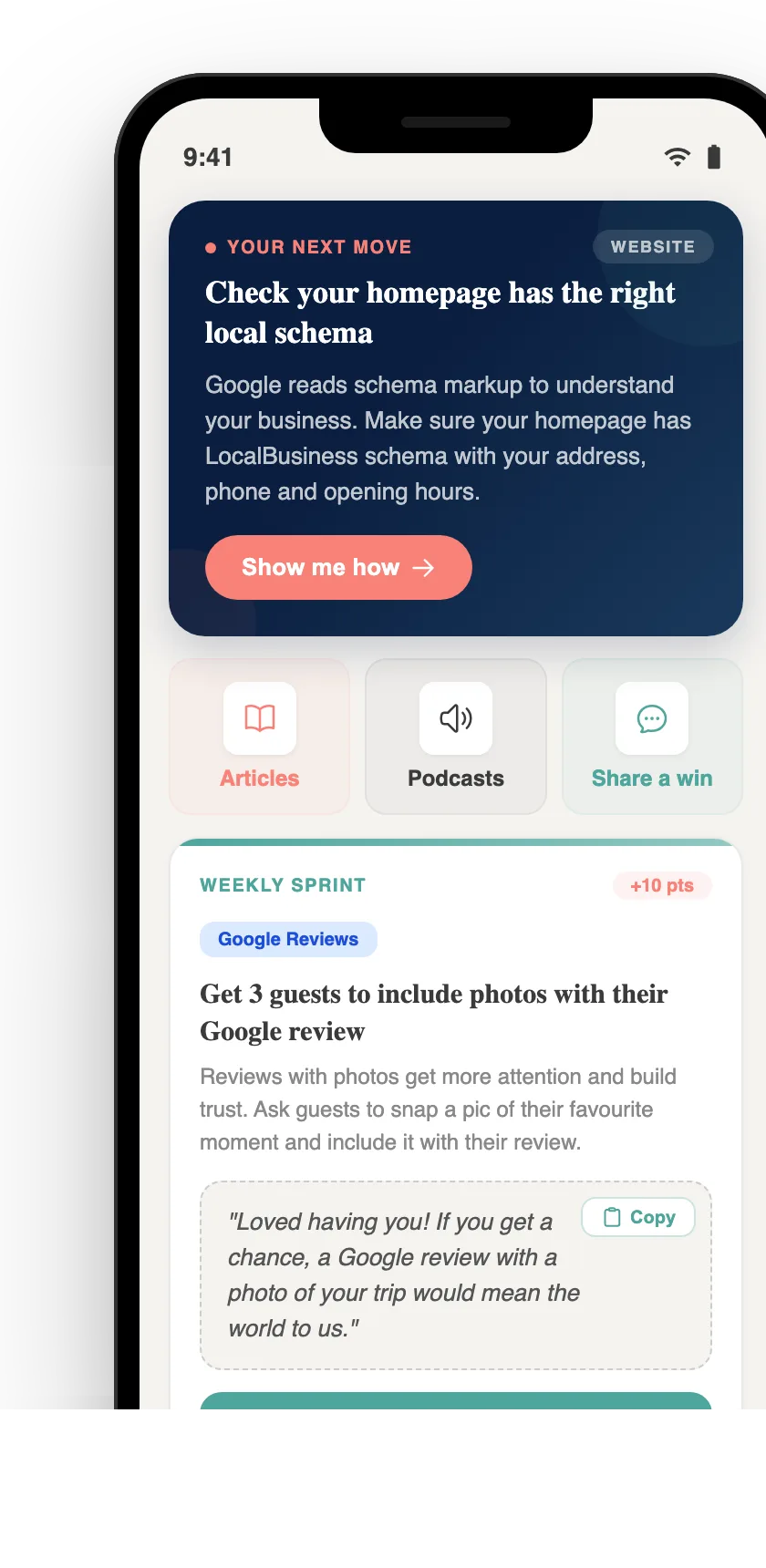
The free Pocket Rocket app gives you a personal AI marketing coach, website audit, weekly action plans and 5-minute tips. Built for tourism operators.
Get access to all our training, coaching, and tools built for tourism operators who want to grow with confidence.
Explore membership