
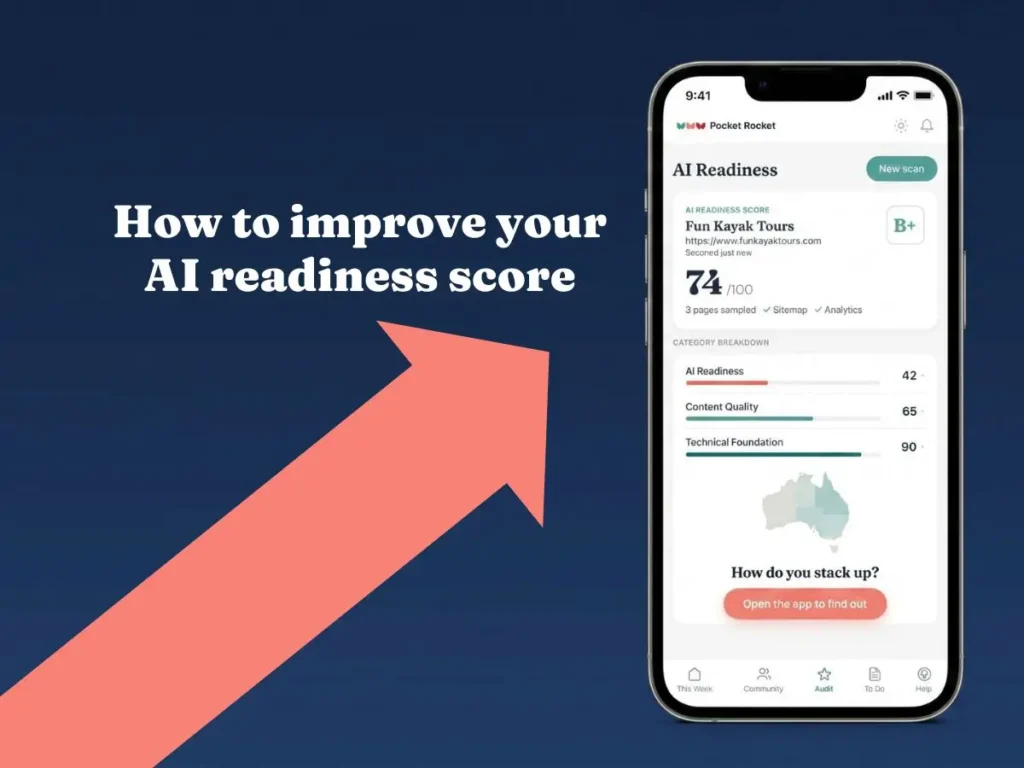
AI tools like ChatGPT, Google AI Overviews, and Perplexity are where more travellers now start their trip research. A higher AI Readiness score means more of them can read, quote, and recommend your business. Tourism Tribe built the AI Readiness Audit to show tourism operators exactly where their website stands against those signals. It is free, takes about a minute, and works for any small tourism business with a live website. The audit scans up to three of your live website pages and scores them against the signals those tools use when deciding which businesses to mention. Each category measures something specific they check before quoting your tourism business to a traveller. This guide shows how to lift every category, in the order that earns the most points, with a do-it-yourself fix and a faster done-with-you route for each.
Haven’t run the audit yet? Start with the free AI Readiness audit. It scans up to three of your key pages and scores them in about a minute. Then come back here and work through the categories from the top.
Quick links
- Where the points are
- Structured Data (20%)
- Content Quality (15%)
- Meta & SEO (15%)
- Content Freshness (12%)
- Technical (10%)
- Facts & Details (10%)
- Rich Media (10%)
- Booking Findability (8%)
- Get help instead of doing it alone
Where the points are
Not every category is worth the same. The weightings reflect how much each signal actually influences whether AI tools trust and quote a business. Machine-readable structured data sits at the top because it gives AI tools a reliable, standardised source of truth about your business. Clear written content follows because AI quotes what is written on the page. If the answer is not there in words, the tool skips your business and recommends one whose page does answer it. Fix the heavy ones first and your score moves faster. Here is how the 100 points split:
- Structured Data: 20%
- Content Quality: 15%
- Meta & SEO: 15%
- Content Freshness: 12%
- Technical: 10%
- Facts & Details: 10%
- Rich Media: 10%
- Booking Findability: 8%
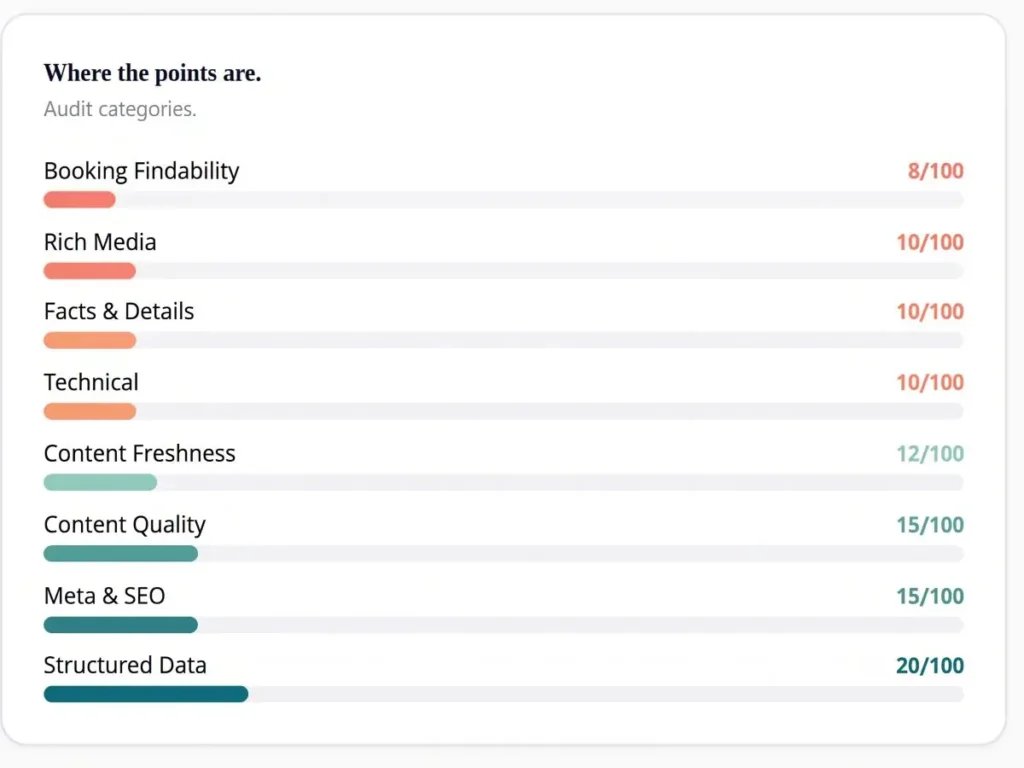
Structured Data alone is a fifth of your score. Start there.
Structured Data (20% of your score)
Structured data is the single biggest lever in your score. It is hidden code on your website (schema.org markup) that labels your business so AI tools read it instead of guessing. Your name, location, opening hours, price range, images, and your linked social profiles all sit inside it.
The audit checks whether your pages carry the right schema type for what you do. A tour or attraction wants TouristAttraction. Accommodation wants Hotel, Motel, or one of the lodging types. A cafe or restaurant wants Restaurant. Every type also wants its supporting properties: opening hours, geo coordinates, an image, a website URL, a price range, and the sameAs links that tie your Facebook, Instagram, and Google Business Profile to the one business.
The DIY fix: check what you have now with the free SEO Pro Extension for Chrome, then add the missing schema. On WordPress with Rank Math, set the schema type per page and fill the fields. On Wix or Squarespace, generate the code with an AI tool and paste it into your page settings. Two reads that walk through it: schema markup for tourism and what Google knows, and how to make your tourism business visible to AI agents using schema markup.
Schema is fiddly the first time. Tourism Tribe members can bring their setup to the fortnightly Tech Sessions, where an expert will look at your markup and tell you exactly what to fix before it goes live.
Content Quality (15% of your score)
Content Quality scores how clearly your page copy answers real visitor questions. The audit reads up to three of your key pages and rates the depth and clarity of what is there. Thin pages and vague marketing copy score low.
AI tools quote the website that answers the question best. If a traveller asks an assistant “is this tour suitable for kids?” and your page never says, the AI sends them to an operator whose page does.
The DIY fix: write plain answers to the questions guests actually ask. Where you are. How long it runs. What is included. Who it suits. What it costs. One idea per paragraph, short sentences, and the specifics in plain text. Cut the adjectives and let the facts do the work.
Members can discuss their web pages at the fortnightly Tech Sessions and ask “is this good enough?” It is one of the most common questions, and they leave with a straight answer and a short list of what to add.
Meta & SEO (15% of your score)
Meta and SEO scores three things: your page title tag, your meta description, and your Open Graph tags. These are the short labels that tell search engines and AI assistants what a page is about and how to summarise it.
A missing title tag or meta description leaves the AI to write its own summary of your business, and it rarely picks the words you would. Open Graph tags control how your link looks when someone shares it, so a missing set means a bare link with no image.
The DIY fix: give every page a unique title and a meta description that answers the page’s main question in one sentence. Add the four Open Graph tags (title, description, image, type). On WordPress with Rank Math, these are fields on each page. Fill them in rather than leaving the defaults.
This is a quick win once you know where the fields are. Members can learn more about the importance of these fields in the SEO and website courses. They can also bring their setup to a Tech Session and someone will walk through where to find them on their platform. Usually sorted in a few minutes.
Content Freshness (12% of your score)
Content Freshness scores whether AI sees signs your information is current. It looks for dates in your content, a dateModified value in your schema, and a blog or news section that shows the business is active.
AI tools weight recent information higher. A page with no date could be from last week or five years ago, and the assistant treats stale-looking content with suspicion. A site that publishes regularly reads as a live, trading business.
The DIY fix: show a “last updated” date on key pages, keep your prices and seasons current, and run a simple blog or news feed. You do not need to post weekly. A short update every few weeks is enough to signal the business is active.
Our fortnightly Tourism Tech Sessions are a great source of things you’ll want to be updating in your website. Members get a steady stream of prompts and topics from the Tech Sessions, so the blog never runs dry.
Technical (10% of your score)
The Technical category checks the plumbing AI crawlers rely on: HTTPS, a sitemap, a sensible robots.txt, and analytics like Google Analytics or Tag Manager. If a crawler cannot reach your pages, nothing else on this list matters.
The most common problem here is a robots.txt file that blocks the AI crawlers without anyone realising. The second is a missing sitemap, which leaves crawlers to find your pages by luck.
- Confirm your site loads on HTTPS (the padlock in the address bar).
- Generate a sitemap (Rank Math does this) and submit it in Google Search Console.
- Check your robots.txt does not block AI crawlers.
- Confirm Google Analytics or Tag Manager is firing, using Google Tag Assistant.
The robots.txt check trips up a lot of operators. If you are not sure what yours says, the member hotline will read it with you and tell you what to change.
Facts & Details (10% of your score)
Facts and Details scores whether the basics a traveller needs are written on the page in plain text AI can quote. Business name, address, phone, email, opening hours, and prices.
The catch: AI reads text, not pictures. If your opening hours live inside an image or your price list is a PDF, the assistant cannot quote them. It will skip your business and recommend one that put the facts in words.
The DIY fix: put your name, address, phone, hours, and a price guide on the page as plain text. Match the wording to your Google Business Profile so the details agree across the web. Take anything important out of images and PDFs and write it on the page.
This one is mostly time, not skill. Members ask about it regularly at the Tech Sessions. It is a quick conversation and you will leave knowing exactly what to add and where to put it on your specific type of page.
Rich Media (10% of your score)
Rich Media scores three things AI uses for context and proof: descriptive alt text on your images, VideoObject schema on your videos, and review schema (Review or AggregateRating) on your testimonials.
Alt text tells AI what is in a photo. Review schema is the one that earns you mentions, because it lets an assistant quote your star rating when it recommends you. Reviews shown as plain text, with no schema, do not get quoted.
The DIY fix: write specific alt text on every image, for example “Kayaking tour on Round Hill Creek” rather than “image1”. Add VideoObject schema to your videos so AI indexes them. Add Review or AggregateRating schema to your testimonials so your rating is quotable. Rank Math handles the review schema once you set it up.
Review schema sits next to the structured data work from the first section. Members tackle both at the Tech Sessions and can check their markup with the expert hotline before it goes live.
Booking Findability (8% of your score)
Booking Findability scores how easily a visitor, or an AI acting for one, works out how to book or contact you. It looks for a clear booking call to action, a phone number, an email, and a link to your booking system.
AI assistants are starting to hand travellers a next step, not only a recommendation. If your page has no obvious way to book, the assistant cannot pass one on.
The DIY fix: add a clear button that says “Book Now” or “Check Availability”, show your phone and email as plain text, and link straight to your booking system. Keep it above the fold so it is the first thing a visitor sees.
The lowest-weighted category, and often the quickest to fix. Worth doing once the bigger ones are sorted.
Get help instead of doing it alone
You do not have to work through all eight on your own. Tourism Tribe membership gives you the courses, tools, and live help to make these fixes with someone in your corner. The AI Enablement Plans start from $33 a month and include 28+ self-paced courses (schema, SEO, website optimisation, and AI tools), the fortnightly live Tourism Tech Sessions, the member community, and a private expert hotline.
Run the free AI Readiness audit first, then see where you sit against operators in your state on the AI Readiness Index. Want to understand the bigger picture of AI search for tourism? Read GEO readiness for AI search.
Ready to lift your score?
- GEO Assessment: a deeper, expert read of how visible your business is to AI tools right now.
- Digital Direction Plan: a personalised roadmap for your digital and AI strategy.
- AI Enablement Plans: courses, tools, live Tech Sessions, and the expert hotline to fix your score with help.
Frequently Asked Questions
How is the AI Readiness score calculated?
The audit scans up to three of your key pages and scores eight categories: Structured Data (20%), Content Quality (15%), Meta and SEO (15%), Content Freshness (12%), Technical (10%), Facts and Details (10%), Rich Media (10%), and Booking Findability (8%). The categories are weighted and combined into one score out of 100, which maps to a letter grade.
What is the fastest way to raise my AI readiness score?
Start with Structured Data, because it is worth 20% of your score, the most of any category. Add the right schema type for your business with its supporting properties. After that, fix Meta and SEO and Facts and Details, which are quick wins that mostly involve writing your details in plain text. Tackle the heaviest categories first and your score moves faster.
Do I need a developer to add schema?
No. On WordPress with Rank Math, you set the schema type and fill the fields per page with no code. On Wix or Squarespace, you generate the schema code with an AI tool like Claude or ChatGPT, then paste it into your page settings. Tourism Tribe members get a schema course and an expert hotline to check the markup is correct before it goes live.
How often should I re-run the audit?
Re-run the free audit after you make changes, so you see the score move and know the fix worked. Beyond that, a monthly check is enough to catch anything that has slipped. You can run the audit again at my.tourismtribe.com/audit.
Will a higher score get my business mentioned by ChatGPT?
A higher score makes your website easier for AI tools to read, quote, and trust, which improves your odds of being recommended. It is not a guarantee, because AI assistants weigh many signals including your reviews and presence across the web. The audit fixes the parts of that picture you control on your own site.
Start with the heavy ones
Your score is eight fixes, not one big rebuild. Start with Structured Data, work down the weights, and re-run the audit after each change so you watch the number climb. If you would rather not do it alone, the AI Enablement Plans give you the courses and the expert hotline to get every category sorted.
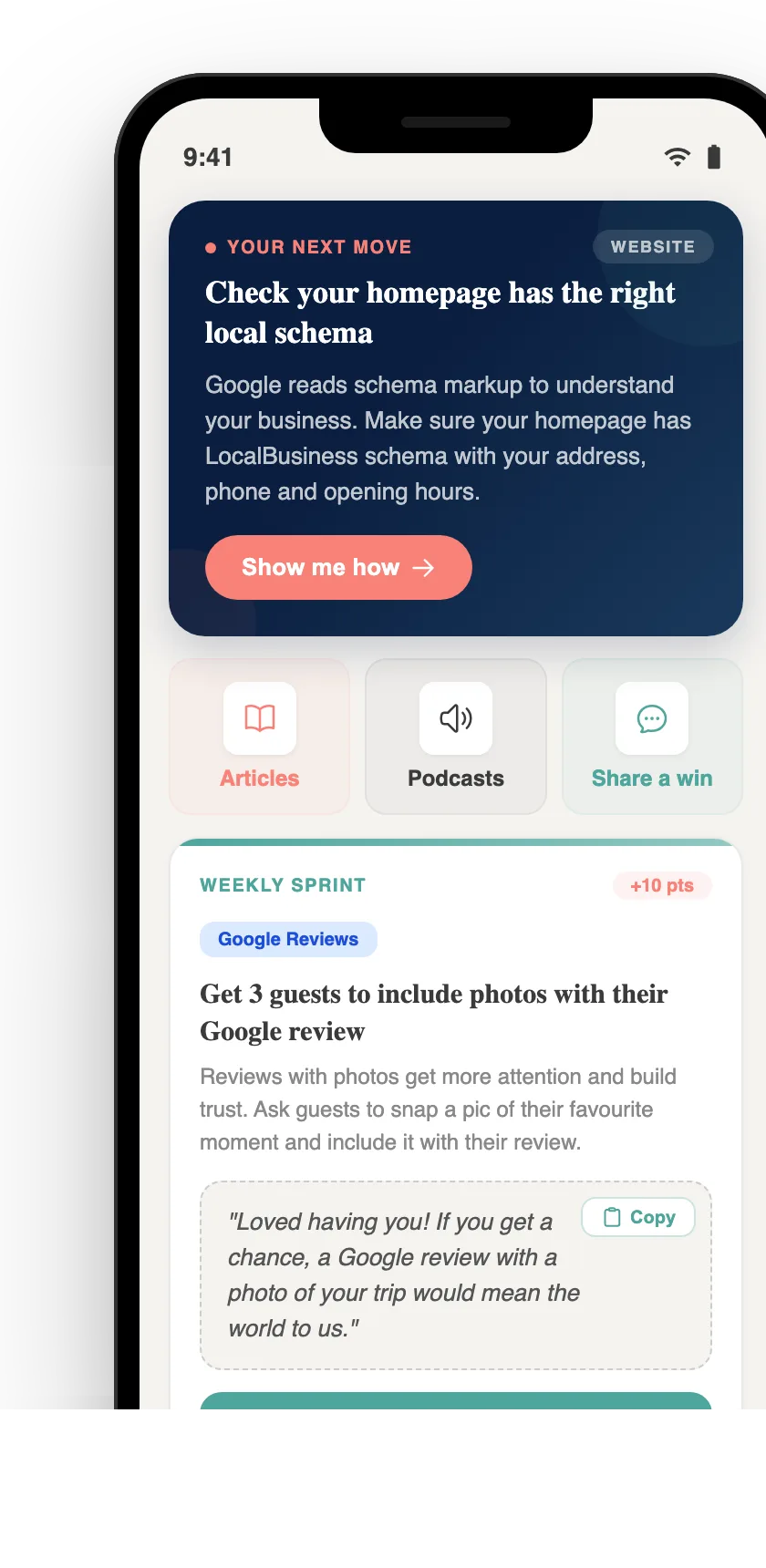
Your free AI marketing coach, right in your pocket
The free Pocket Rocket app gives you a personal AI marketing coach, website audit, weekly action plans and 5-minute tips. Built for tourism operators.