No, not by default. A logo is an image, and AI reads text. Any accreditation badge, membership mark, or award graphic displayed on your website without readable text attached is invisible to AI assistants like ChatGPT, Perplexity, and Google AI Overviews.
Why does it matter whether AI can see your credentials?
When a traveller asks an AI assistant “what is a good eco-certified tour operator in the Daintree?” or “which operators near Margaret River are Quality Tourism accredited?”, the AI builds its answer from the text it can read. Accreditations and memberships are what search researchers call entity signals. They confirm to AI that your business is a real, recognised operator and help it slot you into the right category.
Think about what each of these actually says about your business:
- Quality Tourism Accredited Business (ATAP)
- Ecotourism Australia Advanced Eco Tourism certification
- A 2024 Brolga Award win
- Tourism Accommodation Australia membership
- TripAdvisor Travellers’ Choice
Each credential tells a story about your standards. Shown only as an unlabelled graphic, that story never gets read. Named in plain text, it becomes a fact AI can repeat when it recommends you.
Award wins are particularly valuable here. A named award with its year is a citable trust marker. AI has something concrete to say about your business when it encounters “Winner, 2024 Queensland Tourism Award, Nature Tourism category” in your page text. An unidentified ribbon graphic gives it nothing.
What does AI actually read on your website?
AI reads text. That covers three things:
- The visible words on your page
- The alt text on your images (the short description you attach to each image in your CMS)
- The text inside your schema markup, the machine-readable structured data in your site code
AI does not see what your logos look like. It cannot identify a Quality Tourism badge by its shape or colour scheme. Without words attached to the image, the logo is as meaningful to AI as a blank square. This is the same reason schema markup matters across your whole website: AI reads your site the way a screen reader does, parsing words and data structures, not looking at the visual design.
How do you make your accreditations readable by AI?
There are three practical fixes. You do not need to pick just one.
1. Set descriptive alt text on every accreditation logo image
Alt text is the text description attached to an image file. It was originally designed to help screen readers describe images to people with vision impairments, and it does exactly the same job for AI crawlers. For an accreditation logo, the alt text should name the body or award in full.
Useful alt text: Quality Tourism Accredited Business
Not useful: logo, badge, or left blank
A few Australian examples:
Ecotourism Australia Advanced Eco Tourism certified operator2024 Queensland Brolga Award winner, Nature Tourism categoryCaravan Industry Association of Australia memberTripAdvisor Travellers’ Choice 2024
The test is simple: if you removed the image and left only the alt text, would a reader understand what the credential is? If yes, the alt text is doing its job.
2. Add a short text label beneath each logo
A one-line text caption naming the accreditation body sits right next to the image and is always readable by AI, regardless of whether alt text is configured correctly in your CMS. Even a small text element beneath your logos row, such as “Quality Tourism Accredited Business | Ecotourism Australia”, gives AI the words it needs. Some operators use a short sentence: “Proudly accredited and certified.” That phrasing is too vague. Name each body specifically.
3. Name your credentials in plain text on your About page
Running paragraph text is the most reliable signal of all. A sentence on your About page that reads “We are a Quality Tourism Accredited Business and hold Ecotourism Australia’s Advanced Eco Tourism certification” puts those credentials into page text that any AI will read. This is stronger than alt text alone because it connects your credentials to a paragraph about your business. It also reads naturally to any human visitor who lands on that page.
For operators with a developer available, there is a fourth option: adding your memberships and awards to your Organisation schema using the memberOf and award fields. This puts your credentials into structured data that AI tools read directly. Your web person can handle this if you raise it with them.
How do I check whether my logos have readable text?
You do not need a developer for this. Three checks you can do yourself:
Check 1: Right-click the logo on your live website
On a desktop browser, right-click any accreditation or award logo on your homepage and choose “Inspect” (Chrome) or “Inspect Element” (Firefox). In the panel that opens, look for the <img tag for that image and find the alt= attribute. If it reads alt="" (empty), alt="logo", or has no alt attribute at all, AI cannot read that image. If it reads alt="Quality Tourism Accredited Business", it is set correctly.
Check 2: Open your CMS media library
If you use WordPress, go to Media > Library. Click on any accreditation logo. Look for the “Alternative Text” field in the sidebar. If it is blank, that image has no alt text anywhere on your site.
Check 3: Search your page text
Use Ctrl+F (Cmd+F on Mac) to search your homepage for the name of each accreditation body. If “Quality Tourism” or “Ecotourism Australia” or your award name does not appear in the visible text, there is no readable text for AI to find, regardless of whether the logo is present.
Any of these three checks takes under five minutes. If you find gaps, the fix is usually a short edit in your CMS, or a quick request to your web person.
Frequently Asked Questions
Which accreditations matter most to AI?
Any named, verifiable credential helps. In Australian tourism, Quality Tourism accreditation (ATAP), Ecotourism Australia certifications (Nature Tourism, Eco Tourism, Advanced Eco Tourism), state and national tourism award wins (Brolga Awards, STAR Awards, Australian Tourism Awards), and industry body memberships like Tourism Accommodation Australia are all recognisable entities. Name them in full rather than by abbreviation alone: “ATAP accredited” is less useful to AI than “Quality Tourism Accredited Business (ATAP)”.
What should the alt text say for an accreditation logo?
Name the body in full with any relevant qualifier or year. For example: “Quality Tourism Accredited Business”, “Ecotourism Australia Advanced Eco Tourism certified operator”, “2024 TripAdvisor Travellers’ Choice award winner”, “Australian Tourism Award finalist, Ecotourism category”. Avoid generic phrases like “award logo” or “certification badge”. AI needs a proper name, not a description of what the graphic looks like.
Does this only apply to my homepage?
The homepage is the highest-priority page because AI tools typically crawl it first and weight it heavily. Your About page is the second most important location for credentials, because that is where users and AI expect background information about your business. If you have a dedicated awards or accreditations page, link to it from the homepage and name it clearly in that link text. Credentials buried in a PDF or on an unlinked page are unlikely to be read by AI at all.
I have award logos from several years. Do I need alt text on all of them?
Yes, but prioritise current accreditations and recent wins. A 2024 award reads as a stronger signal to AI than a 2017 award. Give accurate alt text to every logo, and keep your most current credentials prominent on the page. Older wins can stay as supporting context.
Will adding credentials to schema markup do more than alt text?
Schema markup and alt text serve different but complementary roles. Schema puts your credentials into a machine-readable format that AI agents read during crawls. Alt text and visible body text make the same credentials readable within the page content. If you can do both, do both. If schema feels out of reach right now, start with alt text and a visible text label. Those two changes alone make a real difference to what AI can read about your business.
My website builder does not let me add alt text to images. What do I do?
The reliable workaround is a short text caption placed directly beneath each logo as a visible text element. That text is always readable by AI, regardless of the image alt text setting. If your builder genuinely cannot support alt text on images at all, flag it with your website provider as a requirement. It is a significant limitation on your AI visibility, and it is worth knowing about.
Check your accreditations today, then see the full picture
The right-click check above takes 15 minutes. If you find blank alt text or missing text labels, the fix is usually a short CMS edit or a quick brief to your web person.
Your accreditations row is one piece of how AI reads your credibility. AI is now assessing dozens of signals across your website and your Google Business Profile before it decides whether to recommend you, from whether your phone number is a clickable link to whether your tour descriptions answer the questions travellers actually ask.
If you want to know exactly where you stand, Tourism Tribe’s GEO Assessment audits your entire online presence through the lens of generative AI and gives you a prioritised action plan. For operators who want ongoing support, the Digital Direction Plan includes quarterly strategy sessions with our team and monthly monitoring of your AI visibility. Members on the AI Enablement Plan get access to regular tech training sessions that cover exactly these kinds of practical fixes.
Start with the alt text check. When you are ready to see everything AI sees about your business, we are here.
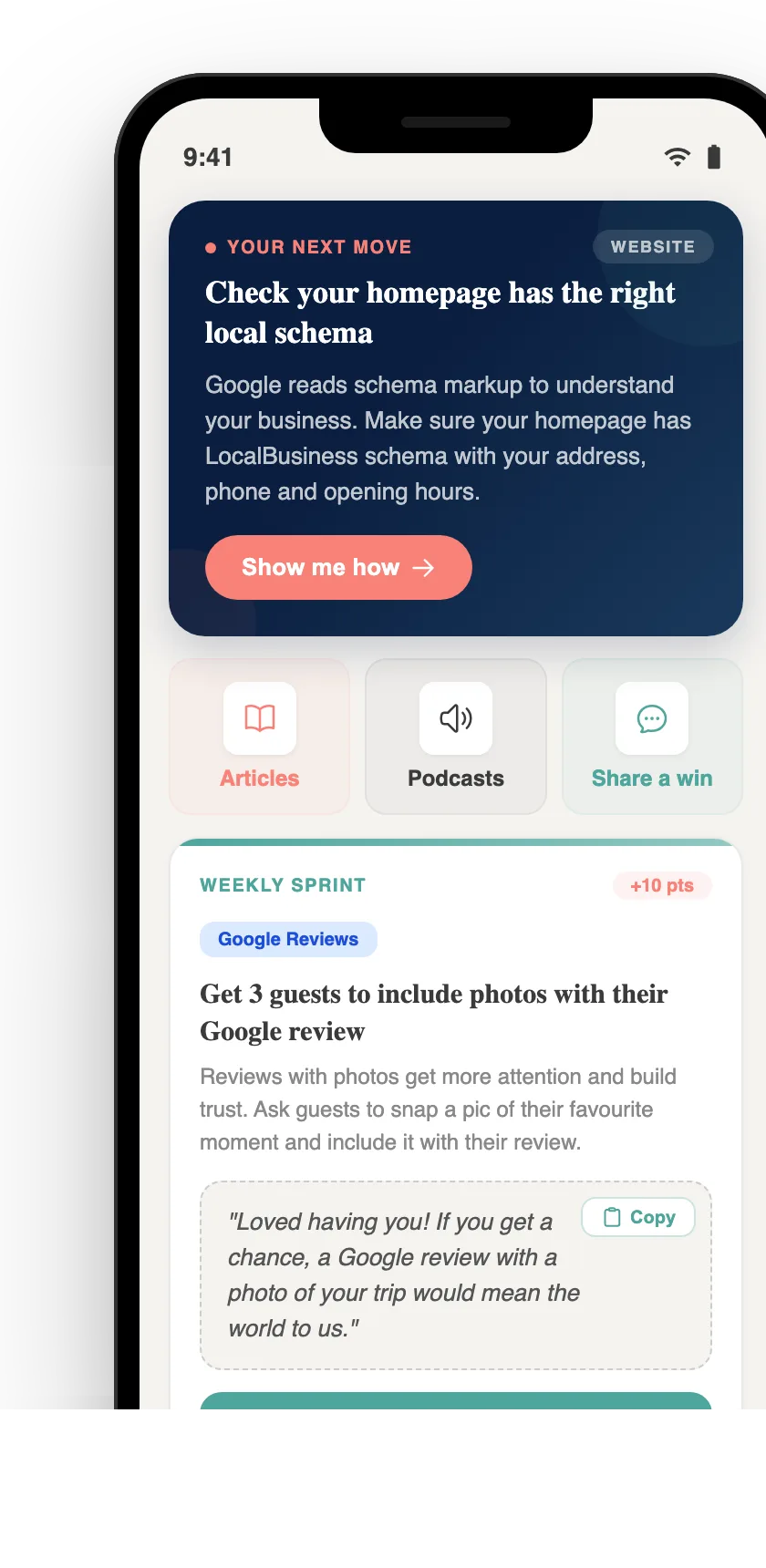
Your free AI marketing coach, right in your pocket
The free Pocket Rocket app gives you a personal AI marketing coach, website audit, weekly action plans and 5-minute tips. Built for tourism operators.