
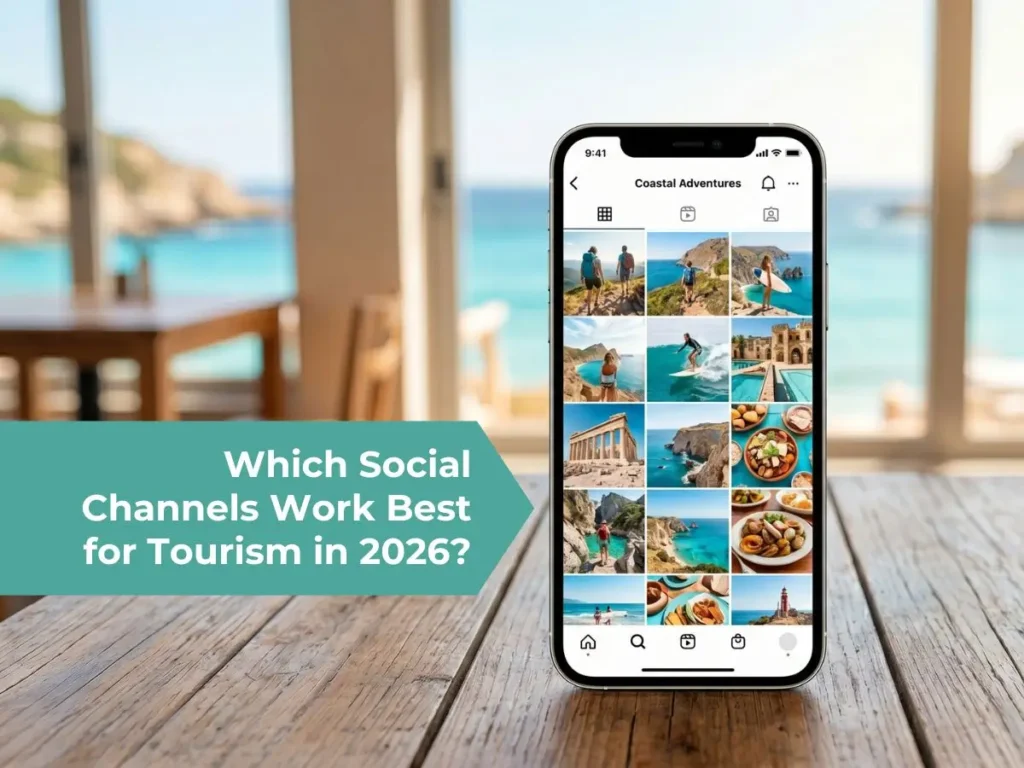
Instagram, Facebook, and TikTok each play a different role for small tourism businesses in 2026. In a Tourism Tech Session on 9 April 2026, Tourism Tribe co-founder Liz Ward walked members through how AI search has changed what social media is actually for, which platforms to prioritise based on your audience, and how to optimise your Instagram profile to show up in search.
Quick links
- Why social media is now about validation
- Facebook: who it’s for and how to use it
- Instagram: the primary channel for tourism
- TikTok: is it worth trying?
- How to repurpose one video across all platforms
- How to optimise your Instagram profile for search
- Things to try this week
Watch the recording
Members will see the replay when logged in. Log in here.
What are Tourism Tech Sessions?
Our Tourism Tech Sessions are twice monthly group coaching calls designed to support AI Enablement Plan members, whether you’re a direct member or a participant of one of our tourism digital capability programs. These sessions provide a space to:
- Learn the latest developments in tourism tech
- Ask questions in a safe, supportive environment
- Hear real-life examples and get practical demos
- Get the confidence to implement what you’ve learned
If you’re not a member, this article will walk you through the key takeaways. Join an AI Enablement Plan to access future Tourism Tech Sessions and have an expert at your fingertips to ask your business-specific questions.
Why social media is now about validation, not inspiration
Social media’s job for small tourism businesses has changed. Six months ago, the goal was to inspire travellers during the dreaming stage of their journey. Now, its main role is validation.
More than 80% of people have used an AI tool (ChatGPT by OpenAI, Perplexity, or Google’s AI Overview) to search for travel ideas, accommodation, or experiences. When AI recommends your business, the next thing people do is check your social media to confirm you’re real, active, and worth booking.
The AI tools do the same check. Google deepened its Instagram integration in 2025 to pull more signals from social profiles. A stale or photo-only profile tells both people and AI that the business isn’t active.
The goal on social media is no longer to reach strangers. It’s to confirm what AI has already told them.
Facebook: who it’s for and how to use it
Facebook still matters for most tourism businesses, but mainly for those with an older or more local audience. People who joined Facebook in 2004 are now in their 40s. Those who joined at 40 are in their 60s. They haven’t left, and they’re often your best customers.
Facebook also shows up in search results. A business listing that hasn’t been updated in months sends a poor signal to both people and AI. Post regularly, even if it’s the same content you created for Instagram.
Three rules for Facebook posts:
- No hashtags. Facebook users don’t search by hashtag, and leaving Instagram hashtags on a Facebook post signals you didn’t adapt the content for the platform.
- Write a short story above the image. Text sits above the image on Facebook and gets read more than captions on Instagram. Use that space.
- Include links when relevant. People on Facebook are more likely to click through to your website than people on Instagram. Don’t add links to every post, but use them when they add value.
Use Meta Business Suite to post to both Instagram and Facebook at the same time with different text for each platform. If you’re short on time, sharing Instagram content to Facebook is fine as long as you remove the hashtags and rewrite the caption.
Instagram: the primary channel for tourism
Instagram is still the main platform for travel inspiration and decision-making. It’s where people check your business before they book.
Photos on their own are no longer enough. A session participant described building a beautiful grid of product images, only to find they’d stopped performing because the shift right now is to video. Liz Ward’s recommendation: aim for every second post to be a short video. Alternate between a carousel of images and a reel.
For video on Instagram:
- First 3 seconds are critical. They decide whether someone keeps watching. Start with something that grabs attention.
- Phone quality is fine. Videos don’t need professional production. Good lighting and a steady hand are enough.
- Add a voiceover or closed captions. Most people watch with sound off. Closed captions lift engagement and make your content accessible.
- Keep it short. A 30-60 second reel that tells a story outperforms a longer polished video.
- Entertain or educate. Every video should do one of those two things. If it doesn’t, it won’t perform regardless of production quality.
Instagram’s hashtag limit is now 5. Keep 3 consistent to your business and swap 1-2 to match the specific post.
TikTok: is it worth trying?
TikTok’s average user is now 26-27 years old, and 35% of users are 30 or older. It’s not a teenagers’ platform anymore, and the age group is expanding quickly.
If you’re already making short reels for Instagram, posting them to TikTok costs very little extra effort. TikTok’s algorithm reaches new audiences more generously than Instagram’s, particularly for newer accounts. Tourism Tribe started posting educational short videos and gained several hundred followers without a paid strategy.
You don’t need a TikTok account to research the platform. Search your destination or niche without logging in to see what content exists and what’s getting engagement. If your immediate area has little activity, search broader: your region, a nearby attraction, or your activity type.
The format that works best on TikTok is a person on camera or a voiceover with closed captions over real footage. A well-chosen background track significantly lifts engagement. Like Instagram, TikTok allows up to 5 hashtags per post.
How to repurpose one video across all platforms
Making a short video takes time. Get full value from each one by posting it across every platform where your audience might find you.
- Film and edit in Canva, CapCut, or similar. Edit outside Instagram so you can download the finished file with closed captions baked in.
- Post to Instagram as a reel. Add music within Instagram using its licensed library.
- Share to Facebook reels. Use Meta Business Suite to post to both platforms, or share from Instagram and edit the Facebook version to remove hashtags and rewrite the caption as a short story.
- Post separately to TikTok. Write a fresh caption with up to 5 hashtags. Add music from TikTok’s own library, not baked into the file.
- Upload to YouTube as a Short. Vertical video in 9:16 format goes directly to YouTube Shorts. YouTube is still a search engine, and Shorts get indexed.
One note on music: don’t bake licensed music into the file before exporting. Use each platform’s own music library when posting. Instagram’s music licence doesn’t carry over to TikTok.
How to optimise your Instagram profile for search
Your Instagram profile is often the first thing a potential customer looks at after hearing about your business from AI search. Two changes make the biggest difference.
First: optimise your account name for search. Your account name is different from your username or handle. Instagram’s search function reads the account name field. If someone searches “native garden walk Lara” and your account name says “Friends of Kevin Hoffman Walk,” they won’t find you. Go to Edit Profile and put your most searchable phrases there: your location, your activity type, what you offer. You can change the account name twice per fortnight.
Second: pin your three best posts to the top of the grid. Instagram profiles display in a grid of three columns. The first three visible posts are your first impression. Pin posts that show the actual experience someone would have. A beautiful image of your walk, a video of the gallery, a reel of an event. A post titled “Where to find us” doesn’t create the kind of first impression that makes someone want to visit.
A few other profile improvements:
- Bio content: Describe what visitors experience, not your org structure. Visitors don’t need to know you’re volunteer-run before they’ve decided to come. Tell them what they’ll see and do.
- Story highlights: Create one for your core experience. The Walk. The Venue. The Accommodation. Delete old event highlights that no longer represent what you currently offer.
- Link in bio: Put your website first. Most visitors want to go there. If you use Linktree, put the website link at the top of the list.
Things to try this week
- Check when you last posted on Facebook. If it’s been more than two weeks, post something this week. Remove any Instagram hashtags and rewrite the caption as a short story above the image.
- Optimise your Instagram account name. Go to Edit Profile and update the account name field with your location and what you offer. Use the words someone would search to find a business like yours.
- Pin three posts to the top of your Instagram grid. Choose your strongest images or videos. They should show the experience you offer, not administrative content.
- Film one short video on your phone this week. A walk-through, a behind-the-scenes moment, something that shows what visitors experience. First 3 seconds matter most.
- Search TikTok for your destination or niche. No account needed. See what’s already there and what’s getting engagement.
- Post your next Instagram reel to TikTok as well. Create a free account if you haven’t already. Write a fresh caption and add music from TikTok’s own library.
Want to get your tourism business more visible online?
Social media and AI search now work together to determine whether travellers find and trust your business. Tourism Tribe offers three ways to help:
- GEO Assessment: find out how visible your business is to AI tools right now
- Digital Direction Plan: a personalised roadmap for your digital and AI strategy
- AI Enablement Plans: ongoing access to Tourism Tech Sessions, tools, and hands-on support
Which social media platform is best for a small tourism business?
Instagram is the primary platform for most tourism businesses in 2026. It has the highest concentration of travellers checking businesses before booking. Facebook remains important if your audience is older or local, as it shows up in search results and signals that your business is active. TikTok is worth adding if you are already making short videos, as its algorithm reaches new audiences more readily than Instagram does.
How has AI search changed the role of social media for tourism businesses?
Social media for small tourism businesses has shifted from inspiring new customers to validating businesses that AI tools have already recommended. Over 80% of travellers now use AI tools like ChatGPT, Perplexity, or Google AI Overview to find travel ideas. When those tools recommend a business, people go to Instagram or Facebook to check whether it is real and active. A well-maintained social media presence confirms your credibility to both people and AI crawlers.
Should I be on TikTok as a tourism business?
TikTok is worth trying if you are already making short videos for Instagram. Its average user is now 26-27 years old, and 35% of users are 30 or older. If you post the same reels you create for Instagram, the extra effort is minimal. TikTok’s algorithm tends to reach new audiences more generously than Instagram’s, especially for newer accounts.
How do I make my Instagram profile show up in search?
Optimise the account name field in your Instagram profile, which is separate from your username or handle. Instagram’s search function reads the account name, so add searchable words there: your location, what you offer, and your activity type. A phrase like native garden walk Lara Victoria will appear in search results where a name like Friends of Kevin Hoffman Walk would not. You can update the account name twice per fortnight.
Should I use hashtags on Facebook posts?
No. Facebook users do not search by hashtag, and leaving Instagram hashtags on a Facebook post signals that the content was not adapted for the platform. On Facebook, focus on writing a short descriptive caption above the image instead. Links to your website also perform better on Facebook than on Instagram, so include them when relevant.
How often should a tourism business post on Instagram?
Consistency matters more than volume. Aim for a regular cadence you can maintain, whether that is two posts per week or one. On format, Liz Ward recommends making every second post a short video reel, alternating with a carousel of images. Video significantly outperforms static photos for reach and engagement on Instagram in 2026.
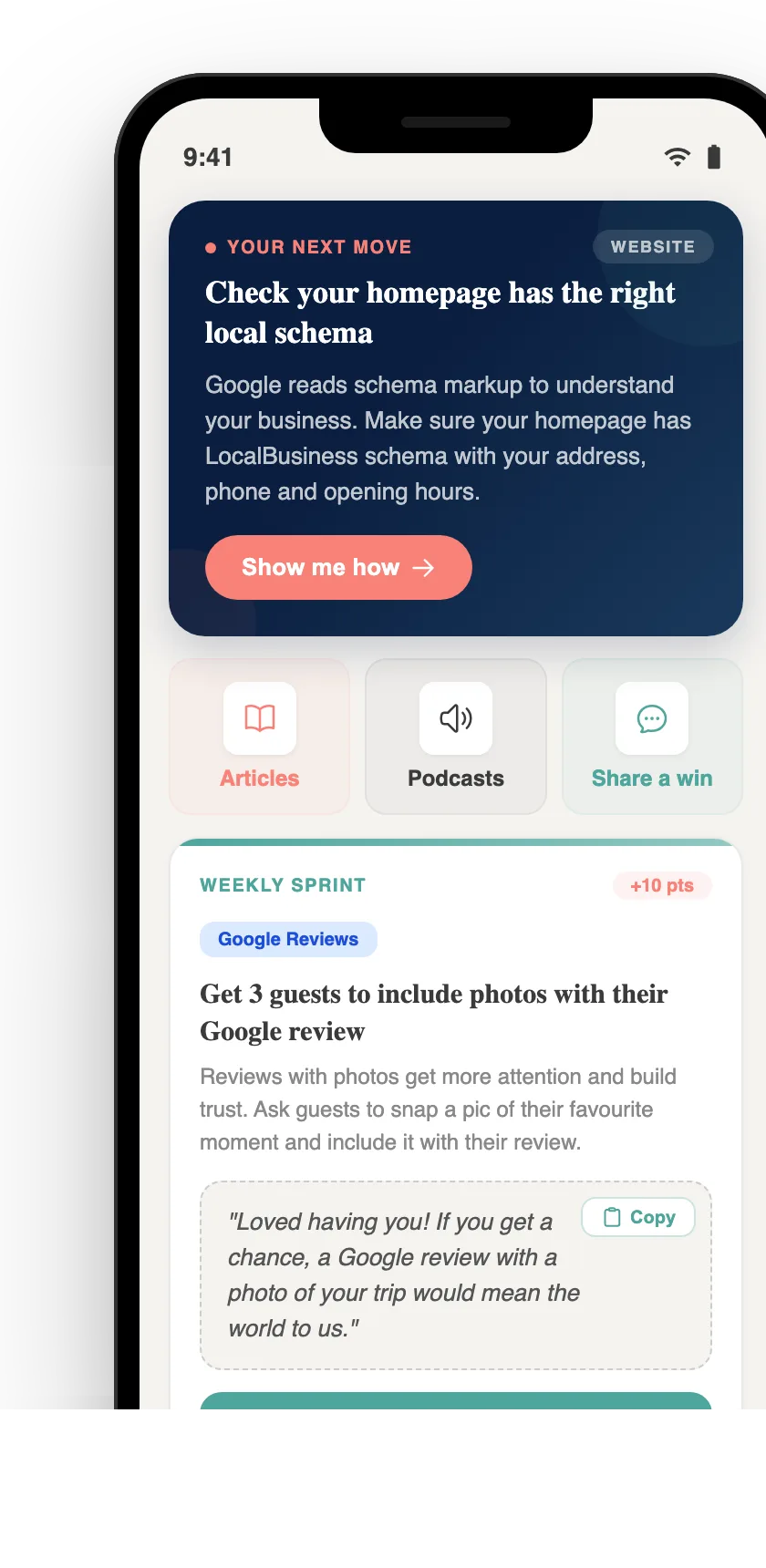
Your free AI marketing coach, right in your pocket
The free Pocket Rocket app gives you a personal AI marketing coach, website audit, weekly action plans and 5-minute tips. Built for tourism operators.