

Write in complete sentences with specific, concrete facts: durations, prices, named places, inclusions, start times. AI quotes passages it can extract cleanly from a page, and marketing adjectives give it nothing to extract.
When a traveller asks ChatGPT, Perplexity, or Google AI “whale-watching tours near Hervey Bay”, the AI does not just list websites. It pulls a passage from a trusted source and presents it as the answer. That passage needs to already exist on your page, clearly written and ready to lift. This post shows you exactly what that looks like.
Why does AI need quotable content?
AI tools like ChatGPT, Perplexity, Google AI Overviews, and Bing Copilot draw on indexed web content, their own training data, and real-time web searches to build answers. No single AI engine crawls your site live the way a person visits it. Google and Bing index your pages, and those same signals feed into AI-powered search results. The content quality, structure, and accuracy of your pages all affect how often AI tools cite you.
What AI is looking for is specific. It answers travellers with facts: how long a tour runs, what it costs, where it departs, what is included, how far from town. It pulls those specifics out of pages it trusts. “An unforgettable experience in a stunning location” gives it nothing to quote. “A 3-hour guided kayak tour of Sydney Harbour, departing Lavender Bay at 9am, $95 per adult, includes wetsuit and morning tea” gives the AI five facts it can lift and cite.
Pages built mostly from images, slogans, or vague praise give AI nothing to work with. You can appear in search results and still be invisible to AI if the substance is not there.
What does a quotable block actually look like?
A quotable block is a direct, well-formed answer to one specific question a traveller might ask. It sits under a clear heading that matches the question, and it is written in plain English with concrete details.
Here is the same cellar door written two ways.
Not quotable: “Our winery is located in the heart of one of Australia’s most celebrated wine regions, offering an unforgettable tasting experience in a breathtaking setting.”
Quotable: “Our cellar door is on Broke Road in Pokolbin, Hunter Valley, NSW. We offer seated tastings Tuesday to Sunday from 10am to 5pm. A standard tasting of six wines is $15 per person, redeemable against a purchase. Groups of 10 or more need to book ahead.”
The second version answers four questions a traveller might ask before deciding to visit: where is it, when is it open, what does it cost, do I need to book. The AI can quote any sentence from it accurately. The first version is invisible to a machine looking for information.
Why do adjectives give AI nothing to work with?
The most common content gap Tourism Tribe sees on tourism websites is marketing copy that praises without informing. “World-class”, “award-winning”, “iconic” cost nothing to write and give the reader nothing to act on. AI has the same problem with them.
The fix is to ask, for each sentence: what is the fact behind this claim? If you say your location is stunning, what specifically makes it stunning? The 270-degree ocean view from the dining deck, the position above the Noosa River, the proximity to the rainforest? Say that instead.
For every product page, make sure you have stated plainly:
- Duration (for example “3 hours”, “half day”, “2-night minimum”)
- Price per person, plus what is and is not included
- Start time and departure point, with a street address or landmark
- Group sizes (minimum and maximum if relevant)
- Who it suits: families, adults only, fitness level, age limits
- What to bring or wear
- Whether bookings are required and how to make them
These are the details AI extracts and cites. They are also exactly what a traveller needs before booking. If they exist only in your head or your booking system, AI cannot quote them.
How should I structure each page so AI can find the right section?
Headings are the structure AI uses to pull out answers. A page with no headings buries every fact inside one block of text. A page with clear, descriptive headings lets AI find the section that matches what the traveller asked.
Turn your likely customer questions into headings. Instead of “About our tour”, use “What is included in the tour?” Instead of “Location”, use “Where does the tour depart from?” These question-style headings match the way travellers speak to AI assistants, and AI retrieves and cites the section that directly answers the question.
Short paragraphs matter too. Two to four sentences per section is enough. Long unbroken blocks are harder for both people and machines to parse. Spelling and grammar errors also make a page harder to trust and harder to parse accurately.
Write as though for someone who has never heard of your business or your town. If your page assumes local knowledge (“just past the roundabout” or “near the well-known lagoon”), a traveller planning from Sydney or Singapore will not find what they need, and neither will AI.
Work through pages in this order of priority. First, your homepage and each individual product or tour page. Second, a dedicated FAQ page that answers the questions customers ask before booking. Third, customer reviews on the page and a full contact page with your address and phone number. Finally, regular fresh content such as blog posts (once a quarter is enough to keep the site from going stale). If you only reach the first two, you have covered what matters most.
How do I check my own site right now?
Open your homepage and your best-selling product or tour page. For each page, ask:
- If I read only the headings, do I understand what this business offers?
- Is there a price on this page, written as text?
- Does the page state a specific location, address, or landmark?
- Is the duration of the experience clearly stated?
- Is there a question a traveller would ask before booking that this page does not answer?
If the headings alone do not tell the story, add one clear descriptive heading per section. If there is no price, add it. If there is no address or specific location detail, add it.
If your pages are mostly images and short slogans, start writing. Three to five paragraphs per section, under descriptive headings, with the specific facts a traveller needs. This is owner-level writing and you do not need a developer.
For more on adding structured data so AI can read your facts even more reliably, see Schema Markup for Tourism: What Google Knows About Your Business.
Frequently asked questions
Does Google actually read my website content for AI Overviews?
Google indexes your pages and uses that indexed content to help build AI Overviews. ChatGPT, Perplexity, and Gemini draw on their own training data and, in some cases, real-time web searches. No single AI engine visits your site live the way a human does. The practical result: the same content quality and structure that earns good Google rankings also makes you a credible source for AI to quote.
How long should a product page actually be?
Long enough to answer every question a traveller would ask before booking, and no longer. For a single tour or experience, that is typically 400 to 600 words of real prose: an overview paragraph, a “What’s included” section, a “What to expect on the day” section with duration and departure details, a pricing section, and a short FAQ block. Pages under 200 words give AI nothing to work with.
What is the one change that will make the biggest difference this week?
Pick your most popular product or tour page and rewrite every vague sentence to carry a concrete fact: a duration, a price, a place name, or an inclusion. That single pass can meaningfully change how quotable the page is, and it takes less than an hour.
Should I put FAQs on product pages or on a separate FAQ page?
Both. A dedicated FAQ page is a useful central reference, but the FAQs most likely to get cited are the ones on each product page, directly below the experience they relate to. AI matches a question to the most relevant page. Our article on how to write FAQs for tourism websites covers how to write them so they convert and rank.
Will this work if my website is on Wix or Squarespace?
Yes. The writing advice here applies to any platform. The content itself (clear headings, factual paragraphs, FAQ sections) is what matters most for AI quoting. For platform-specific steps on adding schema markup, read this guide to schema and AI visibility.
Does improving content for AI mean ignoring regular SEO?
No. Content that is quotable for AI and well-structured for search is largely the same content. Specific writing under descriptive headings, with the facts travellers need, performs in both. If your SEO foundation is solid, making your content more factual builds on it.
Is your business showing up in AI search?
If you want to know how your business currently appears in tools like ChatGPT, Gemini, and Google AI Overviews, our GEO Assessment tests your real visibility and gives you a clear action plan. It covers your full online presence through the lens of AI search, for $395.
If you need a broader roadmap for where to focus your digital strategy, the Digital Direction Plan gives you a personalised plan built around where your business is today.
And if you want to work through these changes with ongoing support, AI Enablement Plans include fortnightly tech sessions and hands-on help with your website content and AI readiness.
Find out more about our AI services
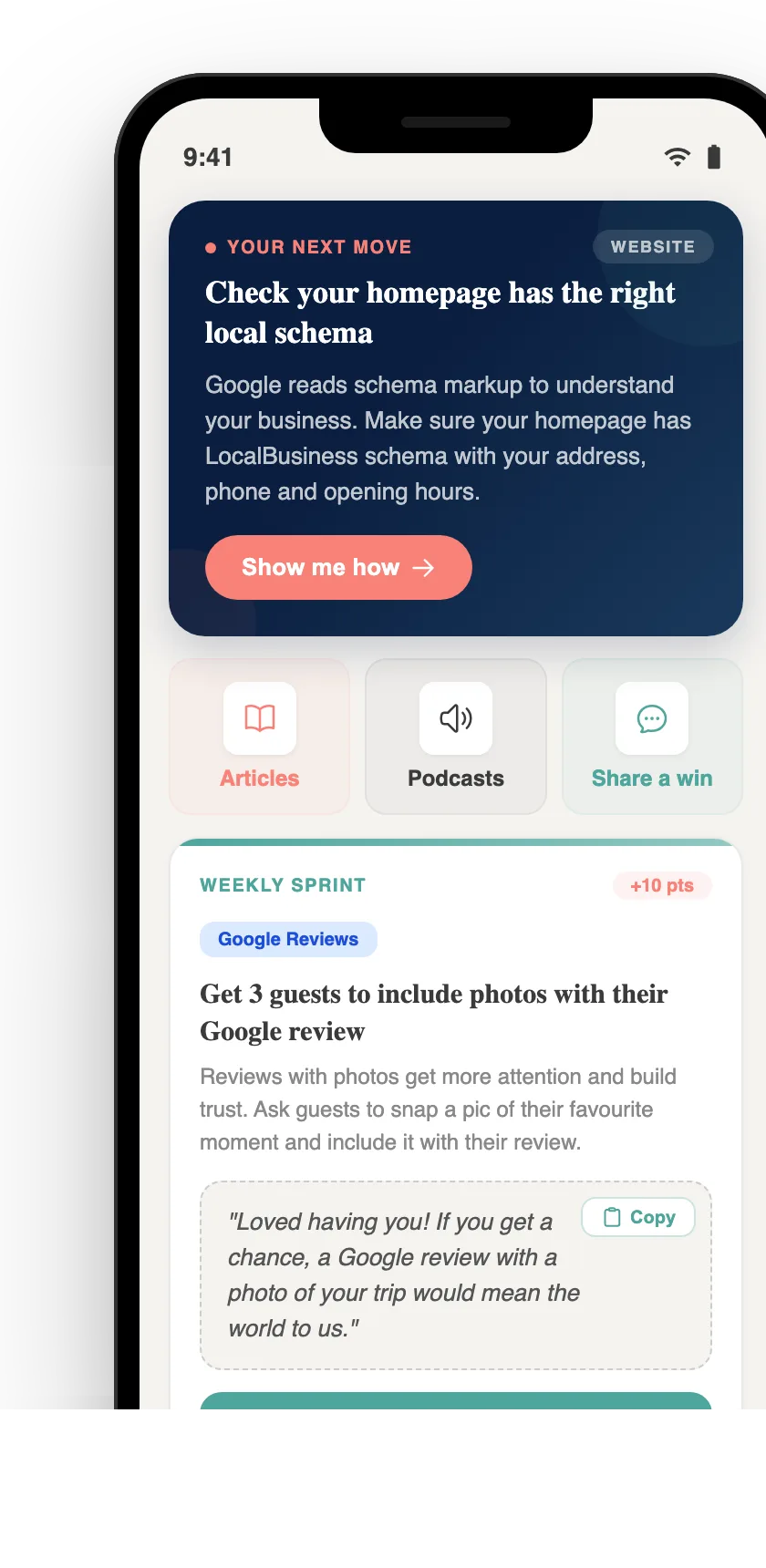
Your free AI marketing coach, right in your pocket
The free Pocket Rocket app gives you a personal AI marketing coach, website audit, weekly action plans and 5-minute tips. Built for tourism operators.