

Yes. Show your prices, and make sure they are written as plain text on the page. That is the format travellers can read and AI assistants can quote when someone asks how much your tour, tasting, or room costs.
Why do travellers and AI assistants both need to see your prices?
When someone types “how much is a wine tasting in the Yarra Valley” or “find me a day tour under $150 in the Whitsundays” into ChatGPT, Gemini, or Perplexity, the AI answers from prices it can read on your website. It does not ring you. It does not fill in a contact form. It reads text.
If your prices are not there as readable text, the AI does one of three things: it skips you, it guesses, or it quotes a competitor who published their prices. None of those outcomes leads to a booking.
There is a second audience too. Before most travellers enquire, they scan your website to check whether your pricing fits their budget. If they cannot see a number quickly, many do not ask. They move on.
Publishing prices removes a barrier for both audiences at once.
What format do my prices need to be in?
Format matters as much as the decision to publish.
Plain text on a page is what you want. A price typed directly into your website, “from $99 per person” or “standard room from $185 per night”, can be read by any AI assistant, any search engine, and any visitor.
An image of a price is effectively invisible to AI. A beautifully designed rate card saved as a JPG or PNG looks fine on screen, but AI sees an image file, not numbers it can read or quote.
A PDF rate sheet is better than an image, but still harder and less reliable for AI to find and read. AI tools often skip PDFs, so do not depend on one as your only pricing source.
Behind an enquiry form means no one can see the price before they contact you. Both travellers and AI assistants move on.
The fix is simple: type your prices directly into a page in your website builder or CMS. A dedicated pricing page, individual product or tour pages, or a text block in your booking widget all work. The price just needs to be readable text, reachable in one or two clicks from your homepage.
What if I am worried about showing my prices?
Two concerns come up most often.
The first is sticker shock. The worry is that seeing the price before understanding the value will put people off. But online, the traveller who cannot find your price does not wait to understand the value. They return to Google and find someone who published theirs. A “from $X” price with a short note on what is included gives context without a hard sell. It qualifies your visitors, so the enquiries you receive come from people who are already comfortable with your range.
The second concern is competitor visibility. Competitors can view your website whenever they choose. Your potential customers are the people who actually benefit from clear pricing. Keeping it from them costs you bookings, not an edge over rivals.
A “from” price plus a clear description of what is included will serve you better than an enquiry form and silence.
How does this look for different types of tourism businesses?
The principle is the same across sectors. The presentation varies.
For wineries and cellar doors, list each tasting tier with its price and note whether the fee is refunded or waived on a purchase. “Standard tasting (five wines) $15 per person, refunded on a six-bottle purchase” is the kind of text an AI can read and quote when a traveller asks about a wine-region day.
For breweries and distilleries, publish your tasting paddle prices and tap prices as text on your taproom or Visit Us page. If someone asks “how much is a four-beer paddle at this brewery”, the AI answers from what it can read.
For guided classes and workshops, list the price per person for each class, including any group or private-session rate and what is included. “$85 per person, all materials included” is specific, readable, and reassuring.
For transport and transfers, show fares by route, with per-person or per-vehicle pricing and one-way versus return. A traveller comparing transfer options wants those numbers before they make contact.
The same logic applies to tours, accommodation, and experiences of any kind. At minimum, publish a “from” price or a price range.
How do I check whether my prices are actually readable?
Two quick checks you can run right now.
The click-and-select test. Open your pricing or rates page, then try to click and drag your cursor over one of the prices. If you can highlight the number with your cursor, it is plain text and AI can read it. If you cannot select it, it is an image and AI cannot.
The Google index check. Open Google and type site:yourwebsite.com.au prices (replace the domain with yours, and try “rates” or “from” if that gets no result). If Google can find your prices in the search result preview, AI tools can too. If nothing comes back, your prices are not indexed.
If you do not have a pricing page at all, that is the first thing to add.
Should I also add pricing schema to my website?
Schema markup is code in the background of your page that tells AI and search engines exactly what your prices are. You do not need to start there, but it is worth knowing about.
Booking platforms like GetYourGuide mark up every tour listing as a schema.org Product with an AggregateOffer, a “from $X” price range, paired with ratings and reviews. That is partly why they appear so prominently when AI summarises options for a destination. You can do the same on your own website using Product and Offer schema: a plain Offer for a single price, or an AggregateOffer for a “from” price range when you have multiple tiers.
On WordPress, a plugin like RankMath can add Product schema to your tour and experience pages. Having both plain-text prices and schema is the strongest combination for AI discoverability.
For a deeper look at how schema works for tourism operators, see our guide to making your tourism business visible to AI agents using schema markup.
One important point that applies to schema and plain text alike: whatever price you publish is what an AI will quote back to travellers. A stale rate on the page becomes a wrong rate in the AI’s answer. Update your prices whenever your rates change.
Frequently Asked Questions
Does hiding my prices protect me from competitors?
Not in any practical sense. Competitors can view your website whenever they choose. Hiding prices mainly keeps them from travellers who are comparing options, and that works against your bookings.
What if my prices change seasonally?
Publish a price range (“from $X in peak season, from $Y off-peak”) or update your prices each season. The important thing is that there is always some readable text for an AI to work from. A stale price on the page is what the AI will quote, so keep it current.
Can I just say “call for pricing” or “enquire for rates”?
You can, but understand the cost. Visitors and AI assistants who cannot see a price tend to move on to operators who have published one. If your product genuinely requires a custom quote, such as large group charters or bespoke itineraries, pair “enquire for a quote” with a “from” price so visitors know the ballpark before they reach out.
What if my prices are inside my booking system?
If your booking system shows prices as text on the booking widget, AI and Google can often read them. Run the click-and-select test on the booking page to check. If prices appear only several steps into a booking funnel, add a “from” price as plain text earlier on the page so it is visible before a visitor commits to clicking through.
Do I need to list every single price for every product?
No. A “from” price or a price range for each product category is a reasonable minimum. The goal is that a visitor and an AI can both get a sense of your pricing without having to contact you first.
Does this help with Google search as well as AI tools?
Yes. Plain-text prices feed standard Google search results and Google AI Overviews, both of which draw from the same crawled content. A price written as text on your page improves your visibility across all of them. For a broader look at how AI search is changing tourism marketing, see what has changed and what to do.
Not sure where your website stands?
Run the click-and-select check on your pricing pages today. If you want a full picture of how AI tools see your entire online presence, Tourism Tribe offers three ways to help:
- GEO Assessment ($395): find out how visible your business is to AI tools right now, with a clear action plan to improve it
- Digital Direction Plan (from $170/month): quarterly strategy sessions, monthly monitoring, and a prioritised roadmap tailored to your business
- AI Enablement Plans: fortnightly AI and tech training sessions, tools, and expert support to keep you visible as AI search evolves
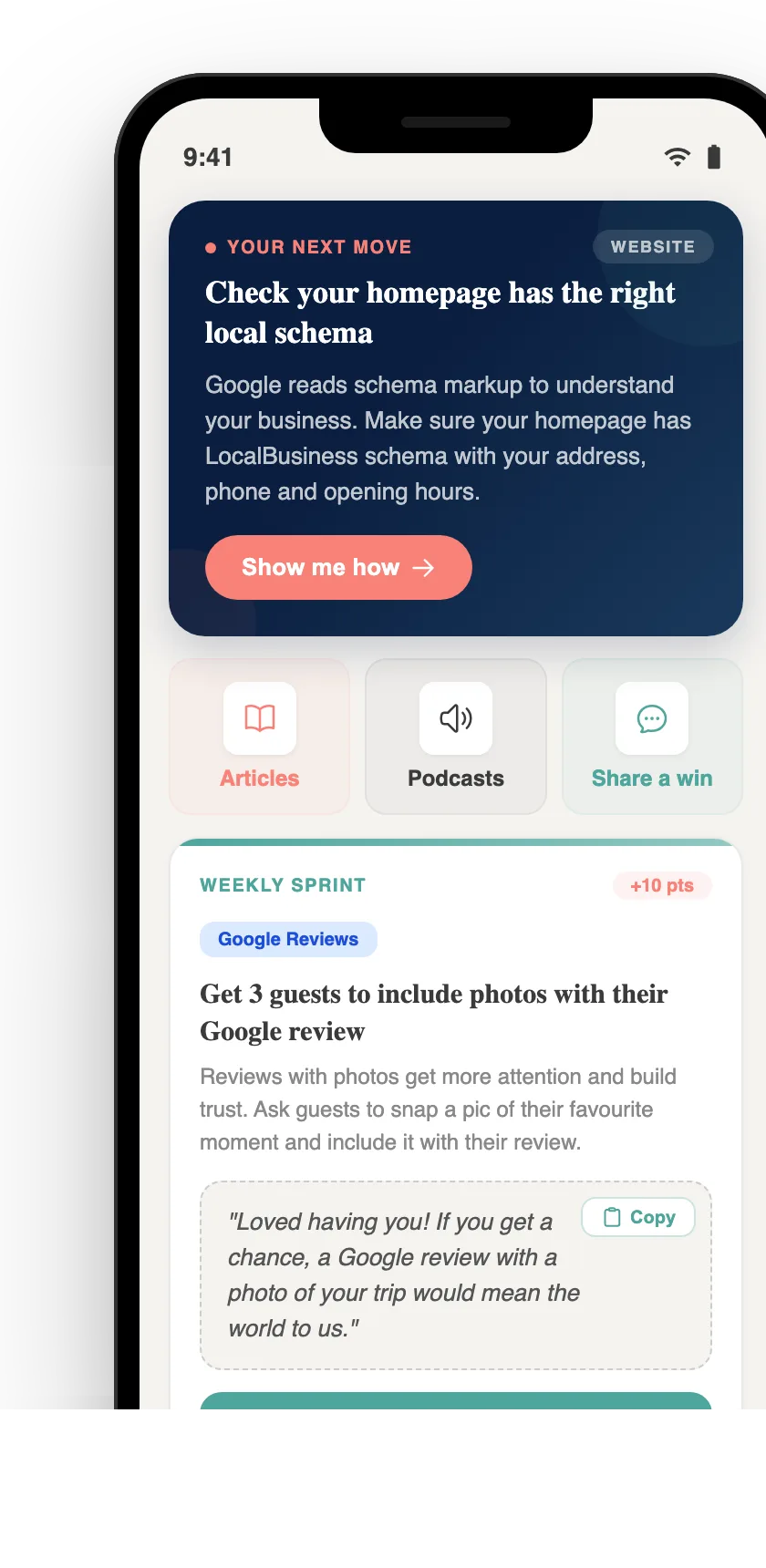
Your free AI marketing coach, right in your pocket
The free Pocket Rocket app gives you a personal AI marketing coach, website audit, weekly action plans and 5-minute tips. Built for tourism operators.