
Yes, and they need to be published as readable text inside your page content, not just embedded in a footer widget or saved as a screenshot. When real guest reviews appear as written text on your pages, AI tools like ChatGPT, Gemini, and Perplexity can read and quote them when a traveller asks which tour, accommodation, or experience is worth booking.
This is one of the fastest changes you can make to improve how your business shows up in AI search. Your Google Business Profile and TripAdvisor listing matter, but they are platforms you do not control. Your own website is the one place where you build exactly the social proof you want, in a format AI can use.
Why does it matter where the review lives?
Most AI crawlers do not run JavaScript. That means any review that loads through a third-party widget, a plugin, or a JavaScript-powered embed is invisible to them. The AI reads the raw page text and does not wait for code to execute.
A TripAdvisor badge in your footer, a Google review widget on your sidebar, or a social media embed carrying a guest quote: none of those are readable by the AI unless the text is also present in the page’s HTML. For the traveller scrolling your website with human eyes, the widgets look fine. For the AI deciding whether to recommend your experience, they count for nothing.
The fix is straightforward: publish the words. Type the review as real text into your page, alongside the reviewer’s first name and the date they visited. That text becomes part of your page content, readable by every tool that looks at it.
What counts as a review AI can actually read?
For a review to work as on-site social proof that AI can use, it needs three things:
- The text of the review, written as real content inside the page body (not an image, not a widget, not a shortcode that loads externally)
- The reviewer’s first name
- A recent date, ideally within the last 12 months
That last point matters more than most operators expect. A page full of 2021 testimonials reads as a business that may have gone quiet. A traveller’s AI assistant is trying to decide what to recommend right now. Fresh dates signal that people are still visiting, still enjoying the experience, and still taking the time to say so.
Aim for at least three reviews per page where you want social proof. One or two feels thin. Three or more starts to build a pattern the AI can work with.
Do my Google and TripAdvisor reviews still matter?
Yes, both platforms still count. AI tools do read Google Business Profile data and off-site review platforms when building their answers. A strong rating with a healthy review count on Google or TripAdvisor is a real signal.
The difference is control. You cannot edit your Google reviews or change the structure of your TripAdvisor listing. On your own website, you decide what the page says, how it is structured, and where the reviews sit relative to your booking call to action.
Think of your own site as the source you control, speaking directly about your specific products and experiences. The off-site platforms are important corroboration. Both working together is stronger than either alone.
Can I copy my Google reviews onto my own website?
Not word for word. Google treats the original review as living on its platform. Copying it verbatim to your own page risks a duplicate content issue that can affect your search visibility.
The better approach: use your Google and TripAdvisor reviews as a brief, not a copy-paste source.
Read through the things guests mention repeatedly. The wildlife sighting. The staff member who remembered their anniversary. The sunset timing on the evening tour. Those themes are the raw material for your own first-party content: testimonials you collect directly from guests, FAQ answers written in your own words, and product page copy that reflects what real guests say about the experience.
For a detailed breakdown of how to turn your review themes into AI-readable content, read Teach the AI: how organising your business info helps travellers find you.
Which pages should carry testimonials?
Not just the homepage. The homepage gets the most traffic, so a testimonials section there makes sense. But AI and search engines both read product and service pages, and that is where the match between the review and the experience matters most.
If you run a family tour and a couples retreat, the family testimonials belong on the family tour page and the couples ones belong on the couples page. A review praising the accessibility of your property belongs on the accommodation description page, not buried on the contact page.
Put each set of reviews where a traveller looking at that specific product or experience would find it most useful. That is also where AI looks when someone asks “is this tour good for families?” or “is this property accessible?”
How do I collect first-party testimonials?
The simplest method is a single sentence in your post-experience thank-you email: “If you have a few words to share about your visit, we would love to hear them.” Include a short link to your Google review page if you want public reviews, or invite them to reply directly if you want to collect private testimonials for your website.
The ones that work best are those that name a specific moment. Not “great experience, would recommend” but “the guide spotted a whale shark at 7am and stayed an extra hour so we could all see it.” That specificity is what reads as credible to both people and AI, and it is what convinces other travellers that this is a real account of a real visit.
Get permission before you publish any testimonial on your website. A quick “would you mind if we shared this on our tour page?” in reply is enough. Keep a record of that permission.
Check your own site right now
Open one of your key product or tour pages and ask:
- Are there at least three guest reviews written as actual text on this page?
- Does each one include a first name and a date from the last 12 months?
- If you viewed the raw page text rather than the designed version, would you be able to read every word of every review?
If the answer to any of those is no, that page has a gap. It is not a difficult gap to fix: you need the words on the page, in readable text, with a name and a date.
Frequently Asked Questions
Do I need a plugin or special design block to add testimonials?
No. A simple testimonials section built with your existing website editor is enough. The requirement is that the text lives in the page body as readable content, not that it comes from a special plugin. A heading, the quote, the reviewer’s first name, and the month and year is sufficient.
Can I use a screenshot of a review instead of typing it out?
No. A screenshot is an image. AI crawlers read text, not images. The words inside a screenshot are invisible to search engines and AI tools alike. Type the review out as real text.
How many reviews do I need per page?
Aim for at least three per page where you want social proof to land. One or two reads as sparse. Three or more starts to form a pattern. More is better, as long as the dates stay recent.
What if my reviews are more than a year old?
Older testimonials are not worthless, but recent ones carry more weight with AI. Make it a habit to add fresh reviews every few months. If your only testimonials are from 2022 or earlier, prioritise collecting new ones before the end of the current season.
Can I republish TripAdvisor reviews on my own site?
TripAdvisor’s terms limit how their review content can be reproduced. Do not copy reviews from TripAdvisor to your own site without checking their current syndication terms. The cleaner route is to collect first-party testimonials directly from your guests.
What is Review schema and should I add it?
Review schema (also called AggregateRating schema) is a small piece of structured data code that tells search engines your page includes reviews with a rating. Adding it gives Google the information it needs to potentially show your star rating directly in search results alongside your listing. It is worth implementing on product pages, but it works as a layer on top of having the review text present in the page content. Schema alone, without the real reviews also written as text, does not carry much weight.
Want help getting this right across your whole site?
On-site reviews are one piece of the picture. Getting your full digital presence AI-readable, from your Google Business Profile to your structured data to the way your product pages are written, is what the GEO Assessment covers. It audits your entire online presence through the lens of generative AI and gives you a clear action plan for exactly what to fix.
If you want ongoing support, the Digital Direction Plan gives you a dedicated strategist watching your digital presence every month and meeting with you quarterly to work through priorities like this one. AI Enablement Plan members get access to regular tech training sessions covering AI search optimisation, with practical support from the Tourism Tribe team.
Start with what you can do today: open one product page and add three real guest reviews as text. Name, quote, date. That one change, on one page, improves what AI reads about your business from this moment forward.
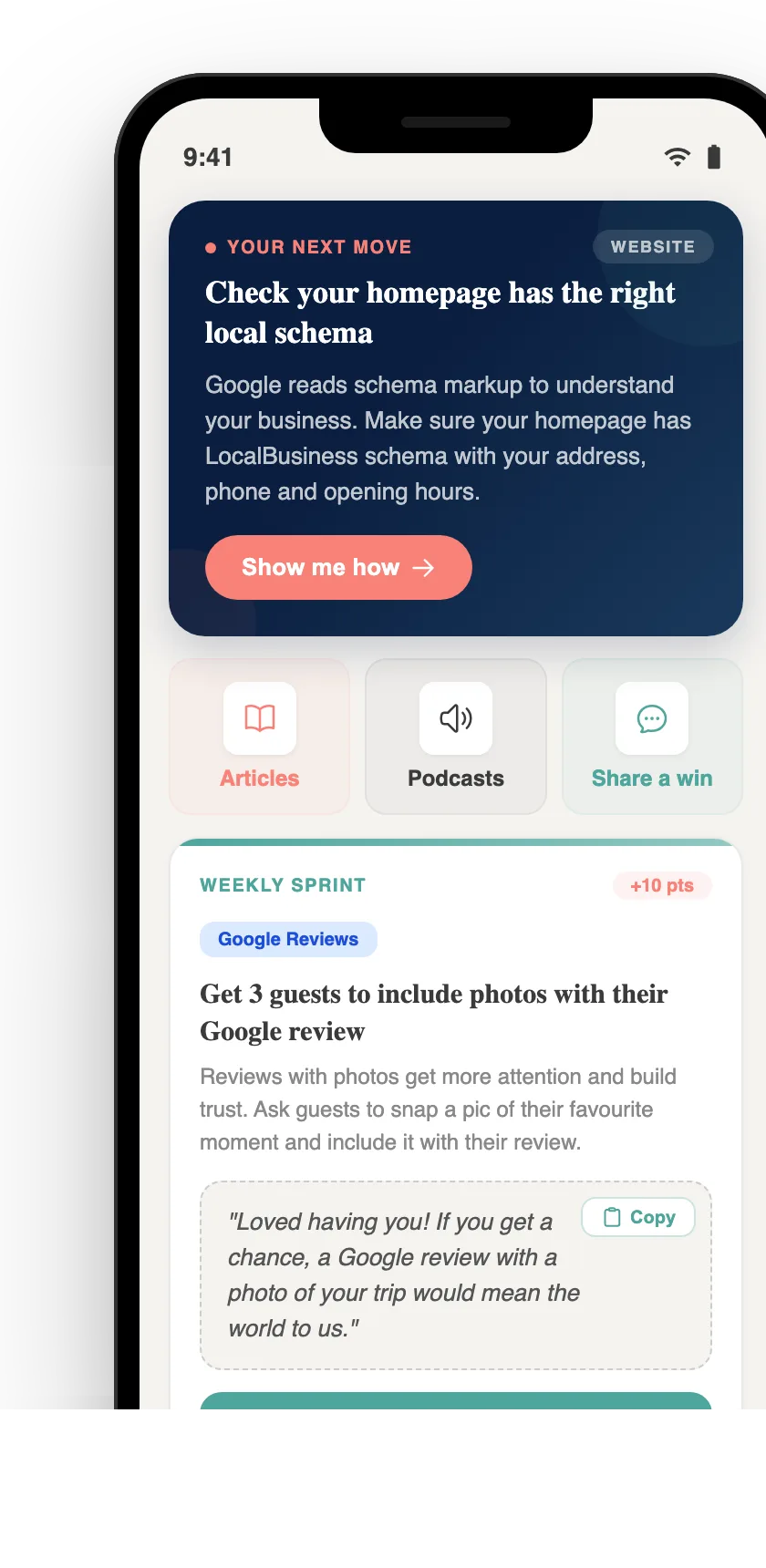
Your free AI marketing coach, right in your pocket
The free Pocket Rocket app gives you a personal AI marketing coach, website audit, weekly action plans and 5-minute tips. Built for tourism operators.