
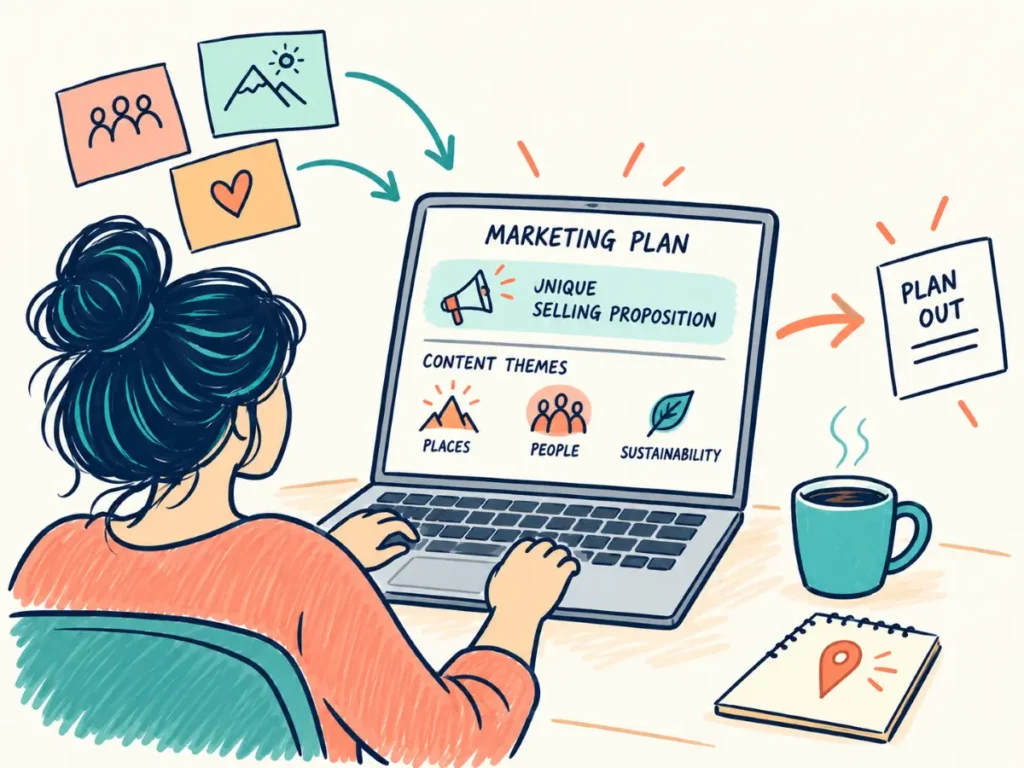
Most tourism marketing plans were built before AI became part of how travellers search and choose. The fundamentals haven’t changed but where you need to show up has. Is it time you refreshed your business’s marketing plan? In this article demonstrate how our Custom GPT, Tourism Marketing Mate, can help tourism operators create a simple marketing plan in minutes complete with your unique selling proposition, core key messages, content themes for social media, a digital presence priority table, and a four-week social media schedule with post ideas, sample captions, and calls to action. This article is an overview of a recent Tourism Tech Session run for our members so we’ve dropped in a few extra juicy bits of advice for tourism operators about improving your Google Business Profile and reviews that were discussed during the session. Read on to learn more.
Quick links
- Watch the recording
- What are Tourism Tech Sessions?
- How AI has changed the way visitors find your business
- What custom GPTs are and how to use Tourism Marketing Mate
- Tourism Marketing Mate in action: a live walkthrough
- Getting social media content when you’re stretched for time
- Google Business Profile: reviews, ratings, and your ranking
- Things to try this week
Watch the recording
Members will see the replay when logged in. Log in here.
What are Tourism Tech Sessions?
Our Tourism Tech Sessions are twice monthly group coaching calls designed to support AI Enablement Plan members, whether you’re a direct member or a participant of one of our tourism digital capability programs. These sessions provide a space to:
- Learn the latest developments in tourism tech
- Ask questions in a safe, supportive environment
- Hear real-life examples and get practical demos
- Get the confidence to implement what you’ve learned
If you’re not a member, this article will walk you through the key takeaways. Join an AI Enablement Plan to access future Tourism Tech Sessions and have an expert at your fingertips to ask your business-specific questions.
How AI has changed the way visitors find your business
Visitors used to type a query into Google, scan the results, and click a link. That path now competes with a different one: someone asks ChatGPT or Gemini to suggest a place to eat in a regional town, and the AI surfaces a recommendation directly. The criteria that determine which businesses appear have also changed.
Search engine optimisation fundamentals still matter. Clear headings, accurate information, and fast-loading pages remain relevant. What has changed is the weight given to structured data and fact-based content. AI systems read your website to extract specific claims: your location, opening hours, what makes your experience distinctive, dietary options, accessibility features. Vague descriptions and pure aesthetic copy are hard for machines to process. Concrete, specific, factual content is not.
Your Google Business Profile has never been more important. LLMs draw on it directly for recommendations, and Google’s own AI is building toward a universal cart where visitors can book through a Google agent without visiting your website. An accurate, active profile with current hours, recent photos, regular update posts, and responses to every review makes your business readable and credible to both humans and AI systems. The point of social media has also changed: for small tourism businesses, it now functions more as validation than discovery. Showing what actually happens in your business carries more weight than polished aesthetic posts.
What custom GPTs are and how to use Tourism Marketing Mate
A custom GPT is a version of ChatGPT that has been pre-loaded with a specific set of instructions and prompts. Where a standard ChatGPT conversation starts blank each time, a custom GPT starts with a defined purpose: it knows what it’s there to do, what questions to ask, and what output to produce. Tourism Tribe has built several custom GPTs specifically for operators, including one for optimising your Australian Tourism Data Warehouse (ATDW) profile.
To access custom GPTs, open ChatGPT, click More, then GPTs. This opens a library where you can search for specific tools. Type “tourism marketing mate” to find the Tourism Tribe GPT. It’ll say it’s by Digital Coaching International – that’s our parent company – so you’ll know you have the right one. You can also find publicly available GPTs here, since the ChatGPT interface and menus are changing so often at the moment we wouldn’t be surprised if it has moved by the time you read this article. Again, search for “tourism marketing mate” to find our GPT.
You can use custom GPTs on a free ChatGPT account, but free accounts are limited to five prompts per day. A paid account removes that limit and gives you the ability to create your own custom GPTs. If you have a paid account, the Tourism Tribe custom GPTs are also listed under your account’s GPT library.
The underlying principle to creating anything of quality with AI is worth understanding before you use any AI planning tool. The output is only as good as the input. The AI can research your website, read your reviews, and identify proof points, but it cannot know what you value, what you want for your business, or what kind of customers you most want to attract. That context has to come from you. Bringing your own lived experience and business vision to an AI tool is what separates it from generating a useful output instead of a generic one.
Tourism Marketing Mate in action: a live walkthrough
To use Tourism Marketing Mate, open it in ChatGPT (a free account works). Give it your business name and your website URL, then describe in a few sentences what makes your experience distinctive: your setting, your guests, what you offer that a competitor nearby does not. That is the full input. The tool researches your public presence: your website, Google Business Profile, listings, and reviews. It uses everything it finds alongside what you told it to build the plan.
The output takes a few minutes and starts with a positioning statement drawn from what your business already says about itself. In the session, the tool identified specific proof points from a regional cafe’s public presence (alfresco dining, ethically sourced produce, accessibility features, warmth noted in reviews) and proposed a unique selling proposition that was distinctive rather than generic. Your plan will reflect your own business in the same way: the more complete your online presence, the more specific the output.
The marketing plan output included:
- Core key messages: the consistent claims the business repeats across every channel
- Seven content themes for social media, each anchored to an emotional or experiential angle (the warm landing point, lunch dishes rather than just coffee, the welcome from the team, what a real visit looks like, seasonal change, local knowledge, and guest stories)
- A digital presence priority table covering website, Google Business Profile, review platforms, destination listings, and social media, ranked by urgency
- A four-week social media schedule: two posts per week, with suggested platform, post purpose, sample captions, and calls to action
A few years ago, producing this level of marketing planning for a client took days and cost thousands of dollars. The same output now takes a single session with the right inputs. The tool can also go further: describe your ideal customers, and it will define target market segments and build customer personas to add to the plan.
Getting social media content when you’re stretched for time
Producing a social media plan is the straightforward part. The harder challenge for most tourism and hospitality operators is the content itself: the photos, the short videos, the real-life moments that make social media posts worth seeing. This came up directly during the session, particularly for hospitality businesses where the team is on the floor during service and there’s no time to stop and film.
One approach that works for restaurants and cafes: invite a group of regular local customers in for a hosted tasting session. You cover the food and set the scene. In exchange, participants sign a talent waiver giving you permission to use any photos or videos taken during the event. Brief a photographer to capture a library of B-roll video and stills: guests arriving, food being plated, the team in action, the space during service. Done twice a year, this builds a content bank you can draw on for months of reels, carousels, and static posts.
On top of that base, keep capturing moments on the fly: a kitchen shot, a table in the late afternoon light, a quick clip of the specials board. The planned content day provides the polish; the candid shots provide the authenticity. Both matter.
Google Business Profile: reviews, ratings, and your ranking
Google’s algorithm for how it ranks businesses in local search and AI recommendations considers four main factors: the rating, the number of reviews, the recency of reviews, and whether the business responds to reviews. A business sitting at 4.0 with 1,200 reviews is not in a hopeless position, but the goal should be a phased improvement: 4.2 first, then 4.5 over twelve months. A rating of 4.5 is a meaningful threshold.
Getting more reviews from repeat customers is a common question. Google does not allow the same account to review a business twice, but other members of a travel party or dining group can each leave their own review. Research shows that 70% of people who are asked directly to leave a review will do so. A direct, personal ask at the end of a meal, in a follow-up message, or when guests are checking out, produces a much higher response rate than a sign at the counter or a line in a newsletter.
The most effective strategy for managing a lower-than-ideal rating is managing expectations before the negative experience occurs. If your venue gets busy on public holiday weekends, prepare guests for that when they book. If your food takes time because it’s made to order, say so. Every review that starts with a mismatch between expectation and reality is a review you could have prevented.
Things to try this week
- Open ChatGPT and search for Tourism Marketing Mate: go to More, then GPTs, and type “tourism marketing mate” in the search bar. Bookmark the link so you can come back to it.
- Run Tourism Marketing Mate for your own business: give it your business name, website URL, and a sentence about what makes you distinct. Read the output against what you know about your business and note what it gets right and what it misses.
- Audit your Google Business Profile: check that opening hours are current, that photos were added in the last 90 days, and that every review from the past three months has a response. These are the factors the algorithm weighs most heavily.
- Plan a content day: identify a quiet week in the next two months where you could invite a small group of regulars in, cover a meal, and get a photographer to capture B-roll and stills for the next six months of social media posts.
- Set a phased review rating goal: if you’re below 4.2, write down what you’ll do differently to ask for reviews (face-to-face ask at the end of a visit, a follow-up message, a check-in email). Track your rating monthly.
Want to get your tourism business found by more visitors?
AI has changed how visitors discover tourism businesses, and a clear, specific marketing plan is the first step to staying visible. Tourism Tribe offers three ways to help:
- GEO Assessment: find out how visible your business is to AI tools right now
- Digital Direction Plan: a personalised roadmap for your digital and AI strategy
- AI Enablement Plans: ongoing access to Tourism Tech Sessions, tools, and hands-on support
What is a custom GPT and how is it different from regular ChatGPT?
A custom GPT is a version of ChatGPT pre-loaded with a specific set of instructions, prompts, and a defined purpose. Where a standard ChatGPT conversation starts blank, a custom GPT starts already knowing what it is designed to do. Tourism Tribe has built custom GPTs specifically for tourism operators, including one for optimising ATDW profiles and another for building marketing plans.
Do I need a paid ChatGPT account to use Tourism Marketing Mate?
No. You can access Tourism Marketing Mate on a free ChatGPT account by searching for it under GPTs. Free accounts are limited to five prompts per day. A paid account removes that limit and also gives you the ability to create your own custom GPTs.
What does Tourism Marketing Mate produce for my business?
Tourism Marketing Mate researches your website, listings, and reviews, then generates a practical marketing plan. The output typically includes a suggested unique selling proposition, core key messages, content themes for social media, a digital presence priority table, and a four-week social media schedule with post ideas, sample captions, and calls to action. You can extend it further by describing your ideal customers, and it will define target market segments and build customer personas.
authenticity.
How do I improve my Google Business Profile rating?
Google’s algorithm weights four main factors: your current rating, the number of reviews, how recent they are, and whether the business responds to them. Set phased goals (4.2 then 4.5) rather than trying to jump to 5.0. Ask guests directly for reviews at the end of a visit or in a follow-up message. Research shows 70% of people who are asked directly will leave a review. Manage expectations before the experience to reduce the gap between what guests expect and what they find.
How has AI changed how tourists find businesses online?
AI tools like ChatGPT and Gemini now answer travel questions directly with confident recommendations, bypassing traditional search results for many queries. Businesses that appear in those recommendations tend to have accurate, fact-based content on their websites with structured data, active and well-maintained Google Business Profiles, and strong review volume and recency. Vague or purely aesthetic content is harder for AI to process and less likely to be surfaced.
How do I get regular social media content when I am too busy to film during service?
Plan a dedicated content day once or twice a year. Invite a small group of regular local customers in for a hosted experience, have them sign a talent waiver, and brief a photographer to capture B-roll video and stills. This builds a content bank you can draw on for months of posts. Between those planned sessions, keep capturing candid moments on the floor. The planned content provides polish; the candid shots provide
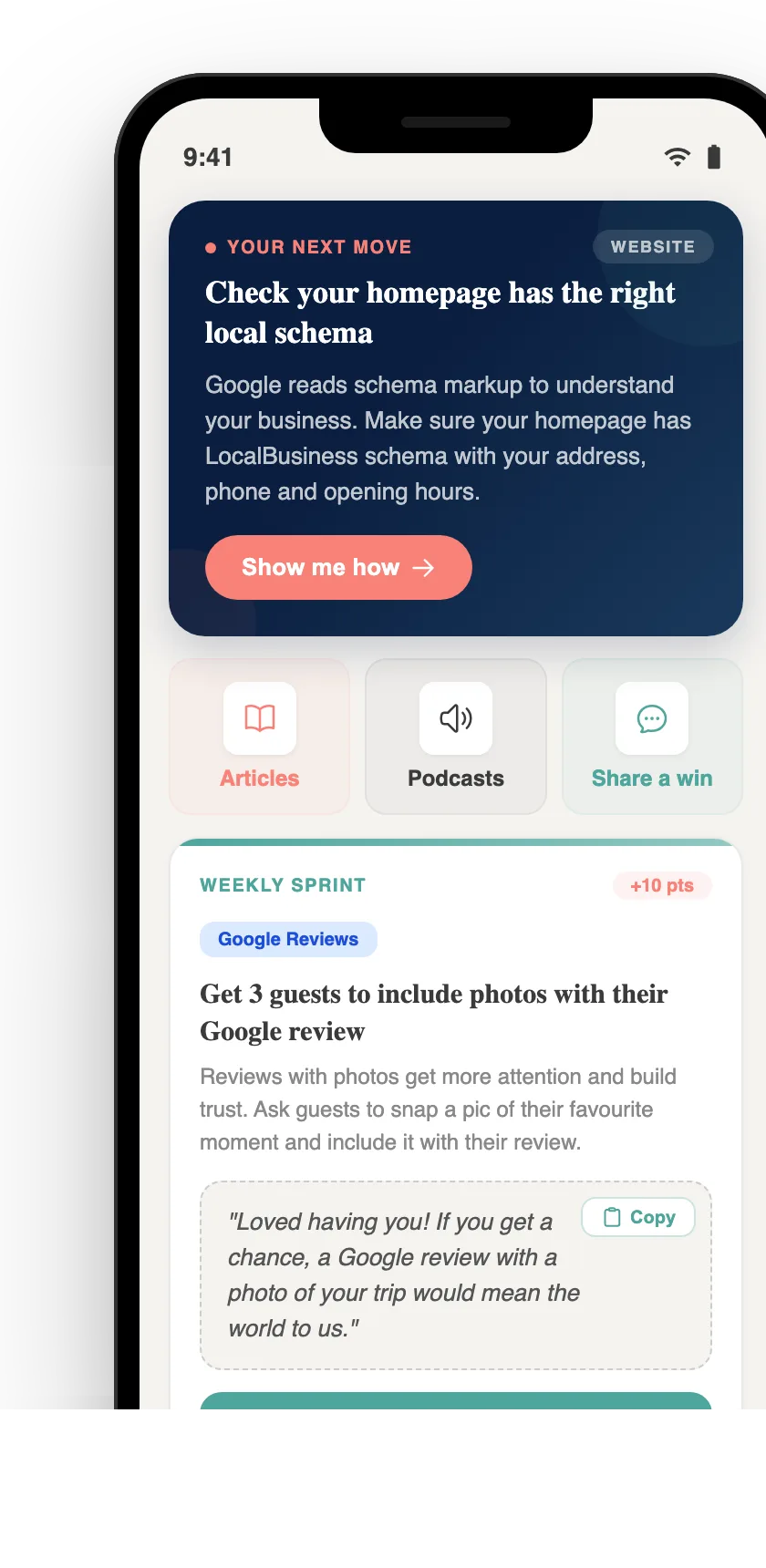
Your free AI marketing coach, right in your pocket
The free Pocket Rocket app gives you a personal AI marketing coach, website audit, weekly action plans and 5-minute tips. Built for tourism operators.