QUICK LINKS:
- The short answer: both, for different jobs
- What the research says about OTA citations
- Training versus live search: two ways AI reads the web
- What each OTA lets AI bots read
- Why your own website still decides the answer
- What to do this month
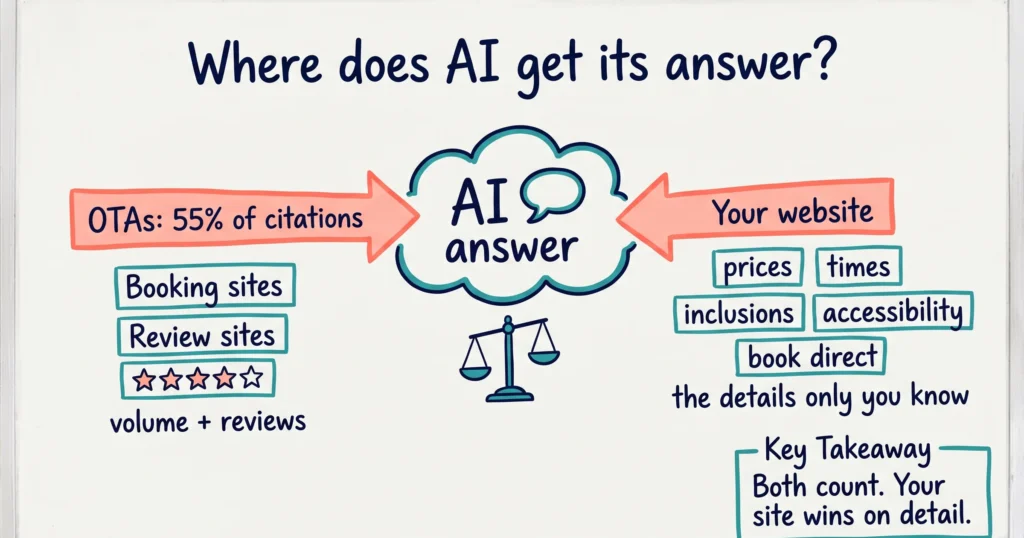
AI tools take tourism information from both OTAs and your own website, and OTAs supply more of it. In Cloudbeds’ study of ChatGPT, Perplexity and Gemini hotel recommendations, 55.3% of all sources cited were OTAs such as Tripadvisor, Booking.com and Expedia. Hotel websites made up over 13% of citations.
That doesn’t make your website optional. OTAs tell AI tools you exist and what guests think of you. Your website is where AI finds the details OTAs don’t carry: your exact tours, your policies, your story and your direct booking link.
Here’s what the evidence says, what each OTA lets AI bots read, and what to do about it.
The short answer: both, for different jobs
AI tools build an answer from several sources at once. Each source plays a different role.
- OTAs and review sites prove you’re real and popular. They carry ratings, review counts, prices and availability.
- Google Business Profile and map listings confirm your name, location, hours and phone.
- Your website supplies the specifics: what’s included, who it suits, departure times, accessibility, cancellation terms.
- Third-party mentions (travel blogs, media, your regional tourism site) add independent proof.
When the sources agree, AI tools recommend you with confidence. When they conflict, AI tools hedge, or recommend whoever’s information is clearer.
What the research says about OTA citations
The best data so far comes from hotels. Cloudbeds analysed 145 consistently top-ranked properties across six global destinations using hundreds of automated queries in ChatGPT, Perplexity and Gemini (Hospitality Net, June 2025).
- 55.3% of sources cited were OTAs, with Tripadvisor, Booking.com and Expedia leading.
- Hotel websites made up over 13% of citations, according to Sojern’s write-up of the same study (Sojern).
Two caveats. The study covered hotels in major global destinations, not tours or regional Australian operators. And AI search changes fast. A September 2026 analysis by Peec AI argues ChatGPT now draws on OpenAI’s own index plus several outside data providers, with Tripadvisor and Yelp among its licensed local partners (Peec AI).
The OTAs also sit inside ChatGPT now. Expedia and Booking.com run as apps within ChatGPT and handle the booking itself (Tourism Tribe).
The direction is clear: OTAs are the loudest voice in AI travel answers. They aren’t the only one.
Training versus live search: two ways AI reads the web
AI tools learn about your business in two separate ways. Knowing the difference explains a lot.
Training. Companies like OpenAI and Anthropic send crawlers (GPTBot, ClaudeBot) to collect web pages. Those pages become part of what the AI model “knows” before anyone asks a question. Training data is months old by the time you see it.
Live search. When a traveller asks a current question, tools like ChatGPT search and Perplexity send a different bot (OAI-SearchBot, ChatGPT-User, PerplexityBot) to read pages right then. These answers show citations you can click.
Travel questions about dates, prices and availability need current information, so AI tools answer them with live search. That’s why the pages a search bot can reach matter so much. For more on the bot types, read three types of AI bot and which one decides if AI recommends you.
What each OTA lets AI bots read
Every website publishes a robots.txt file telling crawlers what they may read. We checked three on 23 October 2026.
Booking.com (robots.txt) has no AI-specific rules. AI crawlers follow the same rules as everyone else, and property pages are open.
Tripadvisor (robots.txt) blocks the training crawlers completely, including GPTBot, ClaudeBot and Google-Extended. It allows the live search bots: ChatGPT-User, OAI-SearchBot, Gemini-Deep-Research and PerplexityBot.
Airbnb (robots.txt) blocks GPTBot, ClaudeBot and Applebot-Extended. It allows OAI-SearchBot and PerplexityBot onto listing pages, but tells OAI-SearchBot to stay off each listing’s reviews, photos, amenities and location pages.
What that means for you: OTAs decide what AI sees of your listing on their platform. You decide what AI sees on your own website. Check your own robots.txt (yourwebsite.com.au/robots.txt) and make sure you aren’t blocking the search bots by accident.
Why your own website still decides the answer
OTAs win on volume. Your website wins on detail, and detail is what a specific traveller question needs.
A traveller asks ChatGPT: “Is there a wheelchair-accessible whale watching tour from Hervey Bay that leaves after 10am?” Booking.com doesn’t hold that. Tripadvisor reviews might mention it. Your tour page, if it says “wheelchair accessible, ramp boarding, departs 10.30am daily, July to October”, answers it outright.
Our 15 FAQs for DMOs put it this way: AI tools currently favour OTAs because OTAs have better structured data, more reviews and more consistent information. Fix those three things on your own site and you compete.
Your website also does three jobs no OTA does for you:
- Verification. AI tools cross-check facts. Your site is the official version.
- Direct booking. If AI cites your site, the traveller lands on your booking page, not a commission page.
- Your story. Why you started, who guides the tour, what makes it different. OTAs don’t carry it.
Hypothetical example: a family-run kayak tour company in Tasmania has 300 reviews on Tripadvisor and a website that says “Contact us for prices”. ChatGPT recommends them, and cites the Tripadvisor page. They add tour pages with prices, inclusions, times and an FAQ, plus live booking. Now the same answer cites their own tour page with a link to book.
What to do this month
- Run the test. Ask ChatGPT, Gemini and Perplexity three questions a guest would ask about your type of experience in your region. Click every citation. Count how many are OTAs, how many are your site.
- Write one page per product. Name, price, duration, departure times, inclusions, who it suits, accessibility, cancellation policy. See how to write website content AI can quote.
- Add an FAQ with the real questions guests ask you by phone and email.
- Make it bookable. “Enquire now” loses to “book now” in AI answers. Read do I need real-time online booking.
- Match your OTA listings to your website. Same name, same prices, same hours, same description facts. Conflicting data is the fastest way to lose an AI recommendation.
- Keep your OTA listings. They’re a source AI trusts. Respond to reviews, keep photos current, keep availability live.
Frequently Asked Questions
Do AI tools trust OTAs more than my website?
They cite OTAs more often. In Cloudbeds’ hotel study, 55.3% of sources cited by ChatGPT, Perplexity and Gemini were OTAs, and hotel websites were over 13%. OTAs win on review volume and structured data. Your website wins when it holds specific facts the OTAs don’t.
Should I stop using OTAs to rank better in AI search?
No. OTA listings are one of the sources AI tools trust most, and Expedia and Booking.com now run as apps inside ChatGPT. Keep your OTA listings accurate and build your own website alongside them.
Can ChatGPT read my Booking.com or Tripadvisor listing?
Yes, through live search. Booking.com has no AI-specific crawler rules. Tripadvisor blocks AI training crawlers but allows ChatGPT’s search bots. Check what each platform allows, because they set the rules for your listing on their site.
Why does ChatGPT link to an OTA instead of my website?
Usually because the OTA page answers the question better. It has prices, reviews and availability in a format AI reads easily. Add the same facts, plus details only you know, to your own product pages and make them bookable.
How do I check which sources AI uses for my business?
Ask ChatGPT, Gemini and Perplexity the questions your guests ask and click the citations in each answer. Note which are OTAs, review sites, listings or your own site. Repeat every three months to track the change.
Conclusion
AI tools use OTAs and your own website, and right now OTAs supply more of the citations. Keep your OTA listings sharp, because AI trusts them. Then make your own website the most complete, bookable source on your products, and run the citation test this month to see where you stand.
Your free AI marketing coach, right in your pocket
The free Pocket Rocket app gives you a personal AI marketing coach, website audit, weekly action plans and 5-minute tips. Built for tourism operators.