Quick links
- Why your Airbnb listing doesn’t carry your name into AI search
- What AI bots are allowed to read on Airbnb
- Build a page AI tools read in full: your own website
- Get your property listed everywhere else under the same name
- Move your best reviews somewhere AI reads them
- Test what AI says about you today
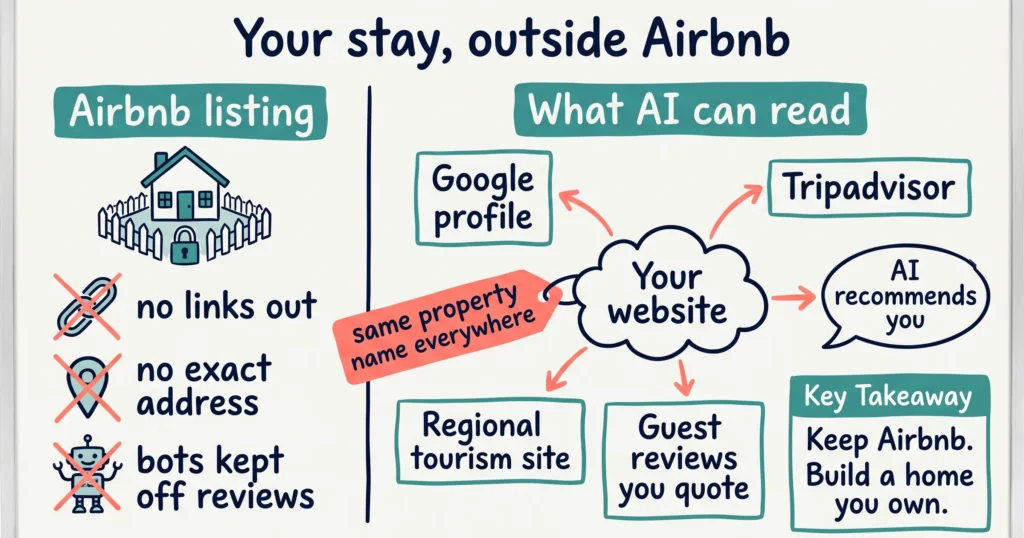
Keep your Airbnb listing, and build a presence outside it. Your Airbnb listing belongs to Airbnb. It has no link to your website. It hides your street address until a guest books. And Airbnb tells six named AI training bots to stay out of the whole site. To get seen by AI tools, you need your own website and matching listings elsewhere, all under one property name.
You don’t have to leave Airbnb to do this. You need a second home for your business that you control.
This guide shows what AI bots are allowed to read on Airbnb today, and what to set up outside it.
Why your Airbnb listing doesn’t carry your name into AI search
AI tools recommend businesses they recognise. Our advice to every operator: give AI a name, a location and facts that match across several sources. Airbnb strips most of that out.
- No links out. Airbnb’s policy bans “links in listing pages or messages that take people off of the Airbnb platform” (Airbnb policy). Your listing won’t point an AI tool, or a guest, to your own site.
- No street address before booking. Airbnb says “the numerical street address will not be shared until the guest’s reservation is confirmed.” Before that, the map shows either a pin or an approximate area, depending on your setting (Airbnb help).
- No contact before booking. Airbnb’s policy says “all communications prior to booking must be on Airbnb.”
Airbnb set it up this way so bookings stay on Airbnb. The side effect: when ChatGPT reads your listing, it sees a nice cottage near a town. It doesn’t see a named business it finds again anywhere else.
What AI bots are allowed to read on Airbnb
Airbnb publishes a file called robots.txt. It tells each crawler which pages to stay out of. We read Airbnb’s Australian file on 23 October 2026 (airbnb.com.au/robots.txt). It treats AI training bots and AI search bots differently.
Six training bots: blocked from the whole site
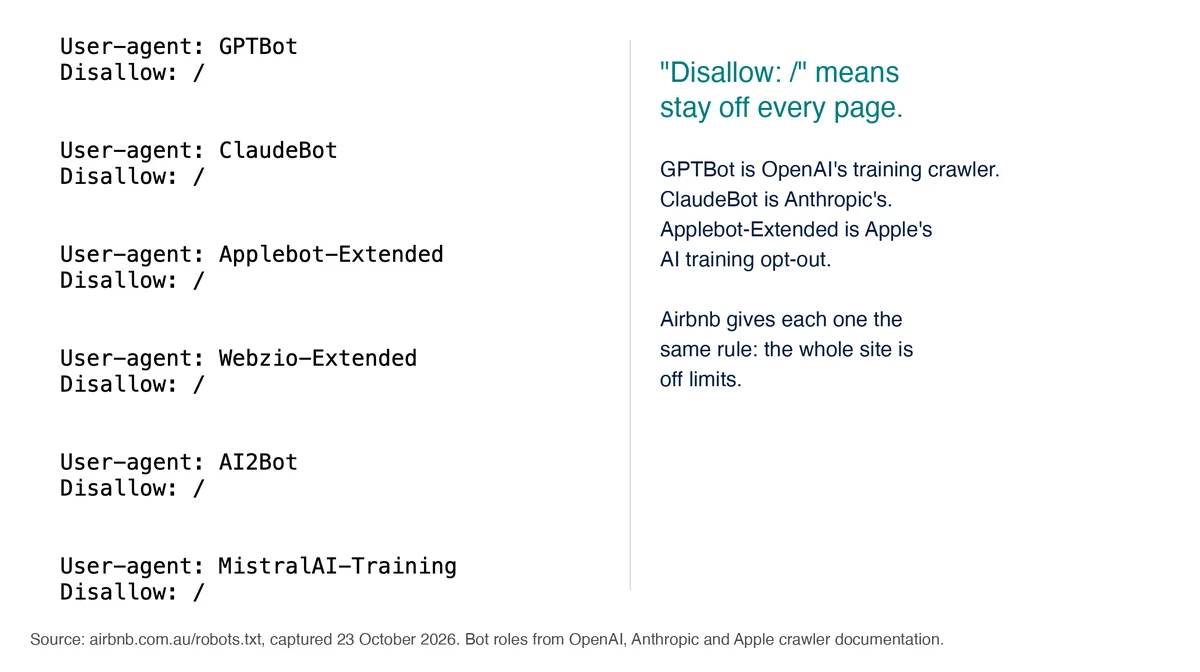
Airbnb gives “Disallow: /” to six bots, including GPTBot, ClaudeBot and Applebot-Extended. That rule covers every page on the site.
- GPTBot is OpenAI’s training crawler. OpenAI says disallowing it “indicates a site’s content should not be used in training generative AI foundation models” (OpenAI).
- ClaudeBot collects web content for Anthropic’s model training. Anthropic says its bots follow robots.txt (Anthropic).
- Applebot-Extended is Apple’s opt-out from training its foundation models. Apple says it “does not crawl webpages”. It controls how Apple uses what Applebot collects (Apple).
In plain words: Airbnb has told OpenAI, Anthropic and Apple not to train their models on your listing.
Google is missing from that list. Airbnb’s file doesn’t name Google-Extended, the token Google uses to control Gemini training and grounding (Google). So Airbnb hasn’t opted out of Gemini training and grounding.
Search bots: listing page yes, the pages behind it no
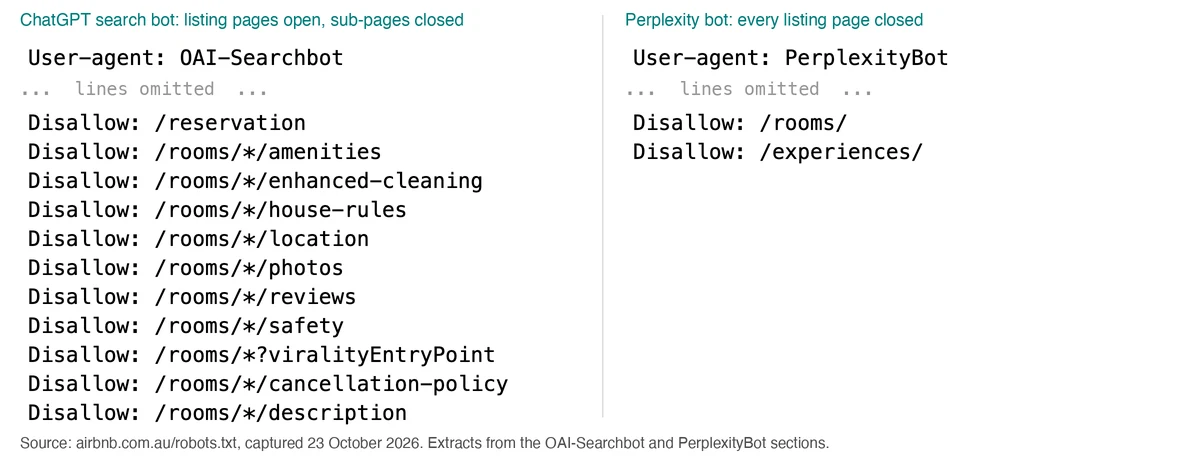
ChatGPT’s search bot (OAI-SearchBot) gets the same rules as Googlebot and Bingbot. It reaches your main listing page. It’s told to stay off the separate pages under each listing for amenities, reviews, photos, location, house rules, cancellation policy and description.
PerplexityBot fares worse. Airbnb disallows /rooms/, the folder that holds every listing. Perplexity’s search crawler is told to stay off your listing entirely. Perplexity says its separate user-requested fetcher “generally ignores robots.txt rules” (Perplexity).
Robots.txt is a request, not a lock. OpenAI says that when a ChatGPT user asks it to visit a page, “robots.txt rules may not apply” (OpenAI). Don’t plan your visibility around that.
For comparison, Tripadvisor’s robots.txt also blocks GPTBot, ClaudeBot and Applebot-Extended, and lets ChatGPT’s search bot and PerplexityBot in (tripadvisor.com.au/robots.txt). To see what each type of bot does on your own site, read three types of AI bot and which one decides if AI recommends you.
Build a page AI tools read in full: your own website
Your website is the one source where you control every word and every robots.txt rule.
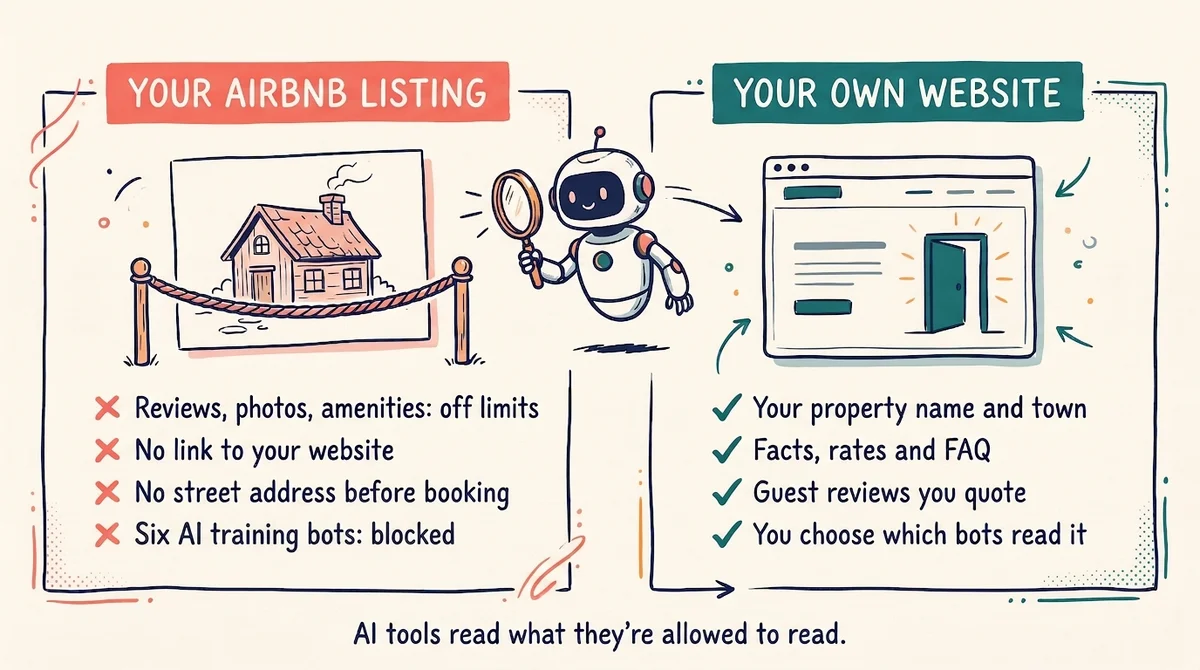
It doesn’t need to be big. A short-stay host needs five things:
- Your property name, town and region in the page title and first paragraph. “Fernhill Cottage, a two-bedroom stay in Healesville, Yarra Valley.”
- Facts, not adjectives. Bedrooms, beds, bathrooms, maximum guests, pets yes or no, parking, and the distance in kilometres to town and nearby attractions.
- Rates. A “from” price per night and the minimum stay. Put the number on the page so AI tools and travellers both see it.
- A way to book. A direct booking engine with live availability works best. Airbnb lets you sync your calendar with other sites through an iCal link. A night booked on one then blocks the other, with imported calendars refreshing every three hours (Airbnb help). Read do I need real-time online booking for the options.
- An FAQ. Check-in time, wifi, accessibility, what’s nearby, what to bring. Answer the questions your guests ask you before they arrive.
Put the same facts in schema markup, the code that labels your page as a place to stay. Our guide to schema markup for tourism explains which types to use.
Plenty of operators already have a website and get little from it. Hostaway surveyed 326 short-term rental operators in 46 countries in late 2025. 70.2% run a direct booking site. 62.3% get less than a quarter of their bookings directly, and 18.4% get none at all (Hostaway 2026 report, PDF).
Get your property listed everywhere else under the same name
Pick one property name and use it everywhere. Search engines and AI assistants check whether several listings belong to one real business. Matching names and contact details are the signal they lean on. Our guide to adding or updating your business listing on third-party websites explains why it all has to match.
- Google Business Profile: check eligibility first. Google’s policy lists “[r]ental or for-sale properties such as holiday homes” as ineligible. A business qualifies only if it “make[s] in-person contact with customers during its stated hours” (Google).
- Apple Maps and Bing Places. See how to register on Apple Maps and Bing, and check each one’s rules for your property type.
- Tripadvisor. If you have a Tripadvisor listing, use the same name there. Its robots.txt lets ChatGPT’s search bot and PerplexityBot read it.
- ATDW. ATDW sends your listing to your state or territory tourism website and other travel sites (ATDW). Those are trusted local sources.
- Booking.com or Vrbo. If you list there too, use the same name and details.
On Airbnb itself, use the property name in your listing title where it fits, so the same name appears there as well.
OTAs dominate the sources AI cites for hotels. Cloudbeds studied hotel recommendations in ChatGPT, Perplexity and Gemini. More than half (55.3%) of all the sources cited were OTAs (Hospitality Net). Holiday homes weren’t part of the study. The lesson still carries: the more trusted places carry your name, the more chances AI has to find it. Our post on whether AI tools use OTAs or your website looks at this in more detail.
Move your best reviews somewhere AI reads them
Airbnb tells ChatGPT’s search bot to stay off each listing’s separate reviews page, and keeps Perplexity’s search crawler off the listing altogether. Your reviews still matter. They need a second home.
- Quote two or three real guest comments on your website, with the guest’s first name and month of stay, and with their permission. Read should I put reviews and testimonials on my own website for how.
- Ask for a Tripadvisor review if you’re listed there.
- Ask for a Google review only if your business has an eligible Business Profile. Put the link in your checkout message. Never offer a discount or freebie for it. Google’s policy bans incentives “such as payment, discounts, free goods and/or services” in exchange for reviews (Google).
Hypothetical example: a host with 140 five-star Airbnb reviews and nothing else online builds a one-page website for Fernhill Cottage. The page quotes three guests, with permission. The host adds the cottage to ATDW and Tripadvisor under the same name. A traveller asks Gemini for “a pet-friendly cottage near Healesville”. Gemini now has a named business, a website and matching listings to read.
Test what AI says about you today
Before you change anything, see where you stand. This test shows you the real sources AI tools use.
- Open ChatGPT, Gemini and Perplexity in a private browser window.
- Ask the question your guests ask. “Where should we stay in Healesville with a dog for a weekend?”
- Ask about you by name. “What do you know about Fernhill Cottage in Healesville?”
- Click the sources each tool cites. Note whether it found your Airbnb listing, your website, another listing, or nothing.
- Save the answers. Run the same questions in three months and compare.
If the answer is “I don’t have information about that property”, that’s your starting point. Read why doesn’t ChatGPT know my business exists? for the most common causes.
Frequently Asked Questions
Does ChatGPT read Airbnb listings?
Partly. Airbnb’s robots.txt lets ChatGPT’s search bot (OAI-SearchBot) reach the main listing page. It tells the bot to stay off the separate reviews, photos, amenities and location pages under each listing. Airbnb blocks OpenAI’s training crawler, GPTBot, from the whole site.
Am I allowed to put my website link in my Airbnb listing?
No. Airbnb’s policy bans links in listing pages or messages that take people off the platform. All communication before a booking must stay on Airbnb. Build your website so travellers and AI tools reach it through search and your other listings instead.
Do I need a website if Airbnb brings me all my bookings?
You need one if you want AI tools to recommend you by name. Your Airbnb listing has no link out, no street address before booking, and limits on what AI bots read. A small website with your property name, facts, rates and an FAQ gives AI tools a source you control.
Will a direct booking website break Airbnb’s rules?
Airbnb’s off-platform policy says nothing against having your own website. What it prohibits is steering Airbnb guests off the platform, through links, messages or discounts to book elsewhere. Keep your website separate and don’t promote it inside your Airbnb listing or messages.
Which listings matter most for AI search besides Airbnb?
Your own website first, then ATDW, Tripadvisor and any other booking sites you use. Google Business Profile lists holiday homes as ineligible, so check Google’s rules before you set one up. Use the same property name and details on every listing.
How do I check what AI says about my Airbnb property?
Ask ChatGPT, Gemini and Perplexity the questions your guests ask, plus a question about your property by name. Click the cited sources to see where each answer came from. Repeat every three months to track progress.
Conclusion
Airbnb keeps your guests, reviews and address inside Airbnb. AI tools see less of you because of it. Keep the listing and build a website you own. Then put the same property name on ATDW, Tripadvisor and every other site you list on. Run the ChatGPT test today so you know your starting point.
Your free AI marketing coach, right in your pocket
The free Pocket Rocket app gives you a personal AI marketing coach, website audit, weekly action plans and 5-minute tips. Built for tourism operators.