
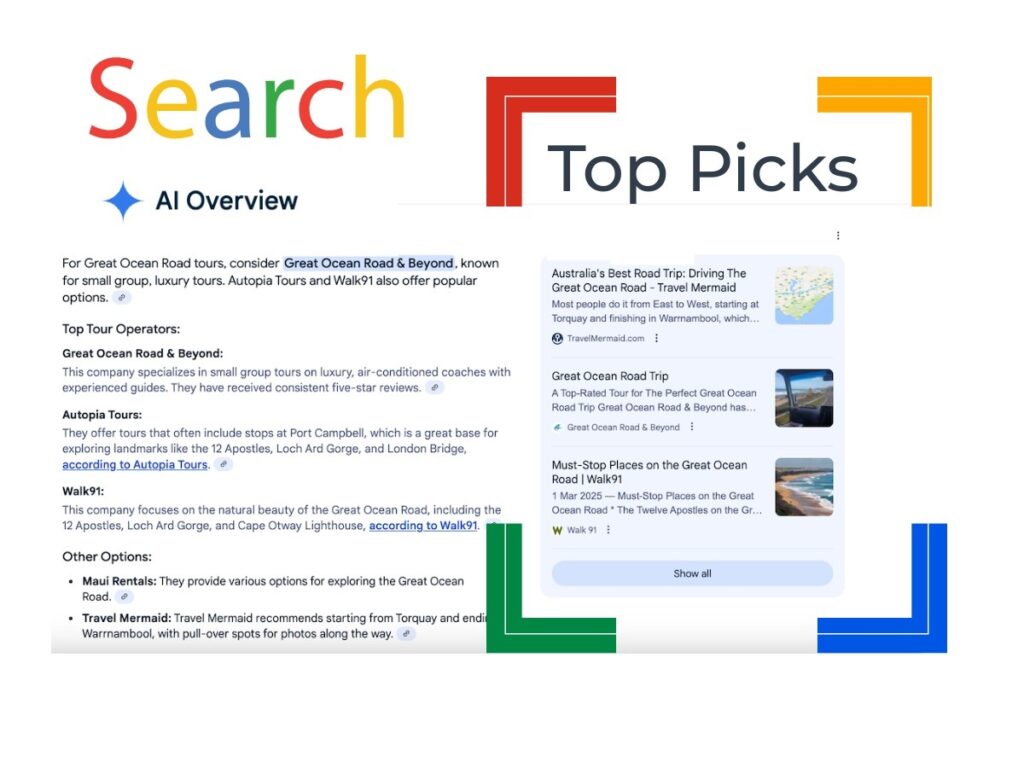
Wondering how to get your tourism business featured in Google’s AI-powered search results? When someone searches now, Google often shows an AI Overview at the top: a short summary with links to the sources it trusts. It’s changing how travellers discover and trust information online. In this post, we explain how to give your website the best shot at being one of those cited sources, using an approach called AI search optimisation (also known as GEO or AEO).
So what exactly is it, and how do you get in?
What are Google AI Overviews?
An AI Overview is the AI-written summary Google now shows at the top of many searches. It cites a handful of websites as its sources, shown as links and cards. When your page is one of them, Google highlights:
- A clickable blog title
- A short AI-written summary
- Your business name and logo (if detected)
- A thumbnail image
- A publish date (if structured data is present)
It’s Google saying: “These are trusted sources worth checking out.”
Getting cited like this is the goal of AI search optimisation (GEO or AEO), which shapes your content so AI tools can read, trust and surface it. We’ve written an introductory blog post to help you understand it and improve your visibility.
- Higher organic traffic
- Authority in the travel planning journey
- AI visibility across Google AI Overviews, ChatGPT, Perplexity and Copilot
Why it matters for tourism operators
Unlike the old list of ten blue links, AI Overviews are built from context-rich, trustworthy content. It’s not about keyword stuffing or backlink spam. Instead, Google is looking for:
- Well-structured blog content
- Accurate schema markup (
BlogPosting,Article,FAQPage, etc.) - Topical relevance (content that matches searcher intent)
- Author and publish date visibility
- Internal linking to related tours or services
This is about being found AND favoured by AI.
How to get featured in AI Overviews
Here are the practical steps:
- Write helpful, traveller-focused Blog Posts
- Answer real visitor questions (e.g. “best time to kayak in 1770” or “how to hike the Great Ocean Walk”)
- Use subheadings, lists, and short paragraphs for readability
- Use Schema Markup
- Add
BlogPostingschema (most SEO plugins do this automatically) - Include
author,datePublished,headline,image, andmainEntityOfPage
- Add
- Include original images
- These are more likely to be picked up for the thumbnail
- Optimise image filenames and alt tags (e.g.
sunset-kayaking-1770.jpg)
- Internally Link to Tours, FAQs or Booking Pages
- Show Google your blog is part of a content cluster, not a standalone island
- Keep It fresh
- Update blog posts at least every 6 to 8 months
- Refresh schema
dateModifiedwhen content changes
- Optimise for AI Discovery
- Answer the question clearly in the first line or two, then add detail
- Avoid overly salesy language, and focus on helping the traveller decide
Real example: Walk91 featured in Google’s AI results
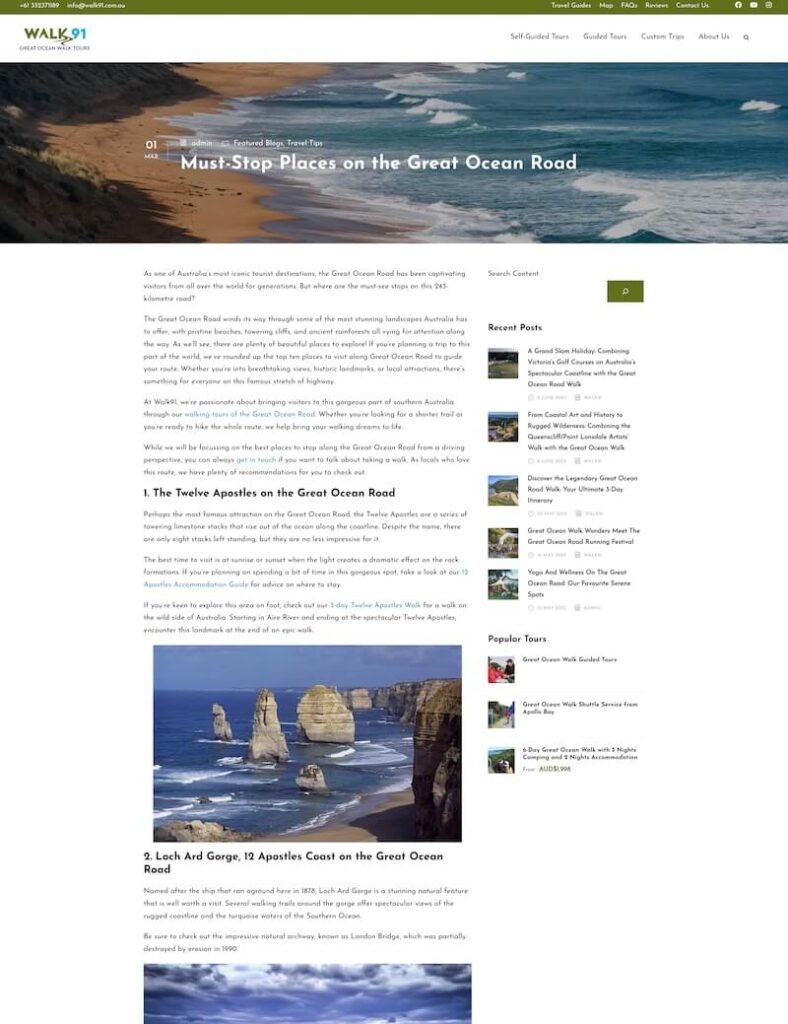
Our friends at Walk91 recently had their blog post appear in Google’s AI results when searching for Great Ocean Road tours. Their blog was:
- Structured with clear H2s and location-rich detail
- Marked up with schema
- Linked to relevant tour offerings
- And offered really valuable content.
Need help?
We offer a Generative Engine Optimisation (GEO) Health Check to help you:
- Identify missing schema and content gaps
- Optimise your blog and product pages for AI visibility
- Audit your presence across Google AI Overviews, ChatGPT and Copilot
Let us help your business show up where it counts: in the AI answers travellers rely on, as well as in the classic search results.

Generative Engine Optimisation (GEO) assessment of your online presence
Frequently Asked Questions
How do I get my tourism business featured in Google’s AI Overviews?
To increase your chances:
Write helpful, well-structured blog content
Use BlogPosting schema with author, date, image, and canonical URL
Keep your content fresh and relevant to search intent
Answer common traveller questions clearly
Is getting into Google’s AI Overviews the same as SEO?
Not quite. This is part of Generative Engine Optimisation (GEO). It goes beyond traditional SEO by optimising your content for how AI systems understand and surface results, especially in tools like Google AI Overviews, ChatGPT and Perplexity.
What kind of content works best for AI search visibility?
AI search prefers content that:
Is up-to-date and well-formatted
Answers common queries conversationally
Includes schema markup
Offers deep context and value (not just fluff)
- C
- O
- M
- P
- A
- S
- S
Convince the board · Out of heads · Make it queryable · Prime operators · Activate AI · Safeguard · Show the value
COMPASS: AI Playbook for DMOs
Turn this into your region’s AI strategy
COMPASS is the seven-move AI playbook for DMOs and tourism organisations.