
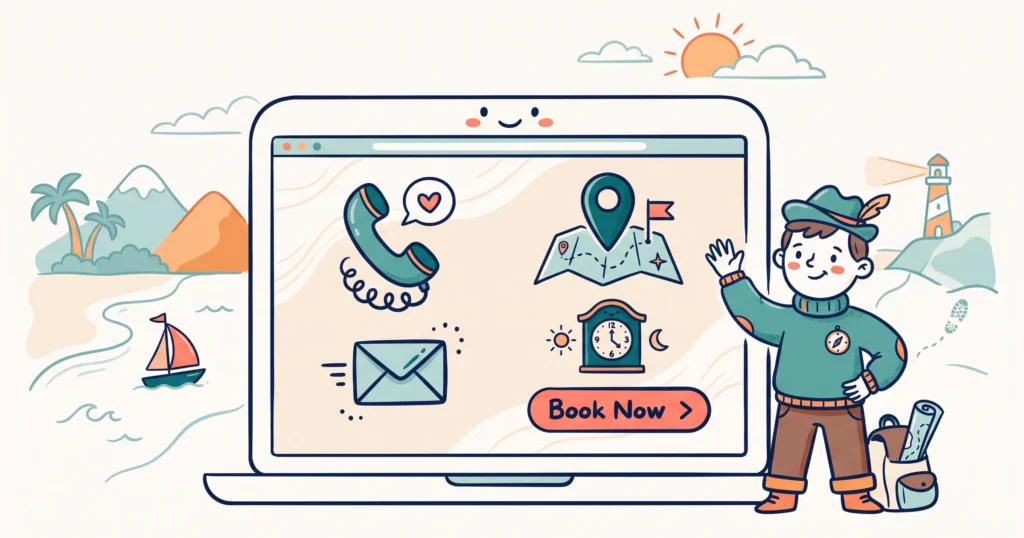
How to build a contact us page that actually gets guests to reach out
A good tourism Contact Us page puts your phone number, email, address, opening hours and a booking link in one place, and gets a reply back within 24 hours. Get it wrong and you lose the booking to whoever answered first.
For most tourism operators, it’s one of the most-visited pages on the website and the last stop before a potential guest decides to book, enquire, or give up and head elsewhere. So, if your contact page hasn’t had a refresh in a while, it’s time to take a closer look.
A great contact page creates a smooth, trustworthy experience that matches the warmth of your in-person hospitality.
Why your contact us page matters
In the early days, most businesses only dealt with guests via phone or post. Now, travellers expect instant access, mobile-friendly design, and quick, friendly responses, whether that’s through your website, email, or social DMs.
A well-built Contact Us page:
- Makes it easy for guests to reach you their preferred way
- Builds trust and shows you’re a real, professional operator
- Reduces friction in the booking journey
- Reinforces your brand voice and customer service values
- Encourages direct bookings (instead of third-party OTAs)
If you’ve already improved your About Us page, you’ll notice the same principles apply: personality, clarity, and reassurance go a long way. (If you haven’t yet, check out our blog “How to build a great About Us page that connects with your guests” for tips.)
Not sure how your current website stacks up? Our Digital Engagement Health Check™ can assess your digital presence and show you practical ways to improve it, including how well your contact page supports your guest journey.
What every tourism contact us page should include
Before you get fancy, make sure you’ve nailed the basics. A best-practice tourism contact page should have:
- Opening hours: when people can expect you to respond or when your reception is open.
- Phone number: make it click-to-call on mobile.
- Email address: don’t rely on a form alone; people still like to see a real address.
- Physical or mailing address: with a Google Maps link or embedded map.
- Booking button: a clear, prominent link to your “Book Now” page.
- Simple contact form: include name, email, phone, message, and optional enquiry type or preferred dates.
- Confirmation message: so people know their message was sent successfully.
- Directions: parking, nearby public transport, or nearest airport/train/bus stop.
- Average response time: e.g. “We reply within 24 hours.”
- Social media icons: Instagram, Facebook, TripAdvisor, YouTube, LinkedIn.
- Accreditation logos: eco-certifications, memberships, or trust badges.
- Accessibility information: a must for inclusive and ethical tourism.
- A friendly image: your team or entrance to reassure guests you’re real people.
Don’t forget accessibility
This one’s worth repeating. The accessible tourism market is growing rapidly, and Australia’s ageing population means more travellers are seeking businesses that understand their needs.
More than one in five Australians live with disability (21.4%), according to the Australian Bureau of Statistics. Travellers with accessible needs took 70.5 million trips in Australia in 2024, according to Tourism Research Australia. That’s a real opportunity, and it’s also the right thing to do.
Be upfront about your accessibility features. Include a short statement or link to more details about your facilities, support options, or any inclusive initiatives. Don’t make potential guests email you just to ask if they can visit comfortably.
You can include this info on your Contact page, in your FAQs, and on your product or accommodation pages.
Add structured data behind the scenes
Your contact details should be readable by machines, not just people. Structured data (schema markup) tags your business name, address, phone, opening hours and location so Google and AI assistants like ChatGPT and Perplexity can pull them accurately when a traveller asks. An SEO plugin like Rank Math tags your Contact page for you. Keep the same name, address and phone number across your website, your Google Business Profile and any directory listings. Mismatched details are one of the first things that erode trust with search engines and AI.
Make it interactive and personal
Travellers love seeing where you are and who they’ll meet. Embed a Google Map showing your location, include written directions for those who prefer step-by-step, and add a friendly photo of your team or entrance.
If you have WhatsApp, Messenger, or live chat, make those options visible. Guests today expect more than just a phone number. They want instant, human communication.
Bonus tip: test it regularly
Pretend you’re a guest and go through your Contact page on your mobile.
- Does the form send properly?
- Are links clickable?
- Is the map easy to zoom?
- Does your confirmation message actually appear?
If not, fix it. Because if you find it frustrating, your guests definitely will.
If you’d like step-by-step help improving your tourism website, our course Make your website the best it can be is a great place to start. You’ll learn how to create pages that convert visitors into bookings and make your customer service shine online.
Quick checklist for your tourism contact page
- Opening hours
- Click-to-call phone number
- Visible email address
- Google Map or directions
- Booking button
- Short, friendly form
- Accessibility information
- Social links and accreditations
- Team photo or property image
- Confirmation message
- Response time
Tick all those off, and you’re already ahead of most tourism operators.
Keep your opening hours consistent everywhere
Show your opening hours on your contact page, then make sure the exact same hours appear on your Google Business Profile and your Facebook page. Travellers check more than one source, and when the times do not match, they do not know which one to trust. Google usually displays the hours from your Google Business Profile, so a stale profile can turn people away even when your contact page is perfect.
Treat your hours as one set of information that lives in three places. When anything changes, update all three the same day: seasonal hours, public holidays, a one-off early close. If you shut for Christmas or open late on a long weekend, a guest who drives out to a locked gate remembers it. Updating your hours for public holidays also tells Google you are active, which helps your local ranking.
Apply the same discipline to your name, address and phone number. Keep them identical across your website, your Google Business Profile, your social pages and any directory listings. While you are there, update your website footer so your hours and contact details sit on every page, not only the contact page. Consistent details across every platform are a strong local search signal, and mismatched ones can quietly hold your ranking back.
Make it easy for guests to find you
Give guests two ways to reach your front door: an embedded, clickable Google Map and clear written directions they can follow offline. A map on its own is not enough in regional Australia, where mobile reception often drops out on the last stretch of road.
Embedding a live map takes a few minutes:
- Open Google Maps and search for your business.
- Click “Share”, then choose “Embed a map”.
- Copy the iframe code Google gives you.
- Paste it into an embed or HTML block on your contact page.
A proper embed lets guests tap through to live directions in their own map app, so they can navigate straight from your page.
Then write directions a person can actually follow. Start from the nearest highway or town and use landmarks, not a bare street address: “Turn off the Bruce Highway at the BP servo, then it is 4 km on your left past the red barn.” Say where to park, and for tours name the exact meeting point and what time to arrive. Because reception is patchy in many regional areas, offer a downloadable or printable PDF of your directions that guests can save before they lose signal. Someone who has your directions on their phone arrives relaxed and on time.
Frequently Asked Questions
Should my opening hours match on my website, Google Business Profile and Facebook?
Yes, your opening hours should be identical on your website, your Google Business Profile and your Facebook page. Travellers check more than one source, so mismatched hours confuse them and can cost you visits. Google usually shows the hours from your Google Business Profile, so update all three whenever your hours change, including seasonal hours and public holidays.
How do I embed a Google Map on my contact page?
To embed a Google Map, open Google Maps, search for your business, click “Share”, then choose “Embed a map”. Copy the iframe code and paste it into an embed or HTML block on your contact page. A proper embed lets guests tap through to live directions in their own map app. Keep your Google Business Profile details matching, since Google Maps often pulls your location and hours straight from there.
What should written directions for my tourism business include?
Good written directions start from the nearest highway or town and use landmarks rather than only a street address. Include where to park, and for tours name the exact meeting point and the time to arrive. Landmark-based directions are easier to follow than an address alone, especially for first-time visitors.
Do I still need written directions if I already have a map on my page?
Yes, written directions still matter even with a map on your page, because mobile reception drops out in many regional areas. Offer a downloadable or printable PDF of your directions that guests can save before they lose signal. That way they can still find you when the map will not load. Our Digital Engagement Health Check can tell you if your directions and other contact details are working the way they should.
How quickly should I respond to enquiries?
Aim to reply within 24 hours, and state that response time clearly on your Contact page. Guests often compare several operators at once, so a fast reply is often the difference between winning the booking and losing it to whoever answers first.
Do I need a physical address if I don’t have a shopfront?
Yes, list an address even if you don’t have a shopfront, such as a tour departure point, an office, or a registered business address. It builds trust and helps guests confirm you are a real, local operator. If you have no fixed location, list your service area instead so guests know where you operate.
Does my Contact Us page need schema markup?
Yes. Schema markup (structured data) tells search engines and AI assistants what your contact details mean, so your name, address, phone and hours can be read and cited accurately. Most tourism operators get it automatically through an SEO plugin like Rank Math, which tags your Contact page for you. Check yours is working with our free Digital Health Check.
Key Takeaways
- Put your phone number, email, address, opening hours and a booking link on one page, and reply within 24 hours.
- Keep your hours, name, address and phone number identical across your website, Google Business Profile, Facebook and any directory listings.
- Give guests both an embedded Google Map and written, landmark-based directions, since mobile reception often drops out in regional Australia.
- Include accessibility information. More than one in five Australians live with disability, and it is the right thing to do.
- Test your contact page on mobile regularly: form submission, clickable links, map zoom and the confirmation message.
Final thought
Your Contact Us page is your online handshake. It’s where potential guests decide if they feel comfortable reaching out, if you seem trustworthy, and if you’re easy to deal with.
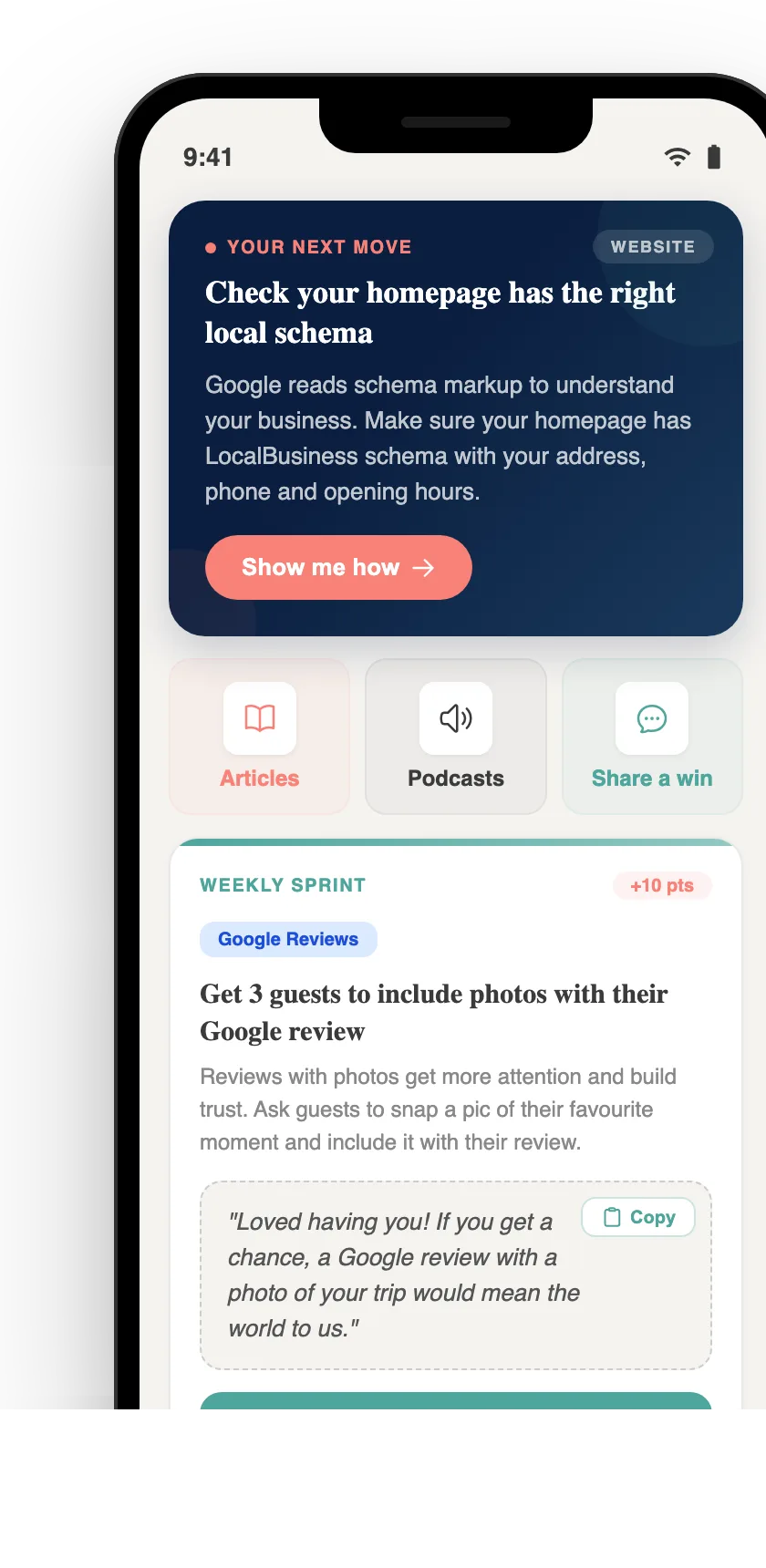
Your free AI marketing coach, right in your pocket
The free Pocket Rocket app gives you a personal AI marketing coach, website audit, weekly action plans and 5-minute tips. Built for tourism operators.