Untangling Tourism Tech — Podcast
9 September 2024
In this episode of the Untangling Tourism Tech podcast, Fabienne Wintle and Liz Ward share valuable insights into the tourism awards process, focusing on tips from experienced judges. The episode provides guidance on how businesses, big or small, can not only participate but excel in these prestigious awards.
Top Tips from Former Judges:
Pro Tip: Even if you’re not ready to submit, downloading the submission guidelines can guide your business strategy for the following year. This will help you align your operations with the excellence standards expected in tourism awards.
This episode is essential listening for tourism operators aiming to take their business to the next level through the pursuit of excellence.
Untangling Tourism Tech Episode 8, with Fabienne Wintle and Liz Ward. Times match the video. We removed filler words and fixed mis-heard names.
[00:00] Hi, Fab. So episode eight is all about being great. Do you like that?
[00:08] Sounds great, because it’s really… so Friday.
[00:12] Yeah, that’s right. Really top of mind for me, all the work that goes on in the industry and the work I’ve been doing recently with businesses in helping them with their tourism award submissions, which is a big thing. Yeah, it’s the season. And it’s just such a big deal to stand on that stage and to be the recipient of a finalist award or your state’s gold award, and then go through to nationals. And it does a lot for businesses in terms of their profile and the pride within their team. It’s really motivating.
[00:46] And I know you’ve been a judge as well over the years and, you know, I’ve done it for many years too. And so when people think about having an excellent business, I thought it might be good to break that down a bit in this podcast about what excellence is, or how it’s judged in the business community and by accreditation frameworks and everything that’s linked to our national and regional tourism awards. And whilst I’m talking about the Australian context, I’m sure this is relatable for all regions, because the measures of excellence that they use are very sound. And really, whether you’re from the tourism industry or another industry, all of these things still would be relatable. So what I thought I might do is unpack, and you ask questions where you think that’s relevant for our audience, but we’ll try to simplify it down into what makes up an excellent business in accordance with the tourism awards process. And this might help tourism operators to decide whether they’re ready to go into the tourism awards, or how they might do some work to get ready to be able to participate.
[01:59] That’s critical because it’s about fitting the box. You know, an operator might think they’re excellent in specific areas, but if they’re missing the areas that are being assessed, it’s a really good thing to actually focus on them the year prior, not just before writing the submission.
[02:17] That’s so true, because in putting together a business excellence submission, there’s evidence that you have to provide, like you’ve tracked and you’ve got your measures of your different marketing activities, or you’ve got evidence of financial success or planning success. So you actually need to start collecting those things 12 months in advance. So that’s a really good point.
[02:39] But I guess at the heart of it, when we think about tourism excellence, one of the most important aspects of that is the experience that the operator is providing through their business. And that customer experience is definitely spelled out within a tourism award submission. You describe it, you describe how your practices and what you do is inclusive and how you cater for people with special needs. And you really try to tell the story of the heart of the experience and how it connects in with place and culture, and whether it’s an adventure type experience or a luxury experience.
[03:13] But a very important part of this is really objective, because what makes up the tourism award scoring, 20% of it in fact, is your online reputation. So your score in Tripadvisor and Google, maybe Booking.com, Expedia, wherever reviews are recorded by your guests and are able to be collected, and the data to be synthesised through the ReviewPro platform, that gives you what’s called a Global Review Index score, a GRI score. And you have to be able to be at the top there, sort of in that top 20 marks out, you know, 80% and above to really be competitive. And hopefully you’re even higher than that. And you’ve got to have achieved 25 reviews in that 12-month period. If you haven’t in the qualifying period, then you can’t actually get your data counted, because ReviewPro can’t do… it’s not enough data to work with.
[04:17] I think that’s really good, that objective component of it. And when we get approached by businesses to say, can you help us with our tourism award submission, the first thing I do is go to their Tripadvisor listing and their Google listing and check out what their average score is. Because if it’s not sitting above an average of four out of five, then I think you’re just… it’s not going to be…
[04:42] Just like if you were to book an experience, you don’t even bother if they’re not sitting above four. So that’s great. So 20% is actually not about what they say they think they are, but it’s about what other people say.
[04:57] Yeah, yeah. There’s a nuance on that. I think it’s 20 out of like 120 marks or something.
[05:02] It’s still a fair bit.
[05:03] Yeah, it is, absolutely it is. So that experience is obviously really important, and so it should be in the excellence awards. And when judges have the opportunity in different regions to go and experience the product, then they also firsthand get to record comments and do like a judge’s visit score as well. So you get that, it’s not secret shopping, but it’s lived experience with the product.
[05:28] Then there’s other aspects that are super important as well. One of them is planning. And this is where it gets tough for small businesses who want to enter the tourism awards. Having said that, I know very small businesses who have stood on the stage and been gold winners in the tourism awards. So just because you’re small and only got a small team, it doesn’t mean you can’t do it. But the planning piece, and you know this, Fab, too, is really hard for small businesses because they’re so operational, their time. And in a tourism award submission, you need to be able to talk about what your business planning process is. So what you do each year, the type of research, like you might look at your regional tourism plans or your state tourism strategy, how you align with that, how you actually go about setting your goals and what goals you set, you know, what are the targets for them. And I know you have conversations with businesses about this stuff all the time, because you’re doing, setting up their Google Analytics, and it all links back to there. But this business planning process sits as a fair chunk of their score, because everything then hooks back to that.
[06:41] Because the next section in a tourism award submission is about innovation. So what are the enhancements or improvements that you’ve made over the qualifying period? And very importantly, how do they link back to your business goals that you set? So you start to see this linkage throughout the submission for people who are able to set goals and then plan out improvements that are going to ensure that they’re always innovating, they’re always staying up to date with what consumers want. So we see the awards framework evolve with starting to talk about things like, how are you catering for people with a disability? How are you preserving the environment? So things that are trending requirements and needs by the traveller, we start to see that reflected into tourism award submission. So then your innovations would also link to things like that, and having a sustainable business too.
[07:49] Then there’s the marketing section. And I think…
[07:53] Tell me more about that one.
[07:55] I think the marketing section is important because without marketing you can’t… it’s very difficult to grow your business. So marketing means different things to different businesses depending on what works for them. But this is another important part for that evidence. Like you’ve got to be able to show that you planned your marketing, you know who your target market is, you’ve got a persona for your ideal customers, your marketing links back once again to your business goals. So what’s the relationship to business goals for these marketing strategies? And then what the activities under each are or were in the qualifying period, and how you measured the success of them.
[08:36] And I know this is music to your ears, right? Because of the Google Analytics setup and being able to measure. And I’m seeing more and more good businesses, winning businesses, are actually reporting data from Google Analytics, reporting social media metrics. Even if they’re a really small business, their submissions look fantastic because they know what they’re doing. They know that that activity, that campaign, their website traffic, all the things they do in marketing, they’re measuring it. And they can say, yeah, well look, it’s generating these leads and we got these sales from these channels. So even a micro business can do that, and in fact can look better than a larger business if they’ve got those metrics in there.
[09:21] Awesome.
[09:22] So that’s very cool. And examples all the way through is important. Like you’ve got photos in of your innovations, the before and after, you’ve got screenshots of your marketing. All of that stacks up as evidence.
[09:34] And then the last section of a tourism award submission is about sustainability and ethics, how you contribute to the community. So that’s a really important section, which used to be, thinking back over the years, it was largely about environmental sustainability, but it’s really broadened in the last couple of years. And this is seeking out your values and attitudes to what your role is in your destination and your community. Like why do you exist as a business, and how are you actually helping the whole destination to grow? What are you doing? Are you bringing in kids from the local school to do work experience with you? Are you supporting some charitable events with sponsorships? How are you interacting with the Indigenous communities and allowing them to use your business as a vehicle to tell their cultural story?
[10:30] Environmental, you know, are you saving on emissions by introducing smarter lighting or water savings? What are you doing in terms of recycling and reducing waste? And once again, measurements come in very importantly here. So if you’re implementing these things, take a measure of what, for example, what that waste is now, how would you measure that versus what you achieve when you implement the improvement, or what those power savings are. And if you can tell a solid story on each of those aspects and have some data and imagery to support it, then you’re in a really competitive place with a tourism award submission.
[11:14] It sounds like even if you’re not thinking about entering, you could just download the submission, and that should be just your guide of what you should be doing next year, or the question you should be asking yourself to be a successful business, really. It’s just free intel.
[11:27] That’s an amazing thought, Fab. I’ve never thought of that before, and all the time I’ve been around the awards, I’ve never thought of that, just without even submitting. Approaching your industry, your tourism industry council, whatever state you’re in, and say, look, I know I’m not ready to submit yet, but gosh, I’d love to see the guidelines for my categories so I can work towards them. That’s a really clever thing, clever way to look at it.
[11:55] I was just thinking about it because, you know, so many new businesses come to us, and obviously we help with this digital aspect mostly, but they ask questions about everything else. And well, isn’t that the go-to? Go for gold, really.
[12:10] Yeah, yeah, absolutely.
[12:12] Start right from the very beginning.
[12:15] We see a lot of businesses, and I know in my own history as well, going way back in before we started this business together and I was at the Australian Tourism Data Warehouse, is we entered for multiple years, because there was a category for like education type services, and we had the Tourism e-kit. And we entered for several years and we weren’t a finalist in the first two years, and we just kept getting better every year, working off the judges’ feedback. So the judges, so even entering, knowing that you’re probably not going to get into the top three, but get that judges’ feedback is another strategy.
[12:54] Because all these judges are experienced.
[12:57] Eventually we got to gold, we went to nationals. Like we just kept getting better all the time, because we started to implement the things that were required, you know, across all facets of the submission, and it drives you towards excellence. So it’s awesome.
[13:16] So, all right, yes. So something to look out for for all businesses in Australia: the cycle commences somewhere around June, and then you have a couple of months to get your submission done. And it’s at the end of the year, normally in November, that all the state gala ceremonies are on, where the winners are announced, and then the national awards is usually in March. So that gives people a bit of a timeframe to do the awards.
[13:47] So in June is when you should get your to-do list, pretty much, whether you’re going to enter or not. Just set some goals, even if they’re small. Just pick one area of the five areas, are they? And focus on them.
[14:02] Correct.
[14:02] That’s very insightful, Liz, thank you.
[14:05] My pleasure.
[14:06] All right, we’ll see you next time for a new episode of Untangling Tourism Tech.
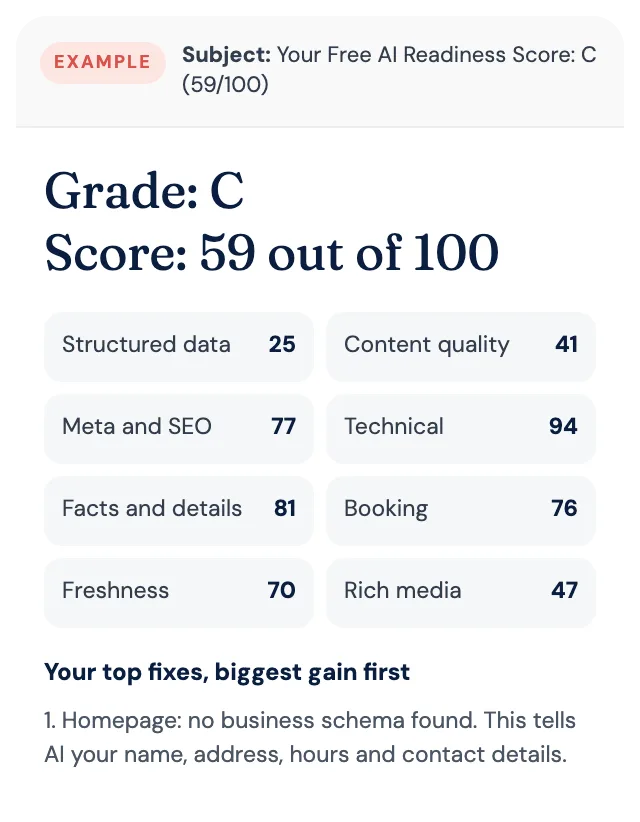
Free AI Readiness Score
Get your grade, a score out of 100 and your top fixes, by email. Free for tourism operators. No login and nothing to install.
Get access to all our training, coaching, and tools built for tourism operators who want to grow with confidence.
Explore membership