Untangling Tourism Tech — Podcast
12 August 2026
Most destination marketing organisations call Tourism Tribe with the same request: fix our website, it’s losing rankings. It’s the wrong question. Ask Google out loud where to grab lunch or where to stay for the weekend, and the answer comes back sourced from the operator’s Google Business Profile, not the region’s tourism website.
In episode 21 of Untangling Tourism Tech, Fabienne Wintle and Liz Ward get honest about what’s actually working when they sit down with DMOs in the early stages of AI transformation: how the old regional directory lost its job to Google Business Profiles, what it means for a DMO’s purpose when AI agents do the searching, and the practical tool giving operators a clear read on their own discoverability.
The call almost always starts the same way: we’re losing visitation, what do we do to fix the website? It’s not the wrong instinct, just the wrong target. The listings on a DMO’s website, the pages, the layout, none of that is where the real damage is happening.
Ask a phone in voice mode for dinner recommendations and it never has to look at a website at all. The answer comes straight from Google’s own data on the operator, their Google Business Profile. The directory a DMO spent years building, once the “golden child” of regional tourism marketing, has been left behind, and the DMO no longer controls how its own region is perceived.
When this lands in a room with a board member or CEO present, the conversation changes. What looked like a marketing update turns into a question about relevance itself: how does the region and its operators actually show up when AI makes the recommendation? That’s a leadership question, not a content calendar one, and it’s why getting decision-makers in the room for this realisation matters as much as the fix that follows.
Talking to a phone in voice mode is instructing an AI agent, Gemini or ChatGPT, to go and find the answer and report back. That handover matters. It’s no longer a human reading a website. It’s one assistant querying whatever is readable, most often a database rather than a page designed for people, and returning a decision.
That’s the thinking behind the “M” in Tourism Tribe’s Compass framework from the DMO AI Playbook: making a region’s knowledge queryable, not just crawlable. A DMO’s job shifts from publishing content for people to making sure the right systems can be read by the agents doing the work on people’s behalf.
One tool doing real work right now is the AI Digital Health Check. It gives operators a practical read on their own discoverability and bookability, across their Google Business Profile, website, and social presence, all viewed through an AI lens. For the DMO, it builds a dashboard view across the whole regional ecosystem, so shifts in AI visibility are visible over time instead of guessed at.
The response from operators has been strong. One-on-one mentoring sessions in New South Wales last week had operators saying the health check told them exactly what to do, filling gaps they suspected were there but couldn’t name.
Plenty of DMOs are still using AI the way most of us did in 2023: getting ChatGPT to draft a reply to a review. That’s not wrong, it’s just not where the value is anymore. A health check is only useful if it closes the loop: what needs to shift, and how does that shift get built into the next round. The tools now exist to get AI to handle 80% of that cycle. The trick is to build the skill to complete the work, and then on each use, give the AI feedback to train it to improve the other 20%, not stopping once the first draft appears.
A common reaction from DMO staff is some version of why didn’t anyone tell us this. It’s a fair question with an unglamorous answer: no council, regional body, or national body can move at the speed AI does, because government process is, by design, slower than private enterprise. Waiting to be brought up to speed isn’t a plan.
The staff making real progress are usually the ones playing with AI somewhere outside work too, whether that’s music, a hobby, anything that builds transferable comfort with the tools. That self-directed curiosity, and championing it openly inside the team does more for AI literacy than any single training session.
Reviews and recent photos still matter, but that’s old news, five years old by some estimates. The newer signals are behavioural. How often people tap “get directions” on a listing. Whether a business’s popular-times data shows it busy, since a busy cafe reads as a good experience signal to AI the same way it does to a person walking past. How long people’s phones stay on site, because dwell time behaves like a proxy for satisfaction.
None of that is exotic to activate. Put a “get directions” link in a confirmation email. Put it on a QR code at reception. Log into the Google Business Profile regularly, keep categories, offers, services, and product listings current, and treat that login itself as a signal of an active, trustworthy business. The DMOs seeing the fastest gains are the ones getting managerial access to key regional listings, like the visitor information centre’s own profile, and turning notifications on so engagement signals are visible in real time.
Start with the Google Business Profile, not the website: log in, update categories, offers, services and products, and get regional listings under proper managerial access with notifications on.
Fabienne and Liz are also running two DMO-only webinars stepping through a full AI transformation journey using the Compass framework, including the mistakes worth avoiding, on Tuesday 18 August at 1pm and Wednesday 19 August at 4pm.
The Compass Model and the DMO AI Playbook it comes from are available at tourismtribe.com/compass-ai-playbook-dmo.
When someone asks ChatGPT or Gemini for a recommendation, the answer is sourced from the operator’s Google Business Profile, not the DMO’s website or directory. The website’s structure and content still matter, but it’s no longer the main input AI tools use to decide what to recommend in a region.
The Compass framework is the practical model in Tourism Tribe’s DMO AI Playbook for helping destination marketing organisations plan their AI transformation. Part of it focuses on making a region’s knowledge queryable, not just crawlable, so AI agents can read and use it directly rather than relying only on published web pages.
The AI Digital Health Check is a tool that gives tourism operators a practical read on their own discoverability and bookability, covering their Google Business Profile, website, and social media presence through an AI lens. For DMOs, it also builds a dashboard view across their regional ecosystem so shifts in AI visibility can be tracked over time.
Beyond reviews and recent photos, AI tools appear to weigh behavioural signals: how often people tap get directions, whether popular times data shows a business is busy, and how long people’s phones stay on site as a proxy for a good experience. Regularly logging in and keeping categories, offers, services and products current is also treated as a signal of an active business.
Start with the Google Business Profile rather than the website: log in regularly, keep categories, offers, services and products current, and secure managerial access with notifications turned on for key regional listings, such as the visitor information centre. Encouraging operators to do the same across their own listings compounds the effect across the region.
Councils, regional bodies and national bodies typically move slower than private enterprise by design, so waiting for formal guidance on AI isn’t a realistic plan. The DMO staff making the fastest progress tend to be the ones already experimenting with AI in their own interests outside work, then bringing that comfort and curiosity back into the team.
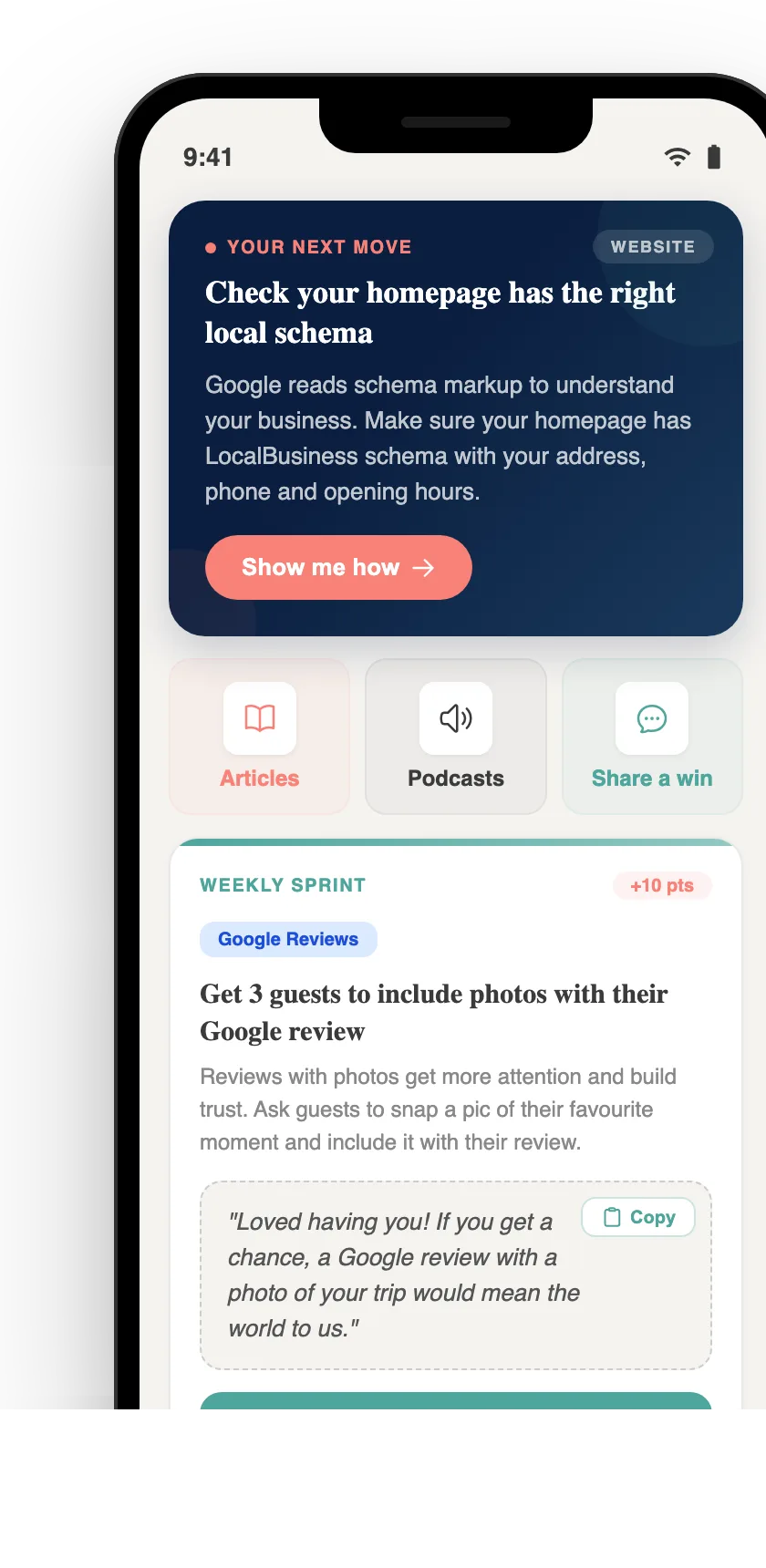
The free Pocket Rocket app gives you a personal AI marketing coach, website audit, weekly action plans and 5-minute tips. Built for tourism operators.
Get access to all our training, coaching, and tools built for tourism operators who want to grow with confidence.
Explore membership