Untangling Tourism Tech — Podcast
1 November 2026
We took two weeks off and came back to a different AI world. On 29 September, ChatGPT launched Dots, its personal agent. Fabienne called hers Bob. Liz called hers Meg. Within days, other personal agents were everywhere.
In Episode 23 of Untangling Tourism Tech, Fabienne Wintle and Liz Ward explain what a personal agent is, how it differs from the chatbots and work agents you may already use, and what happened when Liz took up Fabienne’s challenge to set one up herself.
Fabienne promised on the episode to share the slide she talked through, so here it is. AI tools now fall into three groups, and the same company can sit in more than one.
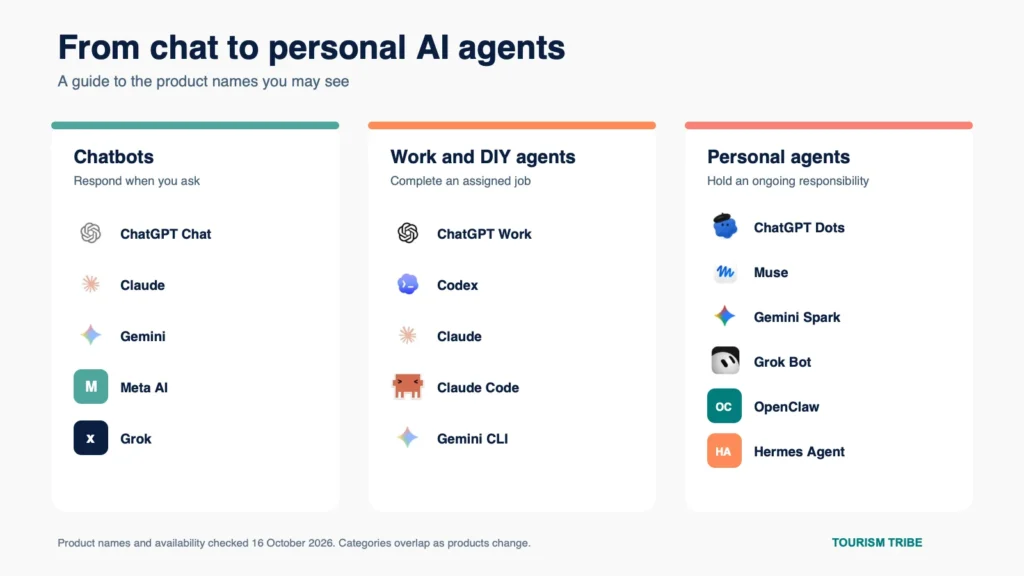
Fabienne’s picture of a personal agent is the assistant in The Devil Wears Prada, running alongside the boss with everything she needs: the hairdresser booking, the travel, the meeting prep. She knows that you walked past the bakery and that you will be starving in two hours, so she buys the croissant before you ask.
That proactivity is the difference. A work agent does the job you set. A personal agent learns how you work and acts on it. In ChatGPT you cannot see or change the rules behind that proactivity, which is one way the AI companies are trying to keep you in one tool. The other difference is where they run. They are cloud based, so they keep working after you close your laptop.
Fabienne challenged Liz to set up her own personal agent, and to do it without asking Fabienne for help. Liz started on a Friday night, connected Meg to her Tourism Tribe Google account, and Meg could immediately see her calendar, her Drive and her email. Before they had even agreed the ground rules, Meg was offering useful help: a draft reply to an email that had just arrived, a reminder about tomorrow morning, a nudge to stand up and breathe.
The bigger win was what came next. Talking to Meg, often out loud because that is where the detail comes out, Liz was guided into ChatGPT’s work mode to build things she had never built:
As Fabienne points out, Liz has commissioned many websites. She knew exactly what good looked like. What changed is that she no longer needed to find a developer to get there.
Liz sees a widening gap between people who have started and people who have not. If your curiosity has not yet turned into a commitment to learning, the climb gets steeper every month. Two situations come up again and again:
Liz’s view is that everyone is now accountable for their own AI learning. Do not wait for your employer to offer training or open up the tools. Pick something practical you want to achieve, like a side business, meal planning or packing for a trip, and learn by doing it. It feels like learning a language: you learn the words, then you have to throw yourself into the sentences.
Want to learn alongside other operators? Our fortnightly group Tourism Tech Sessions are full of practical advice and shared experience from people doing exactly this.
A personal AI agent is an AI assistant that holds an ongoing responsibility for you. It connects to your email, calendar and files, learns how you work, and offers help before you ask, such as drafting a reply to an email that has just arrived or reminding you what is coming up tomorrow.
A chatbot answers when you ask and starts each conversation from scratch. A work agent completes a job you assign, often on a schedule, and can now use your computer to do it. A personal agent is connected to the same places but acts on its own initiative, the way a good executive assistant would.
In October 2026 the personal agents included ChatGPT Dots, Muse, Gemini Spark, Grok Bot, OpenClaw and Hermes Agent. Product names change often, so start with the AI tool you already use and pay for.
No. Liz Ward set up her personal agent, Meg, by connecting it to her Google account and talking to it. Meg then guided her through building a workshop website and a weekly social media workflow, without a developer.
Many employers, including government teams limited to Copilot, have not yet opened up AI tools or training. Liz Ward’s view is that everyone is now accountable for their own AI learning, because roles are being redesigned around people who can use these tools well.
Set one clear goal, give it full context including what good looks like, use a capable paid model, and let it work without micromanaging. Ask it to interview you for anything it is missing.
Untangling Tourism Tech Episode 23, with Fabienne Wintle and Liz Ward. Each line shows who is speaking and when. Times match the video. We removed filler words and fixed mis-heard names.
[00:30] Fabienne Wintle: Hello, Liz. We are at episode 23 of Untangling Tourism Tech today.
[00:40] Liz Ward: I love that.
[00:42] Fabienne Wintle: Last time, yeah, I mean, it’s going, right? Just one decision at ATE a few years ago, on a whim, no real good tech to record ourselves. And the momentum we gained, and momentum is the word of the day, from this podcast has been amazing. So it shows a little idea will grow.
[01:02] Liz Ward: Absolutely. And that’s a great point to say welcome to our members and our clients and those of you that we don’t know. Thank you so much for finding these interviews that we do with each other of use. I meet many people when I’m out and about who say, love the podcast, listen to it all the time. And I always get something valuable. So we’re really pleased about that. That gives us momentum to keep going. So we’re at episode 23, Fab. That’s incredible. And what are we talking about today?
[01:35] Fabienne Wintle: Oh, we can talk about our holiday and how doing nothing for two weeks got us so behind in AI and we had to play catch up because what happened during our holiday, Liz, personal agents, ChatGPT, launched Dot, or Dots, I still don’t know, because I called mine Bob and you called yours Meg on the 29th of September. So almost a month ago. And since then, you know, there’s been Claude announcing there’s Grok, there’s Muse, all the personal agents are out in the woodworks, but we thought we’d cover today. What on earth is a personal agent and how can it be helpful to tourism organisation, businesses, small business owner, anyone really, that wants to move forward in their business?
[02:29] Liz Ward: That’s great, Fab. So take us through just for those people listening who are a little unclear about what a personal AI assistant is compared to another type of AI tool and an LLM that they could be using. Explain the differences. That would be awesome.
[02:45] Fabienne Wintle: Well, if you remember this beautiful movie called The Devil Wears Prada, and I always visualise it, there’s the boss and there’s the lady literally running around next to her with the books and everything that she needs to do.
[02:59] Liz Ward: Can I just say, this is the only podcast where you’ll see one of the presenters get up and do a running move.
[03:05] Fabienne Wintle: Well, I sometimes also use my handbag to explain context, but I don’t have the handbag today. So yes, visualise The Devil Wears Prada. And I always remember going, my goodness, isn’t this CEO so lucky to have this woman that is managing her life, her personal life, her hairdresser’s appointment, everything, she knows about it, she’s planned it forward, whether it’s travel, holidays, meeting, preparing presentation. Well, that’s what Dot is, right? Basically, it’s just not a little robot, but it lives there alongside you and does all that because it learns from you. So the key difference, and I’ve got a slide on the screen here, and if you’re listening to us, I’ll put this in the attachment somewhere somehow, or in the blog post, so that accompanies this episode. So 2023, that’s how long ago it was, we got ChatGPT, we got all excited, and it was about chatting back and forth, right?
[04:06] Whatever you told it is whatever it responded to. It didn’t have that suitcase of baggage that came with you. It was just a chat. It was fantastic already to respond to reviews, we had to just copy and paste everything. Then it evolved to some sort of a gigantic model. So the chat grew and connected things, I don’t know, people can see me, connecting things into your business. So it could connect to your inbox, it could connect to your drive, et cetera. And then you could set up systems, or we call them automation, or cron jobs, or things on schedule to happen. So every Monday, check my inbox against file ABC, or every time I have a new email that comes in, check it, check the client folder, check our CRM, prepare a response.
[04:58] Liz Ward: Could I ask you a question there, Fab? So you created these agents, right? You programmed them to do these things for you.
[05:08] Fabienne Wintle: Well, before these existed, yes, I kind of programmed the chat, if you’d like, to be able to connect to these inboxes, et cetera. But then that came natively, right, wouldn’t you? Like, I’ve been playing with these things, you have to build it yourself, and then suddenly the [unclear] comes, right. So that came. You could go into Claude, first it was Claude, and I even forget the name now, is it there? Not even. And then you could connect your Gmail, basically like you can download plugins on your phone. But it still required an understanding that you have to log in and create something to happen on demand. So the jargon was quite technical, and the connection, if it didn’t exist, you had to program it like a programmer could, but because of AI you could actually speak to the agent and it would kind of code itself, right, so it didn’t need the programmer.
[06:08] But it still required a bit of will and strength and technical flair to do it. You can do plug and play, everyone can do it. But what’s happened after that is the fact that now, well, there’s two things that happened. In the last episode, we talked about computer use. So that wiped the need for the technical connection. This agent now can log in into your browser and do the connections. So anyone, like I was talking to my friend yesterday, who needed to program her Square, right, and she’s saying, I’m screenshotting it into ChatGPT. She was doing the chatbot way. I said, no, let it access your Square, give it permissions and watch your screen and she was like, oh my goodness, it’s actually moving the mouse, I’m like yes, that’s what it means. So the mere mortals that are not techy and don’t like developing things, now they realise the power of AI because anything that is done on a computer can now be done by an agent and you can watch it do your screen.
[07:09] So that was amazing. Then came the personal agents. So instead of relying on you to tell it to do things or do things every Monday, we have The Devil Wears Prada’s assistant, she knows what’s happening in your life. And she knows that when you walk past the bakery where you see the lovely croissant that you might have just had breakfast, she’s going to go and buy you one because she knows in two hours you’re going to be starving. That’s what these personal agents do. So they live, they’re connected exactly to the same place as work or the other agents are connected, except they’re proactive and that proactivity belongs to how ChatGPT is coded. I tried to go in and see what the rules are for that proactivity, but you can’t. In all the other tools, you can actually see and you can change the rules, there you can’t.
[08:03] So that’s how they’re trying to get people to stay with one tool. And this is where the war’s at, at the moment, ChatGPT Dots, you know, is Muse better, Gemini’s changed names again, I haven’t figured it out, Grok bots, they’re all over Facebook and social with their aunts, but they’re not really proactive agents, they’re just agents, but they’re not quite proactive. Now the key difference with all these people compared to work is that they are agents, they’re real people and they have a little computer in the back end that you actually see. They’re cloud-based, it means when you turn your computer off, as long as their computer, their browser is logged in all your accounts, it can keep on going before that need to run on a server and they have to be programmed. All you need now is the non-tech way, you need the screen and keeps on going.
[08:55] It’s magical. But let’s share about, let’s share your story because I threw a challenge to you, right? 10 days ago Liz.
[09:03] Liz Ward: You did, you did and I love it. I just love it. And I think you hit me in my soft spot, which is Liz, you genuinely can have your personal assistant back now and that was my hook when, okay, we’ve known that this is coming, let’s check this out. And I had been using my Meg version one, which you programmed for me, which, you know, helped with some tasks and things within the business, but setting up my Dot, which I now call Meg as well. And that’s Meg version two. It absolutely has been my personal enabler to learning more, to adopting more AI. It hasn’t only been helpful to me as an assistant. And what do you have to know is it was Friday week ago I started setting her up. I only got so,
[09:58] Fabienne Wintle: Friday night,
[09:59] Liz Ward: Friday night, yeah, Friday week ago at night time I started setting her up and I was distracted preparing for the next workshop and presentation that I had to deliver. However, I did get her connected to my Google accounts for Tourism Tribe. And because my other Google accounts where I have calendar items are visible in my Tourism Tribe Google account, she knew all of my commitments that were coming up that are in my calendar. She had access to all of the things on Google Drive, could see all my emails. From the moment she had that, she was proactively offering me help that was useful. And this was before we’d really done the ground rules about how we were going to work together, which, which we’re still evolving and it’s still happening. So she was able to say, you’ve just got an email about this, would you like me to respond in this way?
[10:53] Don’t forget, you’ve got this is what’s happening tomorrow morning, how are you going to fit that in? I did ask her to help me with managing my energy and taking, stop and doing some deep breaths. She always reminds me to do that, you know, have you stood up for five minutes, had a walk around, done some deep breathing, the stuff that I really good always on assistant should be doing. So that’s been helpful and I will keep setting her up, but what has been incredibly helpful, so if you say that personal assistant is in the right hand column and only, you only became available on the 29th of September to set up Dot in ChatGPT, it’s pulling what she’s done is enabled me to go in and understand the capability of the, of the do it yourself assistance of the working with, with ChatGPT work, for example, because I can start a safe conversation often it is verbally because that’s where the greatest nuance and context comes from.
[11:57] If we babble away without trying to type the right words, even though you and I are super fast typists, Fab, you can still get a lot more context and nuance out in the conversation. So by talking with Meg and explaining what it is I’ve got, I want to achieve, she was able to guide me through some processes to develop tools for our clients that I did not have the capability to do. For example, she guided me through, ended up we were in work developing a handout for a workshop instead of taking the old fashioned, boring, boring PDF that’s fillable as a worksheet for the people in the room, it was about experience design, a framework for experience design. What ideas have you got for a business? What, you know, who’s your market, what’s going to make it feasible, all of those things. I would have taken a workbook in a PDF format and they would have had to have downloaded it and then they would have been on their phones and I’d be like, no, I built them a simple website.
[13:13] It looked fantastic. I have never built a website in my life, not a Wix website, not a Squarespace, not a WordPress website.
[13:22] Fabienne Wintle: There was never your wish to learn,
[13:25] Liz Ward: never wanted to learn. Never wanted to learn. I’ve watched you doing your coding and amazing stuff with your incredible tech experience and brain for that and all the things that you have developed. And I’ve gone, that is not for me. I’m the business person, the relations person, the strategist, the workshop deliverer, I’m not going down that tunnel. Whereas I have been able to leapfrog all of that knowledge through starting with the assistant, my personal assistant and then her taking me into work mode, building a website, connecting it to an OpenAI key to be able to… I wasn’t even going to tell you that I had done it because I am not asking anybody else but ChatGPT for advice. If I don’t understand something that I’m being guided to do, log into something, I ask it, I challenge it. So I am still using a lot of me and my business experience and what I know about risk and success and that’s what everyone should do, but I am briefing it really well.
[14:41] I am giving it context, which is so important. And the other win has been, for me, has been creating a workflow for creating social media content from me. So I have been falling over on the promise of doing regular social media content from my perspective for our businesses because I’m too busy doing other things. And like a lot of small business people, it gets left to the last, it’s a luxury to do it. I have now, once again, being guided through the process, I have created this workflow. It has manual intervention at the back end of it, where I am actually going in the drafts are sitting there ready for me to review in the five different social channels. I’m reviewing them, then I’m posting them or scheduling them. Everything else, except for my original thoughts, what I want to cover, a rough voice or video recording of myself talking to it, from there, my assistant is doing the rest and giving me a very polished post, both real and as in video, real and caption and putting it as a draft into those channels.
[16:04] I will be able to achieve that on a weekly basis because all of the con the original content is coming from me, right? It’s based on my experience during that week, which is something I think every business can do, right? To take that concept for whatever, if it’s a tourism or a small business, what’s happening in the business that week, what happened with the customer, what are those behind the scenes things that are happening? So it’s a really great two weeks. It’s been incredible to, well, not even two weeks because yeah, it’s the enablement.
[16:39] Fabienne Wintle: Well, first of all, in three days, because I remember you had a staff meeting Monday morning, you’re presenting the website. So let’s just clarify from everyone, Liz has not built the website. Liz has commissioned the build of how many websites in your life, many huge ones, right? So you know exactly how to define what you want. You just didn’t need to find a developer because Meg has done that for you. And in the back end, she’s invoked the right tools, the right models. So your ideas of how to make a change in the world in tourism tech as a CEO can now be executed much faster because you have taken the reins of these tools.
[17:23] Liz Ward: That’s right. I’m sure I have. Yeah, I have got, there is so much more for me to learn, but when I sit now with people who haven’t even started this journey, I can see this massive chasm that they are about to topple into because they’re not going to be able to catch up. They’re going to fall to the bottom of it and it’s going to be too steep to climb, I believe, because if you haven’t by now let your curiosity develop into a commitment to learning, you better do it really fast because you look at how quickly this has moved and your risk of becoming irrelevant in terms of the skills that you bring to your own business or to your employer, that risk is growing every day.
[18:18] Fabienne Wintle: And how would we explain the process, and I always struggle to, because our team and everyone always say, you’ve got to roll your sleeves and sweat through it, almost like you have a fever and you’ve got to let it crack, and then I’ll talk to you on the other end. I refuse to start before you’ve rolled up your sleeves because at my time helping you is going to go nowhere because you haven’t gone through that process.
[18:47] Liz Ward: It doesn’t work anyway. I don’t believe that you could have somebody sit beside you, like learning Excel, for example, or even learning how to do stuff in the back of your website, whatever. If you had somebody sitting beside you going, now you click this, now you do that, it is not that kind of software experience. You are vibe coding, you are talking, you are having a conversation to tease out. So that’s what my website did that I built for the group is so that they could be challenged on the ideas they had. It would suggest to them what questions to ask, what could be the barriers, da da da. And this is the world we’re moving into. It’s one of conversation of helping somebody on the other side of this to critically think. So it’s not software that if you press this will happen because there are so many variables.
[19:49] It is much more organic than that. You’ve got to arrive at the brief or that context and the requirements of what this thing has to be able to do for you. If it is putting together a social media workflow that you could rely on every week that produced two different types of posts on these channels, that’s a pretty easy place to start to create the description of what this needs to do, who your audience is, what the tone of voice. A lot of people have thought about that before. You start with a conversation on that. So you have to be prepared to, there’s nothing to get wrong. You just have to start and have the conversation back and forth. And then when it doesn’t produce what you want, you refine that. You say you didn’t quite get what I wanted. What I really wanted was blah.
[20:48] And you go on. So I have refused over the last 10, 12 days, which has been interesting, Fab, to not, I refuse to ask you for help because I have wanted to roll my sleeves up and fall over a few times and work out how, I don’t have to fix anything. It’s getting my work, my ChatGPT Work or Meg to fix things for me. I don’t want to fix it. I don’t have to know how to fix it. I don’t mind bouncing things off you at the back end of the process and you go, well, you could have done that. And I go, great. Okay, good. Good to know. I’m going to keep going on at my pace. And I don’t know, maybe people listening to this might go, oh, that’s a bit tedious, Liz. We don’t need to know what your experience is. But I can tell you now there’s a lot of people that are just sitting on the sideline who aren’t game to go in.
[21:45] Fabienne Wintle: Lots of companies too. Lots of people. I’ve had this discussion now with this lovely operator that calls me every now and then, a little bit older than me. And he’s got a staff member that has got all the tools at his disposal, but that staff member is scared to get things wrong. And he calls me saying, what should I do with that staff member? They need to do more of your training. And I’m like, we’ve been talking about this for three months and you know how I’m blunt and honest. And I’m like, you have to learn it. You have to lead by example, because if you don’t, you’re not going to understand how much money they’re costing you and how inefficient it’s going to be in your business. I can’t be of any help. Once you and the staff member come along for the journey, I will have the best time and I’ll give you some tips.
[22:33] But I refuse because it’s going to be a waste of your money. And you have another story, right, that you were telling me about.
[22:43] Liz Ward: We keep hearing, because we do a lot of work with LGA, local government associations and state government associations and other corporate type entities that they have not created yet the governance framework for their staff to use AI tools. They are limited to working in the Office 365 and Microsoft environment and they have access to Copilot. So some of them actually think they’re using AI tools and by definition they are, but it’s not able to call on OpenAI. They’re not able to set up workflows or have a personal agent. All they can do is maybe check some drafts and rewrite things and maybe do some formulas for Excel, that kind of thing. So they’re being extremely held back. Now the staff who talk to us, they know they’re being held back and they’re going, well, we can’t use that. We can’t do that. We can’t do that.
[23:51] Well, my view, just talking about the irrelevancy thing for employees is that everybody is now accountable for their own AI enablement. They do not wait for your employer to offer you AI training, do not wait for your employer to open up access to tools so that you can understand the full capability of agents. You have to self-learn. So when I was sitting around the table with a whole stack of people a couple of weeks ago, we were talking about this topic and they walked away motivated to be self-reliant, to come up with an idea of something that would be helpful in their life, whether it is, and we talked about some of the ideas, like one of the people had a friend. She went, oh, I’ve got a friend who’s used, set up an AI personal assistant to manage her wardrobe. So it’s all organised.
[24:58] When she packs, it gives her a visual of what to pack and what will go with what. And then there was, there’s another woman I know who uses it for her meal planning, grocery shopping. It goes in and does the order for her. It knows what’s in her fridge and her, and her pantry. And it organised, cause she hates that part of her life and she’s too busy for it. So it takes care of that. Then there was another woman who said, well, I’ve got a side hustle. I said, perfect. You’ve actually got the business reason to do it. So create your reason to, because that’s really important. I think for a lot of us is to have a practical outcome that we need to achieve. Therefore you head towards that. And then that gives you something really practical because I think I run this scenario and this was actually said by a trainer who came in to train on Copilot to a educational institution and a very good friend of mine who is 60, who intends to work until she’s close to 70.
[26:03] And she said, Oh, I don’t use AI at all. I don’t, I’m going to, I’m going to retire. I won’t need to, but she’s not going to retire next year. She’s got a few years ahead of her. And he just gave her a real dressing down. And he said, if you don’t do this, you are going to be made redundant. No one is going to want you working with them because you are doing things in such an old fashioned way. They won’t even accept those practices anymore. And that was just talking about using Copilot. Now imagine, imagine this scenario, I’ll say three years at the outset could be happening any time now is that you’ve got local government associations or government departments who do get their governance sorted. They are starting to open up more AI capability in their organisations. At the same time, they’ve done a restructure because they’ve just saved a whole lot of capacity by using AI tools and becoming more time efficient that do a restructure your job as it is today does not exist in this restructure.
[27:10] You apply for this adapted job. You go into the interview. You have not got your AI licence. You have not been training on AI. In come all these candidates who are efficient, confident, know how to use the AI tools have the curiosity to keep learning. Do you think you’re going to get that job? No, you’re not. You are got all of your professional skills, whether they be in marketing, admin, customer. So whatever it is and whatever industry you are in are going to be not needed. So unless you like gardening or cleaning, I’d suggest that you
[27:51] Fabienne Wintle: put in the hard yards at night.
[27:53] Liz Ward: You do. It’s what you say. You do break a sweat. I feel like I go through learning portholes where it’s so painful and I’ve squashed through and then I come out the other side and I’m swimming and that’s what it feels like. And it hurts my brain, but it hurts my brain because it doesn’t hurt as much now. It hurt my brain more before because I was trying to work out what was where, what do I know? I’ve stopped thinking that way now. I’m just saying, guide me, show me. And as my brain starts to recognise maybe things I should know, like where should I be saving all these files? Should I organise them? I hear something called files. Maybe I better go learn about that. Then I’ll ask it to teach me about that. So that’s what I mean about it becoming organic. You sort of, you step through one porthole and then…
[28:47] I think it’s been
[28:48] Fabienne Wintle: like learning a language. You learn the words, but you’ve got to make the sentence and just throw yourself out there and put the accent on. But I’m really worried for people that are not so inclined, that are comfortable in their roles, that are not putting in the effort after work, because there’s no two ways about it. You have to put the effort.
[29:12] Liz Ward: Yeah. But the HR rules aren’t in play here. Like turning around to your boss and saying, you can’t make me redundant. You didn’t offer me the training in that. It’s like AI is everywhere. As a human being who wants to be functional in society even, we need to understand the concepts and, you know, because it’s just affecting so much of the world. So we do need to be curious, either that or completely go live off bread.
[29:48] Fabienne Wintle: That sounds very exciting sometimes. So in closing, what are the three main points we would like people who are listening to our podcast to walk away with today? Because you might be sitting there really motivated, about to go and try and use one of these agents, one of these personal agents. I’ll start with the first one, is which one do you choose? Just pick the one where you’ve already got an account, where you’ve already been using AI. So, you know, if you’ve been using Grok or if you’ve been using Claude, go there. Or if you’ve been using ChatGPT and that’s the one you’re familiar with, use the one with the lowest barriers and pay the money, right? Dots doesn’t come with a cheap account. You need to pay. And if you go, oh my goodness, it’s going to cost us $170 a month, you’re in the wrong business.
[30:38] And what it’s going to do for $170 a month is insane, right? So if you think $170 is wrong, you need to really seriously reconsider being in business at this time.
[30:51] Liz Ward: Yep. Agree.
[30:53] Fabienne Wintle: Number two.
[30:54] Liz Ward: Number two is have a goal with it, create, think of that scenario that is a solution, a project you’ve wanted to do, a workflow, something, have something that you imagine is going to give you benefit. And strive for that as a single exercise. Because that-
[31:18] Fabienne Wintle: What good looks like.
[31:19] Liz Ward: Yeah. Yeah. What good looks like. Yeah, exactly. And then provide all of that context. Don’t feel like you can over explain what it is that this thing should do and provide all the inputs, even if it’s verbally about what is going to make it deliver what it is you want it to deliver. So have one single goal to start with.
[31:48] Fabienne Wintle: And to follow up from that, the third one is don’t micromanage. Throw the tokens, throw the money at the expensive model and tell it what good looks like and let it think for an hour or two. If you, that’s the problem with tech people, right, that work in this stuff, is we know the steps that in a normal world it would have to take to do. So we’d think, oh, that’s not possible. So we try and tell it to go that way. And that is so wrong. I’m catching myself a lot doing that very often. No, I have to force myself after having connected the right tools, given it all the context. So this is where I get my bag normally, Liz, and I’ll show the bag. The context, and I’ll take someone really smart, that’s a smart model. So let’s say Astra or at least Opus in Claude and throw the tokens at it and tell it this is what I truly desire, interview me to extract the information that you do not currently have and do not stop until you fully understand, but challenge yourself and give me the solution.
[32:51] It might seem that the AI is going off for one or two hours and it does happen, but it will come up with the thing finished. You might think you might save money by going bit by bit, but then you’ll end up like me sometimes with 20, 30, not tabs open, but tabs of my development interface, if you wish. And then I forget about what job I gave, what person, and then it’s a mess. So you got to trust, you have your chief of staff, you trust it, you give it the goal and you go and do something else. So throw the money at it.
[33:24] Liz Ward: Love it.
[33:25] Fabienne Wintle: Great.
[33:26] Liz Ward: All right, great. I need to get back to working on something. Meg will tell me what that is. I’ll just go check what she’s messaged me and I’ll know what’s next.
[33:40] Fabienne Wintle: And you know where to find us question, give us a buzz, we’re here to help.
[33:44] Liz Ward: Yeah. Don’t forget about the group. The fortnightly group tech sessions are gold. There is lots of practical advice coming through there and shared experience from our clients. So that is a great way to learn, to be in the room with these people.
[34:01] Fabienne Wintle: Thanks Liz.
[34:02] Liz Ward: Thanks Fab. See ya.
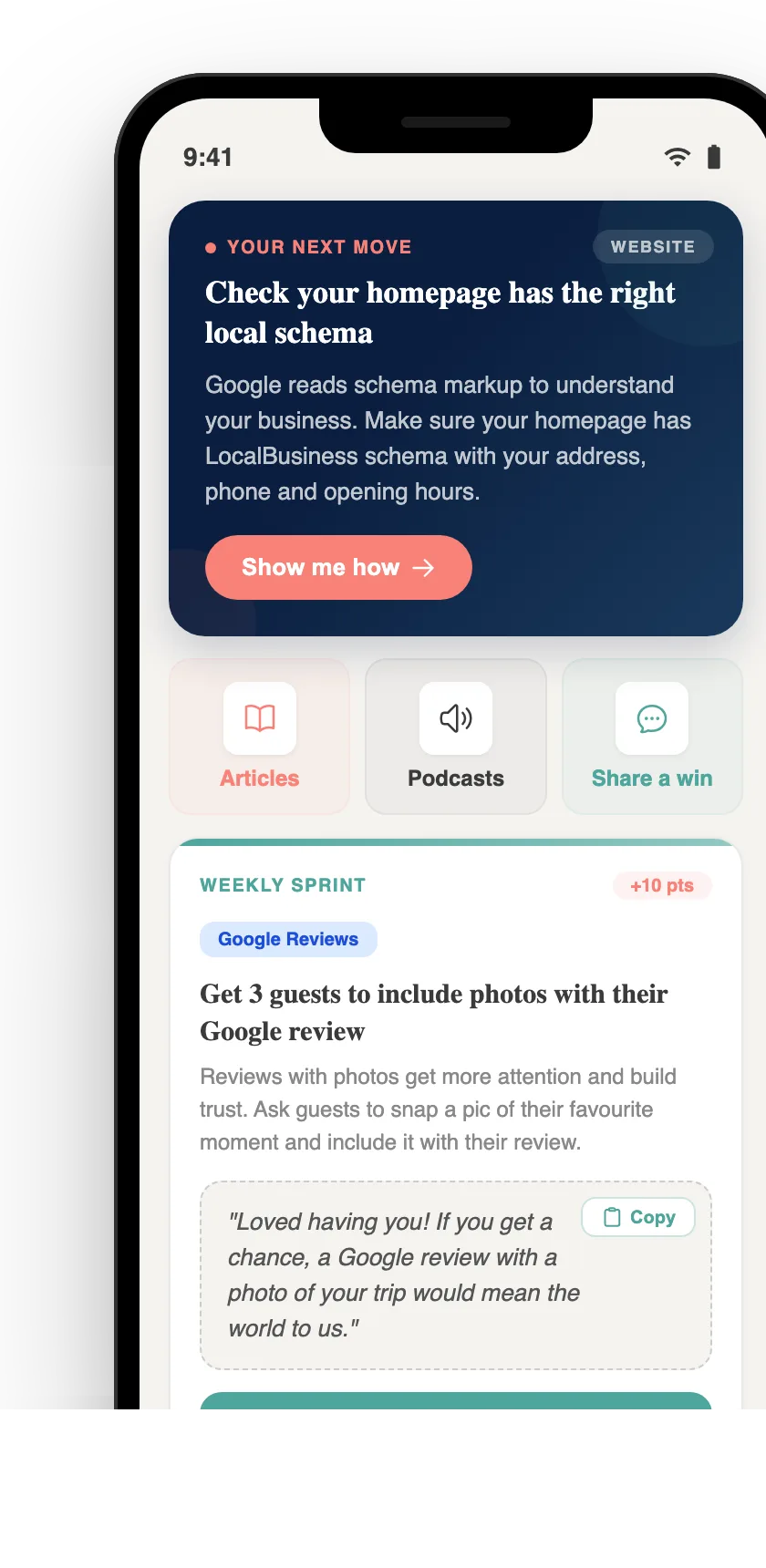
The free Pocket Rocket app gives you a personal AI marketing coach, website audit, weekly action plans and 5-minute tips. Built for tourism operators.
Get access to all our training, coaching, and tools built for tourism operators who want to grow with confidence.
Explore membership