Untangling Tourism Tech — Podcast
12 July 2024
This episode dives into the critical role of analytics in tourism marketing with special guest Lou Clifton, General Manager of Blue Mountains Tourism. This episode is particularly special as Lou reached out to discuss how Destination Marketing Organisations (DMOs) can use data to better serve their regions. Lou’s story highlights the importance of analytics in demonstrating the value of tourism efforts to stakeholders and offers practical advice for tourism operators.
Lou’s journey to this podcast episode began with her desire to highlight the pivotal role of Local Tourism Organisations (LTOs) in providing analytics to councils and visitor information centers. She recently participated in a TikTok webinar hosted by Liz Ward and was inspired to share her insights after reading an article about local government’s role in tourism. Lou realised that in regions with independent LTOs, these organisations are uniquely positioned to offer valuable data on visitation due to their control over destination websites and social media channels. This ability to provide detailed analytics is crucial for demonstrating the value of tourism efforts to local government authorities (LGAs).
Datas in tourism is not just about collecting visitor statistics; it’s about using that data to drive smarter marketing decisions. As Fabienne highlighted, without proper measurements in place, marketing efforts can become a significant drain on resources. Analytics helps ensure that every marketing dollar spent contributes to achieving tangible results.
Setting up and interpreting analytics can be daunting. The technical complexity of tools like Google Tag Manager and GA4 (Google Analytics 4) often leads to a gap between what tourism managers want to measure and how to implement these measurements. Fabienne pointed out the need for collaboration between tourism managers and analytics specialists to bridge this gap and set up meaningful metrics.
Lou Clifton’s journey in tourism underscores the increasing reliance on data-driven decisions. From her early days in PR and press office work in the UK to her current role, Lou has seen firsthand the transformative power of analytics. Working in the Blue Mountains, a World Heritage listed area, Lou balances promoting tourism while advocating for environmental protection. Her approach emphasises the importance of understanding visitor behavior through data to enhance marketing strategies.
One of the recurring themes in the discussion was the educational role tourism managers play. Lou and Fabienne both stressed the need to educate committees and stakeholders on the significance of analytics. By presenting clear, actionable insights, tourism managers can demonstrate the value of their marketing efforts and make a compelling case for continued investment in data-driven strategies.
For those new to analytics, Lou recommends starting with Google Analytics and exploring its various reports. Online resources, such as YouTube tutorials, can be incredibly helpful in building foundational knowledge. Once comfortable with the basics, tourism operators should focus on setting up key events and conversions to track important visitor interactions. This targeted approach ensures that the data collected is both relevant and actionable.
Analytics play a crucial role in demonstrating the return on investment (ROI) for marketing efforts. By tracking key performance indicators (KPIs), tourism managers can provide concrete evidence of the impact of their marketing strategies. This transparency is essential for justifying expenditures and making data-driven decisions that benefit both the organisation and its stakeholders.
As the tourism industry navigates an increasingly digital landscape, the ability to harness the power of analytics is more important than ever. Lou Clifton’s insights offer a valuable guide for tourism operators looking to enhance their marketing strategies and achieve better results through data. By starting with the basics, leveraging online resources, and focusing on key events, tourism managers can unlock the full potential of analytics to drive their marketing efforts forward.
Listen to the full episode of “Untangling Tourism Tech” to hear more from Lou Clifton and learn how you can start using analytics to transform your tourism marketing strategy.
Untangling Tourism Tech Episode 6, with Fabienne Wintle, Liz Ward and guest Lou Clifton of Blue Mountains Tourism. Times match the video. We removed filler words and fixed mis-heard names.
[00:02] Hey, Fab. Hey, how are you today?
[00:04] Hello, Liz. I’ve got a guest today.
[00:08] We do have a guest for episode six of Untangling Tourism Tech. I’m going to be introducing you to Lou Clifton shortly, but just to set the scene, we want to have a quick chat today about an incredibly important topic, and one that you get very excited about, Fab, and have been doing a lot of great work with tourism operators on recently, which is measurement and analytics. And I know that you agree with me that we shouldn’t be spending our valuable time and money on marketing, as one of those things in business that is a big sucker of resources, without having appropriate measurements in place. And I know when we kicked off 2024, we said analytics was one of the three major trends for tourism small businesses and destination marketing organisations, that 2024 was the year that they really had to put something in place to be able to start to use data smartly in their marketing. And so you’ve been doing some pretty interesting work, working with different businesses on digital marketing strategy.
[01:19] Yeah, different tourism organisations from very local small ones to, you know, big, larger regional, almost state ones. And yes, it’s always the same issue. Setting up analytics requires a bit of a mathematical brain. It’s getting harder and harder every year. Analytics 3 was probably easier. Now you really need good knowledge of Google Tag Manager, etc. And translating these business requirements into how to actually turn the knobs to set up the right measurement, the right metrics, is very difficult. And often there’s a clash between, you know, people that work in destination management organisations that want to be able to measure things, but they need to be able to formulate what they want to measure to the web developer or the analytics specialists, so that they can actually set up the metrics to measure the same things. And often it just goes into the too hard basket and it doesn’t happen. So we just want to make that happen, so people can measure what great work they’re doing to bring new visitors to the region.
[02:29] So that’s a perfect opportunity for me to introduce our guest, who is Lou Clifton, who is the general manager of Blue Mountains Tourism in New South Wales. Beautiful part of the world that you live in, Lou.
[02:42] Yeah, certainly lucky to live here. It is lovely.
[02:46] That’s fantastic. Thank you, and thank you for joining us. And Lou came to us because she commented on another podcast, which we love, and then we started having a conversation and uncovered a shared desire to really ensure that the industry is aware of, you know, the power of analytics and its role. But before we go there in that conversation, Lou, could you just tell our audience, please, a little bit about yourself and your career in tourism?
[03:17] Yeah, so thanks for asking me on after I commented. It was great. It’s nice to meet you both. So yeah, I’ve been working in tourism for around 14 years. My career started in PR and press office work for NGOs in the UK, and then I moved over, moved here, moved to Sydney to work for Greenpeace, actually. And from there I moved to New South Wales Government and worked on a major energy efficiency campaign that was very data driven, so it was actually quite a breath of fresh air. So I do understand, working for an NGO or a small business, the resources and financial ability to be able to access research is quite difficult sometimes. So it was great to work on a campaign that had research funded. And then I moved to the Blue Mountains. I worked for Blue Mountains Botanic Garden, and sort of that’s when I really started working, getting involved with tourism. Worked with a local tourism group, and then moved to National Parks as a visitor experience team leader, and joined the Blue Mountains Tourism committee, which I was on for eight years. And then just recently, a few months ago, I moved to a general manager role with Blue Mountains Tourism. So yeah.
[04:40] That’s a really great journey, isn’t it, that you’ve taken, and you’ve gone from a park, or gardens, to parks now, to selling the Blue Mountains, which are just such an iconic destination outside of Sydney and one of our best natural experiences and most scenic areas in Australia. What do you love about your job?
[05:06] I really love the diversity. I think working in tourism, you’re just working with a really diverse range of people, operators of all shapes and sizes, but generally you’re working with people that have a passion for the region and for driving the visitor economy, getting people here, advocating for the protection of where we are, because we’re in a World Heritage area. So that’s really important to us and our messaging and our marketing. And so yeah, just promoting a beautiful place that’s a World Heritage listed national park, or in the World Heritage listed area, is fantastic.
[05:50] Yeah, we often understate that, don’t we, in tourism, that we have such beautiful products to sell, to protect, which is so important. So Fab was saying before how she’s encountering a lot of businesses who are seeking her assistance to improve their marketing, and she’s kicking that off with implementing analytics and making it easy for them to use it and understand it. And because our industry is 95% small to medium enterprises, a lot of them, it’s their first exposure to using data in the business, and as you referenced, for their own kind of research as well, and to be able to make decisions. So you mentioned about the energy NGO project. Have there been other situations in your tourism career where you’ve been able to sort of push that, or make recommendations around using analytics, and then being able to operate with them?
[06:53] Yeah, I mean, when I was at the Botanic Garden at Mount Tomah, we had a sort of locally managed website, that sort of changed now, but because of that I had access to the Google Analytics, so I was able to delve into that and have a look at what was going on. I’m pretty sure from memory that it was a lot simpler. I think, as Fab said at the beginning, 10 years ago the analytics that we were looking at were probably pretty basic, and I think when you look at GA4 now, it is quite overwhelming. So yeah, I guess I was looking at that stage at how our website was working, how many visitors we were getting, where they were coming from, the most visited pages, and all those sort of basic analytics that you get from Google.
[07:44] And now with Blue Mountains Tourism, I mean, I’m just sort of getting my head into all of that at the moment, having just moved from the committee to this role in March, but far more using Google Analytics, but also looking at all our Meta analytics for our socials as well. And there’s great data in being able to see, you know, what’s performing best and who’s responding and where they’re coming from, and those sorts of metrics. We’ve also had some destination marketing campaigns in market through agencies, and so that’s really great because they’ll set up analytic reports for us.
[08:26] And how difficult has it been to kind of bring it in, in your role as GM? Have you had to sort of make cultural adjustments or invest in training? What have been the things that you’ve had to do to get it going?
[08:40] I think, I mean, it’s pretty early days, I think. At the moment, well, I report to the committee, so a large part of the reporting that I provide comes from the analytics, so I can show how our channels are performing. And then that’s also important in terms of our stakeholders, especially members. So, you know, we promote our marketing channels and sell marketing services to our members, and so they want to know what they’re getting for their dollar. So it’s really important to be able to show where our visitors are coming from, what the visitation is. We can even track numbers of people clicking on Book Now buttons on operators’ pages and so on. But I’m sure that Fabienne would be able to show me a whole lot more. What do you think, Fabienne?
[09:39] That’s great to hear that you’re already on the right track, already doing that. Yeah, so what I feel like people forget they can do, and they might not forget, they might not realise actually, is it’s great to see what’s happening on the website, but you actually want to be able to measure the key actions that people take. So what is the reason of your existence? Is it to pass on leads to operators? Is it to pass on clicks to operators’ websites? Is it to get people signed up for a lead generation automation that you might be doing? So setting up those conversions, they can now call them key events. They keep you on your toes all the time.
[10:27] Yeah, that’s really confusing with that event terminology, isn’t it?
[10:30] That’s right. That’s the new difference.
[10:33] Yeah, when I put that into reports, it’s like, no one’s going to… It looks like that’s an event. It doesn’t…
[10:40] An event is an interaction. So remember the old days, we were talking about hits. So the more hits you had… That’s all you could measure, right? Liz and I, I think when we met, we were talking about hits, and then we started talking about visits to pages. So that was kind of the basic things that analytics could measure. But a visit is actually one type of interaction, one type of event. There might be a page scroll, so someone scrolling down the page, that’s another event. A click is another event.
[11:09] So basically now there’s a gazillion interactions that are measured automatically, yet you still need to create your own custom ones, because it might be a click on a specific button on a specific page that is your operator listing, and that is obviously an event. But if it’s a really important event in your business strategy, that’s a key event or a conversion. And you actually need to programmatically program these depending on how your website’s been designed, because if you track a click, it’ll track clicks everywhere. So you really need to get a specialised developer that understands how Google Tag Manager works to be able to set that in place for you, so you’re actually, you know, counting apples and not all the fruit in the fruit salad. And that’s where it gets really difficult. But once you’ve got this set up properly, then you can really report on so many people coming to this page, but only, let’s say, 1% click the button. Oh, is there a problem with the page? Are they in the wrong headspace? So that’s tracking these really important interactions, is what’s really important in Google Analytics.
[12:21] Yeah, definitely.
[12:24] And I suppose with the two of you, you’re very much educators, aren’t you? You must be educating all the time, Lou, when you’re presenting these reports to committees or tourism operators. You’re constantly helping them understand what it means. Is that right?
[12:40] Yeah, I mean, I guess there’s different levels. Some, I mean, some operators are really savvy, so they’re probably across a lot of this. And I think, you know, part of the challenge is that it is pretty overwhelming for people to look at it and then understand it. And I certainly think that I’m just really scratching the surface of what’s possible with our analytics. And we have been quite lucky in terms of campaign performance, you know, those reporting and the measurements are provided for us. So yeah, just sort of getting into the back end of GA now and trying to figure out, yeah, what those key events are, as Fabienne said, and what we need to set up ourselves so that we can better track for our operators is, I mean, it’s a lot of work. So, and it’s like putting the time aside to work on that when you’ve got all the reactive things going on. I think that’s a big challenge for all of us.
[13:42] And I guess if you haven’t got a board or a committee who’s asking the hard questions about the return on investment, while that can happen, the operational staff or GMs don’t need to be as motivated about implementing good reporting. Yet then you get this latent kind of issue of not really being able to clarify the role of the destination marketing organisation and the value that they’re bringing. So it is important what you’re doing, making that investment of time to be able to get the right reporting out and educate your committee, and the stakeholders, about the value that you’re driving.
[14:24] Yeah, absolutely. I mean, the numbers, you know, the numbers talk, don’t they? So as long as you know what you want to achieve, then you can figure out how to measure it. But if you don’t really know what that end goal is, then it becomes very hard. Like you said, you’re just looking at everything, and it becomes a bit meaningless. So if you, you know, if you need to, and we have and we do report on return on investment. And we have, so we received a bushfire recovery grant funding over two years, a couple of years ago, we being Blue Mountains Tourism. I was on the committee then. And so that was very return on investment driven, and we had key performance indicators that we had to report on. So yeah, it’s really important to know what those KPIs are so that you can set up the right measures to be able to report on them. And you need to have that figured out at the outset.
[15:24] But Fab, with the work you’ve been doing with clients, have there been examples of where they’ve been able to make decisions based on the data that you’ve been able to help them extract and report?
[15:38] Yeah, actually a common one is some tourism organisations, you know, realise that, oh, it’s not actually the website button that people click, it might be more so the email enquiry button on an operator… Or, wow, we’re getting a lot of visits to this page, but not as many clicks as what we’d hoped, to pass leads to operators, so we need to fix the design of the page. So yeah, once they… It’s hard as a DMO, because you don’t really sell anything specific, like, your number one role is probably to educate about the destination, not putting bums on seats or bums in beds. And that’s what talks to operators. So if you can get closer to showing them how much business you’re passing on to them, then suddenly they listen better.
[16:30] But a lot of the times DMOs have a, you know, it’s a hard yard to actually go and show the value to operators, you know, when it is about dealing with council or policy development or, I guess, creating new blog articles or getting influencers in town. But it’s hard to really translate that: how much money did that generate for you? So analytics allows you to get a little bit closer to that money in terms of leads. And then now Bookeasy has actually finally integrated GA4 tracking, so DMOs that use Bookeasy can actually show, or can actually track, where these bookings are coming from or what marketing campaigns are working to put bums on seats.
[17:16] That’s so good. And is it able to drill further down, more into sort of, like, psychographic segments, Fabienne? Or is it just still… I mean, I’ve only really seen demographic information, because, I mean, that’s something in terms of, well, who are our real target markets, and are we reaching them, beyond just male, female?
[17:39] Yeah, you can. It relies on people sharing that information with Google, but you can turn on some segments. Unless you’re a massive organisation, I don’t see it gives you very specific data. Yeah, yeah. But the fact that, you know, it can actually tell you what campaigns are working, as in marketing campaign. I’m not talking about an advertising campaign. It could be simply updating your Google Business Profile. Any effort that you put in, I would call a campaign. It can actually show you which campaign leads to more enquiries, yeah, you know, new signups. That’s really important. So I would probably go after that one first, as opposed to the psychographic.
[18:21] Yeah, yeah.
[18:22] Okay, so speaking of going after that one first, would you have a piece of advice, Lou, for local government associations or local tourism organisations, in terms of where they should start? What would be their starting point to be able to have better performance measurement?
[18:44] Starting point would be to make sure that they’ve got access to Google Analytics. So, and then just have a play around. You can’t break anything. Have a good look around at all the different reports and the different screens that it gives you. And then I would probably just watch some YouTubes, some basic YouTubes, to sort of like get a bit of an idea on basic analytics. And then if someone wants to take it a bit deeper, probably talking to someone who has deeper knowledge, like Fabienne. But yeah, that would be my suggestion.
[19:24] That’s great. I love that, that you’re recommending people start by watching YouTube videos. That’s right. Like, just bridge the gap of not knowing what you don’t know. You’ll get so much further from investing and getting a professional to look at things.
[19:38] The other thought I have too, because I’m always interested in the outcomes, is to put yourself in the shoes of a board member sitting around the table. What do they need to ask? What should they be asking? Because they don’t know what they don’t know either. So what should they be asking? And that’s what you need to learn how to present. So if you start with the outcomes, then work backwards, you can kind of then build your knowledge and put in place the reporting and tracking that you need to be able to get to that outcome of answering that question. Because at the moment, most volunteer-run tourism boards or committees, I don’t think there’d be an enormous amount of knowledge on measuring return on investment through digital marketing.
[20:30] Yeah, and I think, you know, there’s a lot of work for those volunteer committees as well, so, you know, they’re really interested at the high level. And I think then it’s important to just focus on, you know, what the most important metrics are to get that longer term outcome. You know, it might not just be, we’ve increased visitation to the website by X number of…
[20:55] That’s gone, 15 years ago, gone. It’s because they might stay one second with that.
[21:01] That’s right. Yeah, that’s right. Yeah, and that’s so changeable as well with other things that are going on in the marketplace. So are there campaigns running? Are big operators running campaigns? Is there something else going on? So there’s a lot that can impact that. So I think, yeah, it’s interesting looking at those events. I can kind of understand why they’re not called conversions, because I guess in my mind, conversions was about creating a booking, which we might not necessarily do via our website. We might indirectly do that. So it’s great to be able to look at, yeah, are people clicking on particular buttons, and how are they actually… what’s their behaviour when they come to the website?
[21:46] Once again, you don’t know what you don’t know till you start to scratch the surface. Yeah, I’d like to wrap it up there and say thank you so much for your time. There’s nothing better than speaking to a professional in the industry who is working on a daily basis in the fields that so many others want to learn about. And you’ve been very generous with your time, and now forever and a day, your words of wisdom will be out there, and you’ll be inspiring others in similar roles to be able to take those first steps to improve their businesses and their organisations. So good on you. Thank you so much, and enjoy life in the Blue Mountains.
[22:29] Thank you. Thanks for the invite. I’ve certainly got a lot more to learn myself, so…
[22:35] Don’t we all. Thanks, Lou. Thanks, everybody. Bye.
[22:38] Bye.
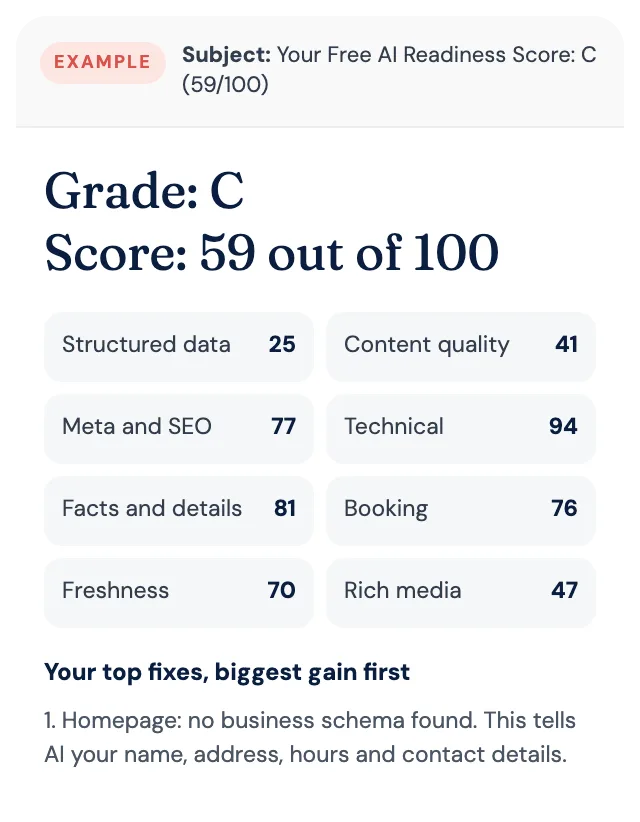
Free AI Readiness Score
Get your grade, a score out of 100 and your top fixes, by email. Free for tourism operators. No login and nothing to install.
Get access to all our training, coaching, and tools built for tourism operators who want to grow with confidence.
Explore membership