Untangling Tourism Tech — Podcast
17 November 2025




Tourism operators are still hesitating to post video because they’re chasing a level of perfection that no visitor actually cares about. In this episode, Liz and Fab walk through why short video is now the most powerful visibility tool you’ve got, how to keep it human in an AI saturated world, and the simple tricks that make creating and repurposing content far easier than you think.
If you’ve been sitting on the fence waiting for the stars to align before you hit upload, this one is your nudge to get moving.
Video isn’t “the next thing.” It’s the in thing…now! Instagram has become a video-first platform. TikTok continues to set the pace. YouTube Shorts is exploding as well. The truth is right there before our eyes: short video is where the people are watching. So if you want to be seen, jump on board.
But, we’re still finding operators and DMOs waiting (hoping) for the perfect lighting, perfect script, perfect timing or a perfect hair day. Let’s be honest, just avoiding it because – it’s scary to put yourself out there! Meanwhile, the operators grabbing attention are the ones filming a 15 second clip on their phone and posting it that same day.
People want entertainment and education, fast. Video delivers that better than anything else in your toolkit. And viewers no longer expect perfect and polished – they tend to like the real and gritty world, bloopers and bad hair included.
Liz and Fab hammer this home in the episode. You don’t need a production studio. You don’t need a brand package. You don’t need a complex storyline.
You can literally start with:
• a handful of photos
• a simple CapCut template
• a quiet audio track
• a clean hook in the first two seconds
That’s enough to tell a story, spark interest and start building confidence.
Once you’ve hit record a few times, your speed improves, your ideas free up and the whole process feels far less intimidating.
Viewers aren’t sitting around hoping to see another perfectly staged shot of your rooms or your café counter. They want you. They want the why behind your recommendations, the personality of your team, the real snippets of your region that make travellers think, “I want to be there.”
You as the operator are the difference. Your story. Your personality. Your jokes. Your take on the place you call home.
Show that, and people will watch and keep watching.
The episode also dives into ethical and practical AI use. Yes, AI can help you script a video or write a caption, but if you just copy whatever the tool spits out, you’ll sound like everyone else using the same prompts.
AI is starting to get good at detecting AI, so use it as your helper, then edit with your own tone, words and point of view.
Authenticity hasn’t gone out of fashion at all, it’s now your competitive edge.
One of our favourite hacks is using tools like Veed.io to turn a longer video into multiple short clips. Record it once, repurpose it over and over. It’s one of the easiest ways for time-poor operators to stay consistent without reinventing the wheel each week.
Other simple pro tips from the episode:
• Keep key subjects centred so your footage works in ads
• Leave space top and bottom so captions don’t overcrowd your visuals
• Don’t plaster your logo everywhere
• Let simple voiceover or music tell the story
• Practice inside Instagram or TikTok daily to keep upgrading your skills
Dead easy, no, but definitely achievable with zero fancy gear if you’re willing to put yourself out there.
At the heart of this episode is one message: stop waiting for perfect and post the video.
Your visitors aren’t scoring your cinematography. They’re looking for personality, honesty and a glimpse into what makes your experience worth their time and money. Every day you don’t post, someone else does.
Tourism Tribe members get access to our twice-monthly tech sessions where operators ask real questions, get practical demos and build confidence with tools like CapCut, Canva, ChatGPT and more.
If you want support, clarity and a community that’s actually using this stuff weekly, check out the memberships and join us.
Because the platforms have made it clear that video gets pushed further and seen by more people. A simple 10–20 second clip will outperform a beautifully staged photo nine times out of ten.
Nope. Your phone, a steady hand (or a cheap stabiliser if you’ve got one) and a clear hook in the first couple of seconds are all you need. Visitors care about the story, not the production value.
Join the club, I don’t know anyone who does. To push past this aversion, start by filming what you love in your region or add a voiceover if showing your face is too scary for now. But over time, showing up as the human behind the business will always connect better.
Use AI to draft ideas or captions, then tweak them so they sound more like you. Don’t copy and paste the output directly, because it shows, and most platforms can spot untouched AI anyway.
Aim for consistency over volume. Even one simple reel a week is enough to build momentum, sharpen your skills and keep visitors discovering your business.
Untangling Tourism Tech Episode 16, with Fabienne Wintle and Liz Ward. Each line shows who is speaking and when. Times match the video. We removed filler words and fixed mis-heard names.
[00:00] Fabienne Wintle: Hi, Liz.
[00:02] Liz Ward: Hi, Fab. How are you?
[00:05] Fabienne Wintle: Great. Episode 16. Welcome, everybody, to all our listeners. Thank you for all your questions and continuous support. This is the second episode of our social media in the Age of AI series. What are we talking about today, Liz?
[00:24] Liz Ward: I really want to talk about video and its critical role in repurposing of content. Also, I think we have to include in this series a discussion about use of AI ethically and thinking about how to avoid the failure points of using AI in your business. Video, and I know you’re passionate about this too, Fab, and here we are making a video. We know that video is no longer negotiable in social media, yet we’re still meeting tourism operators and even destination marketing organisations who are reticent to jump in there. It’s like they’re waiting for the perfect moment or to create the perfect video before they post it. Yet if we think about what gets the most eyeballs, what gets the most engagement, it is short videos. So we’re well past needing to understand that Instagram has repositioned itself as a video platform.
[01:35] You’ve only got to go into reels and start scrolling or do a search on something, and it’s very hard to extract yourself even if you’re not a big social media user because of the journey it takes you on. It’s highly entertaining or it’s highly educational, and you’ll get the same on TikTok, and the thing with TikTok is whilst, yes, younger demographic on TikTok, it’s a great demonstration of what is people are valuing in terms of video content. So the search filters that you can use on when you go onto TikTok and you don’t need an account to do this, it really helps you to understand what content based on search terms and hashtags is the most searched on.
[02:28] So it’s really great to understand what is that people want in terms of video content, and it’ll all come back to entertainment and education, and we need to start thinking of ourselves as content producers. Think of video on social media as the new TV because that’s how people are using it. If you want your destination, the experiences you offer in your businesses to be part of that TV show, then you need to be creating video.
[03:06] Fabienne Wintle: The short and sharp videos, very topical, it’s not a TV production. Do you remember in the old days, there was this term called UGC, user-generated content.
[03:23] Liz Ward: I’ve forgotten that.
[03:25] Fabienne Wintle: That’s exactly what it still is. But as a tourism operator, it doesn’t have to be a video about your rooms, about your latest concrete or your latest carport in your motel. It’s got to be your eye experiencing the region or interviewing your staff. What is different about your business? What’s the heart and soul behind it? Don’t be scared to be on camera and give your opinion. I guess like you and I are doing, let’s say we’re videoing this content. We could be sharing our screen, but we’re not. We’re having a discussion about our expertise, and that’s what people love. Showcase your region, why you love this coffee shop, why you go there every day, while you recommend this tour to operators. What is so special about the fish or the dolphins in the creek? Short and sharp, informative pieces of content.
[04:29] You need to be really familiar with tools like this one that I’m showcasing on our video. This is for people that are listening to us. This is a DJI Osmo tool that just allows us to film video when we’re walking, let’s stabilise. You need to be familiar with how your phone works to obviously create this video content, but with the editing tools or tools to just make it a bit more polished video as well.
[05:04] Liz Ward: Yeah, absolutely. The different forms of video you can start quite simply. We’re seeing people who are completely new to creating videos for social media, whether they’re going to post them onto YouTube Shorts or Instagram Reels or TikTok, which is super easy to post to, by the way, is start with something really simple. You might start by just creating a video that is made up of images and put some music underneath it. Don’t put your brand all over it. Keep it clean. Make sure it’s entertaining and that the very first few seconds of that video is really hooky. You know, people really want to watch it. That’s still so important. It doesn’t have to be perfect. It doesn’t have to be a massive production, but it needs to tell a story.
[05:57] You don’t want a disjointed video that’s got really kind of random different styles of images in it. It needs to sort of have a flow to it and tell a story. And as you say, Fab, you could add a voice over to that and you could have a nice quiet track of music sitting underneath it as well if you want. You just want it to be entertaining and keep people’s attention. And I think you had a great tip the other day you shared with me, which was when you’re making a short video for Instagram, say, for example, and it’s in the 9:16 ratio, 9:16 ratio in terms of size to position your content, your subject matter in the centre, leaving like 50 pixels. I think it was 20% gap, 20% gap top and bottom.
[07:00] So that if you do want to use it later on in a paid ad, it will fit into the space there. I thought that was a great tip.
[07:07] Fabienne Wintle: Yeah, and it’s just a nice one because as well, you know, the bottom on Insta, there’s going to be subtitles or whatever, the captions, not the caption. Yeah, the message that you put in your reel anyway and under the top, there might be something else. So just when you shoot something, have it in the centre of your screen, not the important information, the important content, don’t put it too much at the top. It’s just a nice little tip that allows you to easily repurpose your content. And look, if you forget that, you’ll learn it really quickly when you try and do an ad later. You’re like, “Oh, gosh, I wish I’d just thought about that one.” Yeah, so practice makes perfect, you know.
[07:51] And the other thing that we see, and I’m the first one to constantly have to update my Instagram app and just refresh myself about how things work, is be really familiar with your tools. Use it regularly. The more you try and post, the more you try and edit in Instagram, it just becomes second nature. Just force yourself every day, even if you’re not going to post, to go and practise. So that when you’ve got this great idea, hopefully this planned great idea, it’s much faster.
[08:24] Liz Ward: I saw absolute transformation in a workshop recently where I taught the entire group to use CapCut, either on their phones or on their laptops. And there were people in that room who had never edited a video before, and it really was testament to, if you’ve just got a little bit of hand-holding and guidance, how easy these tools are to use now, so it was just fantastic. I’m going to jump ahead a little bit and just talk about another key tool in social media production, of course, is using something like ChatGPT to be able to write captions for our social posts, script a video even, and we’ve got amazing training materials on scripting videos, which is great. So that’s fantastic.
[09:08] We can really very, very quickly design a stack of videos from a scripting perspective coming out of our content pillars, and there’s a great process for doing that, which we even have as custom GPT that we can share with people. But what I want to just talk about is keeping it very real in the age of AI. So it should absolutely be a time saver, but don’t let it steal your voice. Use it as your assistant, but don’t let that experience get generalised, your brand voice get taken away. You need to have your brand voice and your values at the centre of these stories, and this is super important, and there’s AI detection tools out there. I’ve tested a couple of them. They’re damn spot on.
[10:02] If you just put in AI-generated caption, for example, into them, it knows, and then if you put in one you’ve written or even changed from taking an AI caption and you’ve added your pieces to it and changed the words a bit, it can’t detect it. So we have to use it as a tool, but then make sure that we rewrite it and also be transparent. So when you see on Instagram you’re about to post and it asks you, is this AI-generated, it can tell anyway. So just fess up. It doesn’t matter if you say yes. If you have edited using AI, had AI assistance in creating your image or video, just say yes, because it’s going to know. It’s not going to penalise you for it. It’s about ethical use of AI and being transparent about that.
[10:57] So I just wanted to end our session on that and also say to people, if you’ve got any questions, always come and ask us. Let us know. We’re happy to try to field them or point you to research that will support these things because it’s moving so fast and we want to make the best possible use of AI and we want to make the best possible use of video as well. But I bet you’ve got one other tip for people, Fab. I’m just thinking what you should share is your passion point on repurposing video and how it’s so core to making the most of your content.
[11:38] Fabienne Wintle: Well, my little tip about video, veed.io, Liz, is that the one you’re thinking about?
[11:43] Liz Ward: Yes, I am.
[11:44] Fabienne Wintle: So there’s some great tools. If you actually record a longer video and you’re like, oh, I wish I could just easily edit and make it short, you could use tools like veed.io, where you’ll throw your large video into and it will create shorts for you. So use smart tech to help you with the editing, but use your ideas, your brain, your voice, your identity, not your clone, by the way, which you can already do, but use yourself to be on video. Make it all about you because that’s all we’ve got left, right?
[12:20] Liz Ward: That’s right. That’s right. We’ve just got to be ourselves in the world of AI.
[12:24] That’s great. Great point to end on, Fab. And hopefully we’ll see some of our listeners in a future group tech session. Check out our memberships on Tourism Tribe so that you can come in and join other really curious and people in your industry, other tourism operators and destination marketing organisation professionals who are really curious about AI and technology and want to keep learning. And that’s a great place to meet them and bring your questions is to the twice a month group tech sessions.
[13:03] Fabienne Wintle: Excellent. Thanks, Liz.
[13:06] Liz Ward: Thanks. Bye.
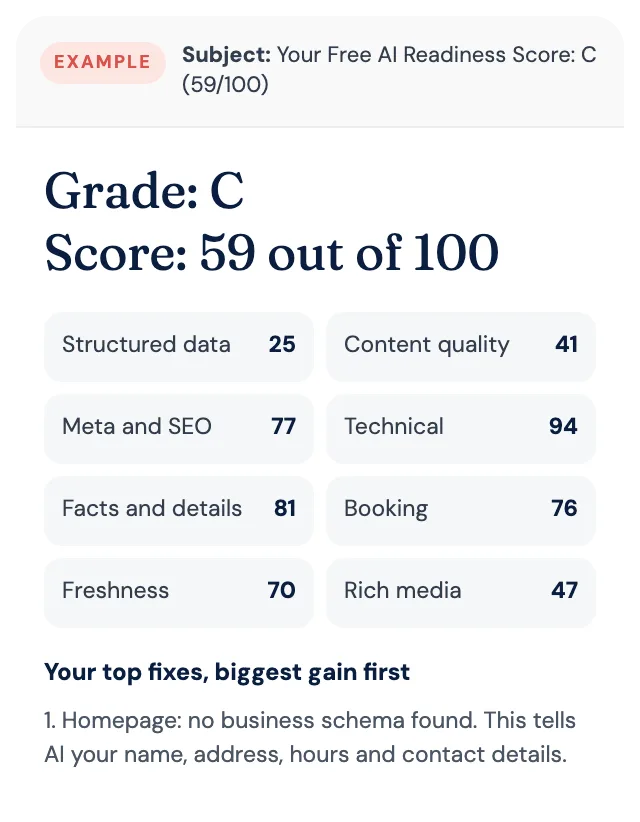
Free AI Readiness Score
Get your grade, a score out of 100 and your top fixes, by email. Free for tourism operators. No login and nothing to install.
Get access to all our training, coaching, and tools built for tourism operators who want to grow with confidence.
Explore membership