
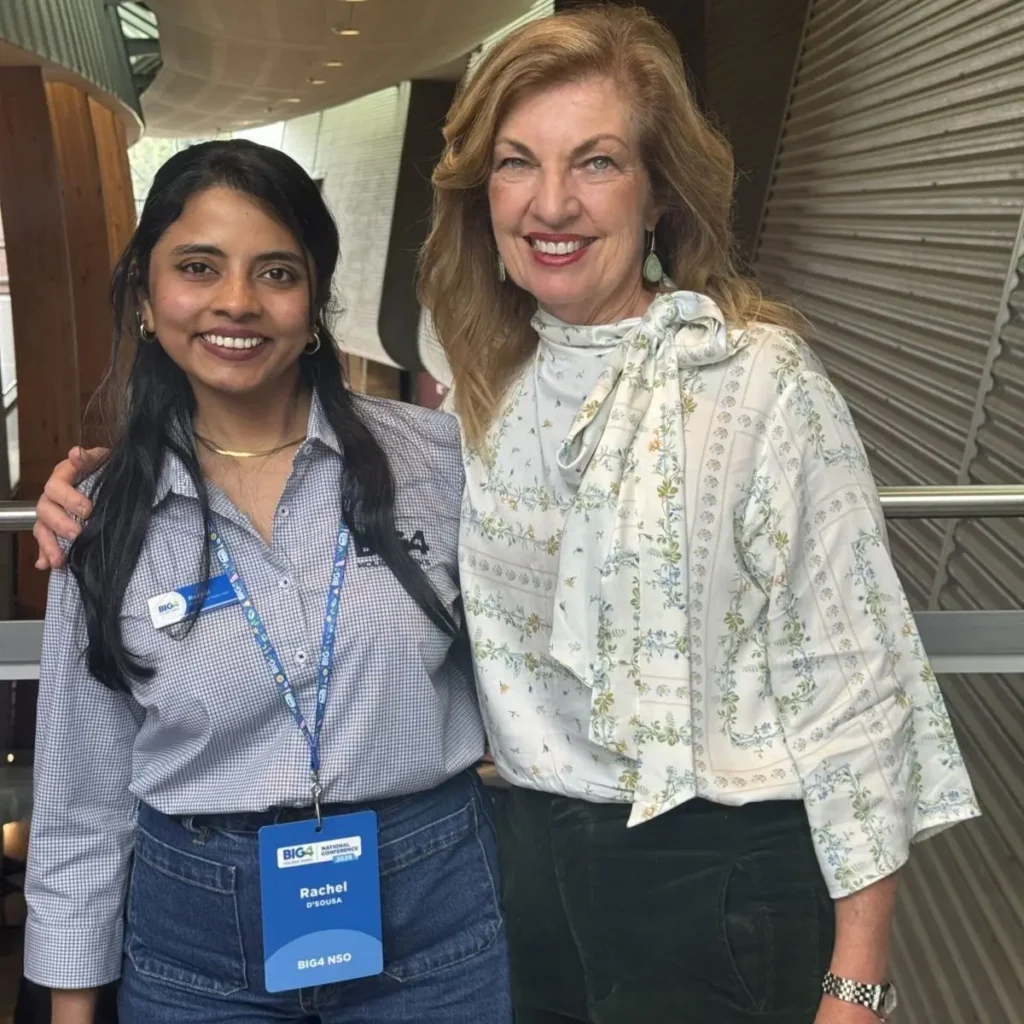
AI search is changing how travellers compare holiday parks, putting more weight on the details that help someone decide whether a park meets their needs. At the BIG4 National Conference on 13 October 2026, Tourism Tribe co-founder Liz Ward explained what this means for park operators and the information they publish online.
Her starting point was practical: your BIG4 page should know your park as well as you do. The accommodation facts, local knowledge and answers you share in a conversation need to be easy to find on the page, too.
Quick links
- How AI changes the guest’s shortlist
- Give your BIG4 page the detail only you know
- Write with facts guests can use
- Keep your information consistent
- Turn guest questions into useful content
- Choose three changes and test the booking path
- Frequently Asked Questions
How AI changes the guest’s shortlist
A traveller can describe a whole trip to an AI assistant and ask it to suggest places that fit. Liz demonstrated this with a 12-day road trip from Brisbane to Cairns, travelling with a small dog and looking for dog-friendly cabins in caravan parks.
That request contains much more information than a short search for accommodation. It gives the route, the length of the trip, the accommodation preference and an essential requirement. A park needs clear information about those details to be considered a suitable option.
Liz described the process as summarising, matching and comparing. The AI pulls information into a shorter response, looks for options that meet the traveller’s needs and produces recommendations. The guest can then ask follow-up questions within the same conversation.
For operators, her point was to consider whether the park appears in that discovery process, alongside familiar measures such as website visits. A guest can now form a view of a property before opening its website. The information available about the park needs to support that decision.
Liz also explored the direction of AI-assisted booking and agents taking on more of the work involved in planning a trip. Her practical advice was to prepare the information those services would need, rather than wait for the booking experience to stop changing.
Give your BIG4 page the detail only you know
BIG4 and its parks contribute different parts of the same guest experience. Liz highlighted the shared brand, website, marketing activity and publishing tools, then focused on what individual parks bring: accurate accommodation information, current photos, local knowledge and the details that make each park distinctive.
Those details are often obvious to the people who work at a park. They may be less obvious to someone comparing several properties for the first time. A brief description that feels sufficient to an operator can leave a prospective guest with unanswered questions.
Think about what you would tell someone over lunch if they asked about your park. Which guests does it suit? What is different about the accommodation? What has changed recently? What can guests do nearby?
Bring that knowledge into your webpage. A useful page helps a visitor understand the experience well enough to decide whether to take the next step.
Write with facts guests can use
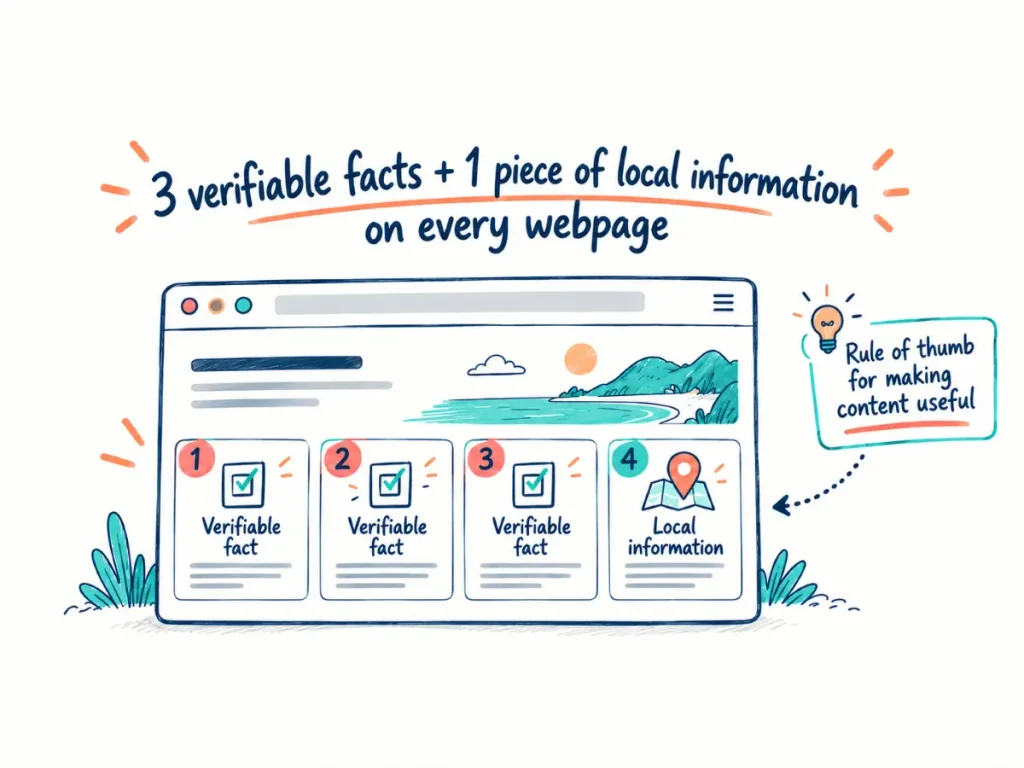
Liz offered a simple writing prompt: include three verifiable facts and one piece of local information when reviewing a page. This is an editorial rule of thumb for making content useful, rather than a formula that guarantees an AI recommendation.
The aim is to replace vague descriptions with information that answers a real question. Accommodation capacity, bedding configurations, inclusions, access features, restrictions and suitability all help a guest compare options.
For example, saying a park is pet friendly leaves room for interpretation. A traveller with a dog needs to know which accommodation options welcome pets and what conditions apply. That distinction mattered in Liz’s road-trip example, because she was looking for cabins.
Local knowledge adds another useful layer. Explain the nearby experience or facility a guest is likely to ask about, with the relevant details. Choose information your team can verify and keep current.
Copy still needs to read naturally. Liz’s advice is to make the writing more factual while keeping it helpful to the people reading it. Photos create an impression, and the words explain what someone can expect.
Images must reflect the experience a guest will actually find so be mindful if using AI to polish images for websites. We encourage real, unfiltered content for social media use, users are looking for authentic images that show the real experience in social channels these days.
Liz also raised structured data, often called schema, as a discussion to have with the person who manages the website. It labels information about the business and its content in a form AI can interpret, and should reflect the information visitors can actually see. Learn more about Schema Markup for Tourism here.
Generative engine optimisation, or GEO, should also be applied to improve how a business can be understood and discovered through AI-generated answers. The practical work of GEO overlaps with sound search engine optimisation (SEO): useful content, accessible pages and accurate information. Google’s guidance on AI features confirms that established SEO practices still apply to AI Overviews and AI Mode, with no separate special markup required.
Keep your information consistent
The facts about a park should agree across its BIG4 page, its own website, Google Business Profile and its Australian Tourism Data Warehouse listing. The writing style can vary between channels, but accommodation details and policies must remain consistent or AI considers it a signal that this information is likely incorrect and will suggest alternatives that it trusts.
An operator might write in a personal, first-person voice on their own website and use a different style on a shared listing. Both can work. What matters is that a guest gets the same answer about capacity, facilities, accessibility and restrictions.
Treat each accommodation page as a page someone could arrive on directly. Include the information relevant to that product, rather than assuming a visitor has already read the homepage or another part of the site. And be specific about facilities. An opening time, an access condition or a limitation may feel like a minor detail to staff, yet it can determine whether a facility meets a guest’s needs.
Start with facts that affect a booking decision. Check that they are current, easy to locate and expressed clearly wherever your park appears. Genuine reviews and active social pages are also places a visitor can look for reassurance about the business once it has been suggested through AI or other sources.
Turn guest questions into useful content
Bring the knowledge held by staff into your web pages and frequently asked questions. The questions guests ask your team are a useful starting point for website content. You most likely already have the answers in the form of emailed questions and replies. Use AI to prepare answers to frequently asked questions across your inbox. Then park team can check that it accurately describes the property and answers the question clearly.
That includes local knowledge built through experience. Your team knows the nearby activities, seasonal differences and practical advice that help visitors get more from their stay. Explain those things in language a guest would recognise, with specific information they can use.
Write as you would speak to a guest, while keeping the answer direct. If more detail is needed, make it easy to reach the relevant information. A useful FAQ should help someone understand the answer without needing to contact reception for the basics.
When using AI-assisted writing: give the tool context about the location, audience and purpose, then add the lived experience your team brings to get useful output that sounds like you.
Photos deserve the same attention. Show the actual accommodation or facility and keep the surrounding descriptions accurate. Descriptive alternative text and relevant page text help explain what an image shows. Work with your website team if you need help adding that information.
Put one useful improvement into practice
Your first step to making improvements for AI search will take you back to the information all park operators already know best: your accommodation, your guests and your local area. Choose one page, check its facts and add an answer that will help the next guest make a decision.
A useful first pass is to choose one accommodation page and work through it from a guest’s perspective:
- Check the facts that affect a booking: capacity, bedding, inclusions, access features and restrictions.
- Compare those details with the same accommodation on your other listings.
- Review the photos and the words explaining them.
- Add a clear answer to a question your team regularly receives.
- Include a piece of useful local knowledge that reflects your team’s experience.
Choose three changes and test the booking path
Your next step: choose three changes to take away from this article. Audit your website, review your FAQs, check webpages for verifiable facts and personal knowledge and check your images.
Then test the booking path on a phone. Go through the process yourself, or ask someone else to try it, and check whether it is easy to understand the options and move towards a booking. Clear booking buttons, product conditions and a way to get help all matter once someone is ready to act.
Your goal for the customer journey: be found, be understood, be trusted and make booking straightforward. Keep track of what changes and what needs attention next, so the work becomes a manageable sequence of improvements.
Help with your next steps
Tourism Tribe’s Pocket Rocket website audit is a great starting point for reviewing your website.
If you want help deciding where to focus, Tourism Tribe’s GEO Assessment reviews your online presence for AI discovery. Our Digital Direction Plan provides ongoing strategic guidance, while AI Enablement Plans provide training and support to help you put changes into practice.
Frequently Asked Questions
What is GEO for a holiday park?
Generative engine optimisation, or GEO, is work to help a business be understood and discovered through AI-generated answers. For a holiday park, that includes clear accommodation descriptions, accurate policies, useful local information and consistent facts across its online presence. It builds on existing SEO work and does not guarantee inclusion in an AI recommendation.
What should a caravan park update on its website first?
Start with the information a guest needs to decide whether the park suits them. Check accommodation capacity, bedding, inclusions, access features and restrictions, then review photos and FAQs. Also include the distinctive details and local knowledge your teams share with guests.
Should the wording on a Big4 park’s website match its BIG4 page?
The writing style can be different, but the facts should agree. A park might use a personal voice on its own website and a different style on a shared listing. Guests should still get the same answer about accommodation, facilities and policies.
Why does local knowledge matter in holiday park content?
Local knowledge helps a traveller understand the stay beyond the accommodation itself. Staff can explain nearby experiences, seasonal details and practical considerations that a generic description misses. Bring that knowledge into your pages and FAQs to really bring the experience to life for travellers considering a stay.
Can AI help a park write its content?
Absolutely. Give AI tools clear context about the location, audience and purpose of an article. Add the experience and practical knowledge of your team, then review the result against the facts of your business. That gives the tool something specific to work with and keeps the content grounded in the actual guest experience.
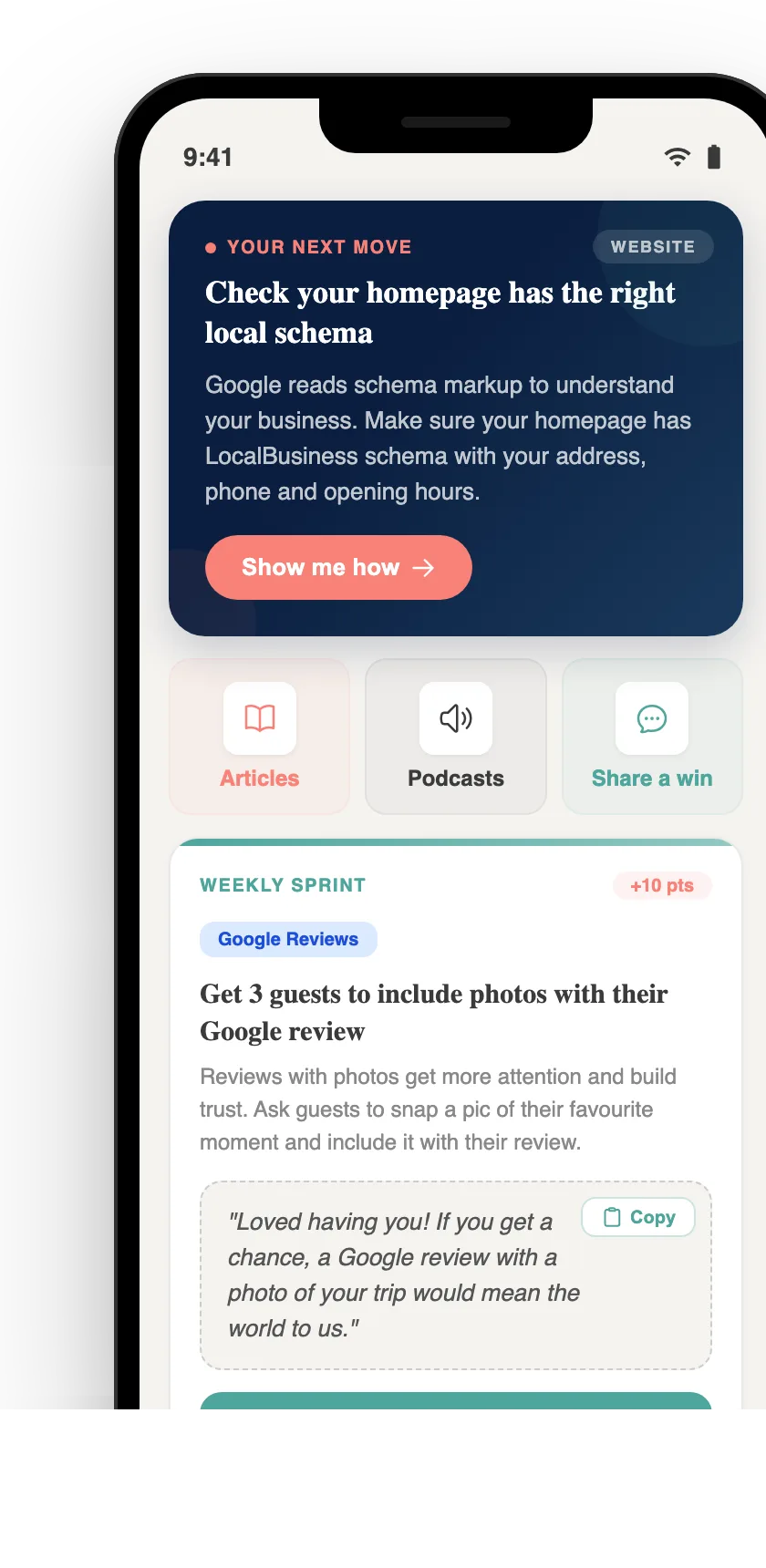
Your free AI marketing coach, right in your pocket
The free Pocket Rocket app gives you a personal AI marketing coach, website audit, weekly action plans and 5-minute tips. Built for tourism operators.