
If you look at your website statistics on Google Analytics (provided you have set up E-commerce tracking or goals), you will see that a huge chunk (about 95% or more) of your website visitors do not buy from you there and then.
Think about them walking into your shop and leaving without making any purchase, or enquiry. If you ‘saw’ this happen, as a business or marketing manager, you would immediately put something in place to change this behaviour, wouldn’t you? Unfortunately, as a website visitor is less ‘tangible’ than seeing people physically walking in a shop, tourism business owners rarely think about the opportunity!
This article will delve into 2 techniques you can easily implement right away to avoid them leaving your site without leaving their ‘details’.
Technique 1: Let them communicate with you on their terms
If you attend a coaching call or a workshop with me, you will hear me continuously mention that your online presence should let your customers communicate with you on their terms. Have you thought about how your customers prefer to communicate with you? Now imagine they are on your website – do you have all these communication channels clearly visible?
Channels you may want to consider are:
- Live Chat or Facebook Messenger as a chat option (we have a course that explains to you how to connect it)
- Clickable phone number on your website (one that people don’t have to dig for! Ensure it is in the header or the footer at least) on every page
- Email address (people may not like filling out contact forms)
- WhatsApp (are your customers from overseas? If so then WhatsApp is a must-have)
- Your Facebook and Insta messaging links
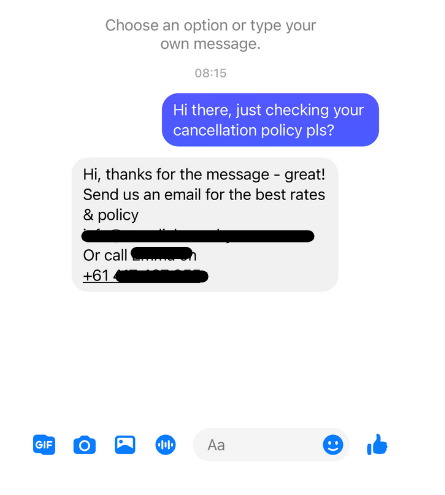
Now for the golden nugget: When your customers initiate that conversation with you, via any of their chosen channels, do not tell them to use another one! Here is a screenshot of exactly what you want to avoid! Imagine having someone on the phone and telling them to write a letter. This is pretty much what this is.
Your challenge: look at your website from both a desktop and mobile perspective and check that you offer enough communication channels to your customer.
Technique 2: Make them want to give you their details for something of value
The number one missed opportunity we see on tourism business websites is that they do not offer visitors the ability to receive something for value in exchange for their email address.
Not everyone is ready to book/buy from you when they visit your website. They may be at a different level of their travel purchase lifecycle. Plus, they may not want to read every page of your website and many of them would jump at an offer that just pops up, at the right time, promising to deliver them something of value.
Imagine you’re a pet-friendly business in Agnes Water. You have done your research and know that most of your potential guests are worried or not certain about the extent of dog-friendly cafes, restaurants, beaches, and areas in general in Agnes Water. So you have developed an irresistible download that pops up just at the right time on your website and that answers all these questions, in colour. And in exchange, you get the email address of your potential customer and can nurture them with an email sequence or any sequence of your choice.
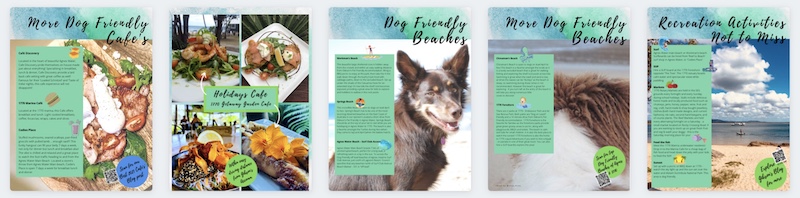
Your challenge: think of something of value you can design for your customer to leave their email address. It doesn’t have to be as beautiful as the one above, it can just be a one-pager! Design it in Canva and attach it to your website using a pop-up that pops at an appropriate time (not right away). We recommend you create the popup and your email nurture sequence in Mailerlite. And watch your email list grow. We have an email marketing automation course that explains how to do just that.
And make sure you post your comments and questions in the Facebook group!
Your homepage is the first thing AI reads
When a traveller asks an AI assistant for a recommendation, your homepage is usually the first page it reads to work out what you sell. If your main products are not laid out plainly with text and links, the assistant has to guess, and it often guesses wrong or skips you.
Treat the homepage as your main sales page. Show each primary product or service with an image, a short description, and a clickable link to that product’s own page. A homepage that is one big image and a welcome message gives AI almost nothing to work with.
Put your products where both can see them
Aim to have every primary product visible within the first scroll or two, each with a clear “View ” button. If someone has to hunt for what you offer, so does the assistant. Each product still needs its own page for the detail, and the homepage links straight to it.
Frequently Asked Questions
Isn’t a striking hero image the most important thing on my homepage?
It matters for people, but AI reads text and links. One big image and a welcome line tells an assistant almost nothing about what you sell. Pair the image with clear product blocks it can read.
What should my homepage actually show?
Each main product or service with an image, a one or two line description, and a link to its own page. A traveller, and an AI reading for them, should be able to tell what you offer and open the right page in one click.
How far down should my products appear?
Within the first scroll or two. If someone has to scroll a long way, the assistant may not connect your products to you. Put your primary tours, rooms, or experiences high on the page, each with a clear “View” button.
Can the homepage do it all, or do I need separate product pages?
Each primary product needs its own page, and the homepage links to them. That gives AI a specific page to recommend, and gives the customer the detail they need to decide.
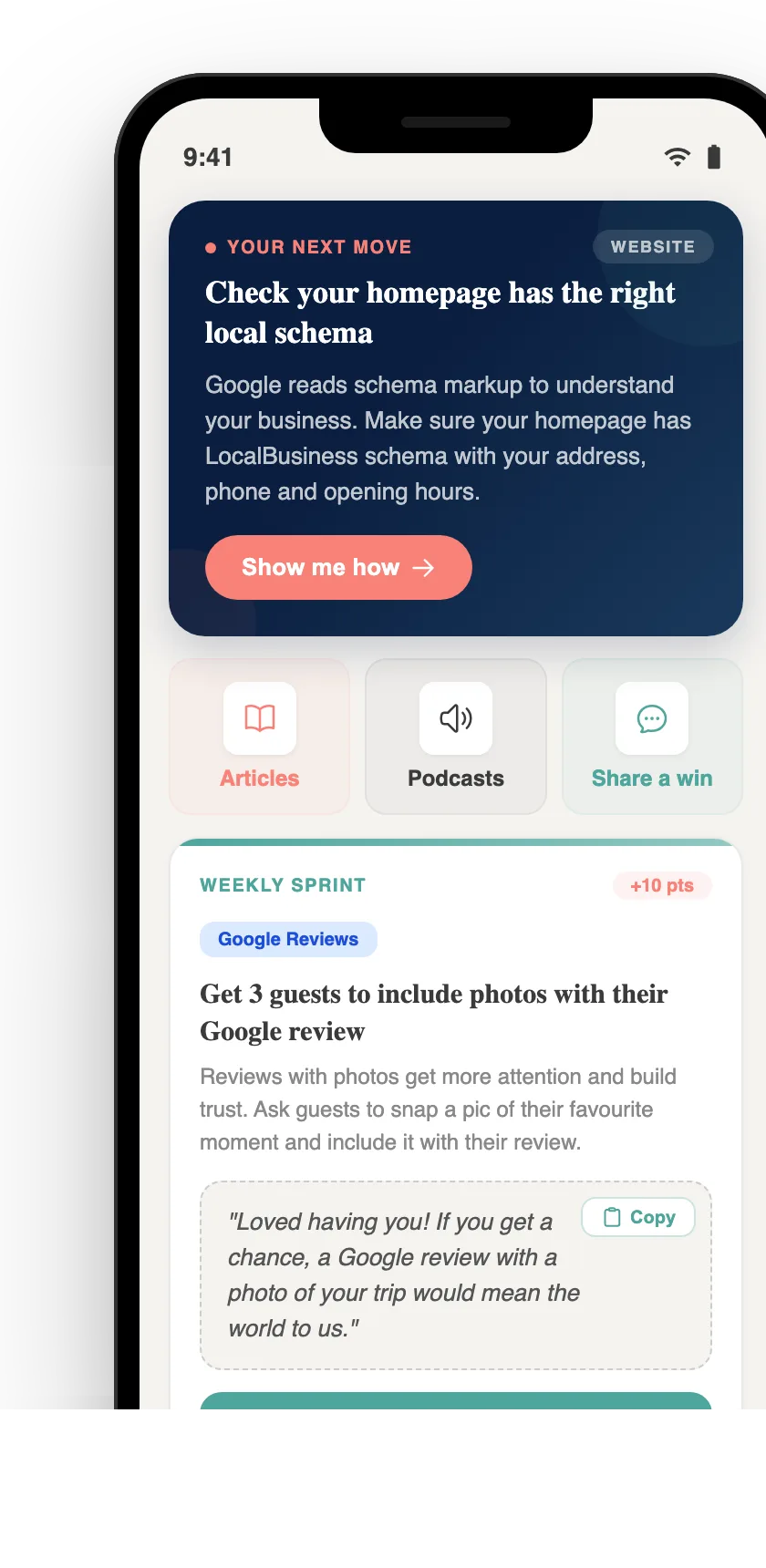
Your free AI marketing coach, right in your pocket
The free Pocket Rocket app gives you a personal AI marketing coach, website audit, weekly action plans and 5-minute tips. Built for tourism operators.