Untangling Tourism Tech — Podcast
24 February 2025
Find us on your favourite podcast provider:







The tourism industry is rapidly evolving, and AI is at the forefront of this transformation. In the latest episode of Untangling Tourism Tech, Fabienne Wintle and Liz Ward explore the latest AI tools reshaping tourism businesses—from research and coding to marketing strategy.
Before you start creating your own content or plans or anything you will rely on in an AI tool like ChatGPT you must commit to using the output ethically and with caution. Ways to do this are to carefully review, critique and challenge the drafts, and finetune and finetune again. Ultimately you will still save a lot of time by using AI for content and planning, but you must ensure that the outputs are accurate, support your vision and align with your brand values.
The prompts below have been tested with many tourism business owners in Tourism Tribe’s AI workshops and have proven incredible helpful to them to firstly get familiar with how ChatGPT works, then how to maximise its potential by using it to fill a typical gap in their business, that being a marketing and social media plan.
Prompt 1: I would like to assist [business name] to develop a marketing plan. To start with I’d like to develop a unique selling proposition. Please review their website including homepage homepage [business website] and suggest a draft unique selling proposition.
Prompt 2: NEEDED IF CHATGPT CAN’T ACCESS WEBSITE Here is some useful copy from the homepage and about page
Prompt 3: Could you suggest an ideal customer persona for this business?
Prompt 4: Now I’d like to develop some content themes for use in digital marketing and social media. What would you suggest?
Prompt 5: Could you consolidate these down to 5 content themes, but don’t lose the good ideas you’ve suggested.
Prompt 6: Which social media platforms and forms of marketing do you think should be prioritised for this business based on their ideal customer and USP?
Prompt 7: Could you suggest a social media schedule with suggested post ideas based on the content themes and prioritised channels of Facebook and Instagram [and Tiktok if relevant to the target market.] The staff don’t have a lot of time to do social media, but could commit to two posts per week on the three channels?
Prompt 8: Please expand to include the post formats including Reels and Stories. Total posts per week would be 2 image or carousel posts, 1 Reel, 1 Story.
Prompt 9: Please put this into a calendar format for me for the month of March 2025.
Prompt 10: I can’t see the formats or calls to action, can you include them in the table as well please?
Prompt 11: Can you create example posts for week 1?
Prompt 12: What hashtags should I use? [remember to prompt it to include key destination #s]
Prompt 13: Please consolidate the final outputs of these prompts into a marketing plan document
AI agents are an exciting but evolving technology. While still in their early stages, they promise greater automation and efficiency. However, Fabienne and Liz emphasise that human oversight is critical—as seen in cases where AI-generated content (like radio ads) contained errors.
We loved this walkthrough of Chat GPT’s operator.
As AI continues to develop, accuracy and brand alignment remain key. The episode highlights how AI can streamline workflows, but tourism businesses must carefully review and refine AI-generated content to maintain authenticity and professionalism.
If you haven’t done so, be sure to fill out the AI Survey for Tourism Businesses. You will also find all our free AI resources grouped here
Untangling Tourism Tech Episode 10, with Fabienne Wintle and Liz Ward. Each line shows who is speaking and when. Times match the video. We removed filler words and fixed mis-heard names.
[00:00] Liz Ward: Hi, Fab.
[00:01] Fabienne Wintle: Hi, Liz.
[00:02] Liz Ward: Thank you everybody who has been emailing us, reaching out, telling us how much they love the last episode where we were untangling AI tourism tech. And we’ve had so many people come to us and say, “Loved the tip about veed.io,” and people are enjoying the practical nature of what we’re sharing. So it’s more of that in this episode, and what we’d like to do today is to share with you the things that we’ve been discovering working on testing tools.
[00:39] And there’s three areas that we wanted to speak with you about today. So Fab, you’ve been doing some great research and testing three of the most popular platforms for AI, so I’m going to interrogate you about that. And then we’re going to have a little bit of a chat about AI agents. What does that mean? What do we think it means? How are they evolving? And then what I’d love to do is share with you a really practical set of chat prompts that will save you a lot of money on management consultants and fill a hole for you in your business. So stay tuned for that, which is our third topic today.
[01:23] So Fab, tell us what you are learning. I know you’re constantly researching and playing, and I get these text messages from you about your latest light bulb moment and revelation with AI tools. So what have you been playing with? What can you tell our audience about in terms of breaking it down and making sense of the tools that you’ve been experimenting with?
[01:47] Fabienne Wintle: Yes, and I do apologise for the excitement in my text messages. So some of you might or might not know, but I’ve got a little pet project on the side, building a new little tourism business. So I’ve been doing a lot of custom coding for this business, because it doesn’t fit any mould. So I started playing around with ChatGPT for coding. So we’ve got the paid version, and I feel that I was really… like it was running out of steam. It didn’t really give me all the information that I needed about the code, or it half answered my question, but still I wasn’t quite… I didn’t know what to do about the rest of the code. So I was hitting a brick wall, and then I came across Grok 3. And Grok 3 is a model that has been given a max of computing power.
[02:36] So that means that obviously an AI tool needs to be trained, like a human needs to be trained about how to do things, and apparently in the AI world, the more computing power, or they call it compute, you give it, the better the results are. So I thought, let’s put my code… And literally, I think I went back and forth for three hours with ChatGPT with this code, and I went to Grok and I said, “Okay, I have a bug. There’s something that’s not happening the way I want it. Here’s my code. What do you think?” And within an instant, Liz, it found the problem, fixed it, and told me even how to improve it. So three hours, one minute. It’s just a matter now of, you know, not whether you use AI or you don’t use AI, but it’s which AI tool do you need to use for the job.
[03:29] And I think the strength in our industry is going to come from operators understanding what tool they should be doing for the job. So obviously Grok is really good at logic, physics, coding. That’s the angle that it takes. ChatGPT is more of a generalist GP, but you might exhaust it, so you might have to go and find other avenues. Well, this is at the time of recording, so 21st of February, because things might be different again next week.
[03:59] And then another one that I quite love a bit as well, so it’s not a one that I use for coding, but it’s a mix… Perplexity, it’s called. It’s a mix between a search engine, and it also pulls in data from AI models. So it’s really handy: instead of going to Google and say, “Hey, what do you think the best AI tools might be for video?”, you actually go to Perplexity, and it acts as a search engine, but it also actually gives you all the footnotes with the links to the articles of where it found the information.
[04:36] Another way I tried Perplexity is I was a bit perplexed about an email that I was writing, and I thought, is there a better way to write that email so it’s more well received? So I pasted from ChatGPT into Perplexity, and immediately it made it sound so much better, and it gave me the reasoning as to why it did, and also with links to some good articles to help me understand for next time.
[05:02] Liz Ward: There’s a difference you were telling me about as well, in terms of how often Perplexity updates its data sources compared to ChatGPT as well. It’s stronger in that way, isn’t it, Fab?
[05:15] Fabienne Wintle: Yeah. So it’s updated daily, so it’s really up to date. That’s the search engine part in a way.
[05:21] Liz Ward: And so from a research perspective, that’s what I’m hearing, it’s more reliable in terms of research, and it’s better at providing you the sources and citations if you were using it from an academic angle as well, using it as a… doing assignments, or if you’re working in academia. So you’ve talked about three that people may or may not have heard about, putting aside ChatGPT, which more and more people are understanding. You’ve talked about Grok, and I’m thinking about that software developer example.
[05:57] If you were working in a DMO, you know, and you are having a new application built, or you’re working with a software developer and you wanted something really purpose-built for your website, and they said to you, “But I can’t do that. We don’t… That can’t be done,” your response could be, “Have you checked with Grok?” and just watch the colour drain out of their faces, and challenge them, because it probably can be done. They just aren’t familiar with how to do it. So they need to be pushed, you know, to take a more problem-solving angle, and Grok could be a great mechanism to do that. With Perplexity, more current data sources.
[06:46] So if you’re going external with your content, and we know with ChatGPT, as a large learning model, as they call them, an LLM, it is really… you get the best results if you’re putting your intelligence and knowledge into it. Whereas if you need to be doing research and going out externally, maybe you would get a better result with Perplexity.
[07:10] Fabienne Wintle: Absolutely, yeah. And Grok is also fantastic if you think… and a lot of our members at Tourism Tribe and people we come across constantly ask us questions, you know, “I’m getting a new website. What do I need?” I was thinking that would be a great place to copy and paste a quote that you got from a web developer, because sometimes these quotes are really technical, and you feel like you don’t understand, and then you forget about: are they actually considering my business? Is there other things they should be considering that I can’t even conceive? So if you copy that quote in Grok, it’ll actually tell you, you know, have they thought about just one tiny part of your business? What other things should you be considering? So I thought that would be another really good use of a model like Grok, because of the scientific background.
[08:01] Liz Ward: Fantastic, that’s great. Let’s move on to agents. So I don’t know who listening to this has heard about AI agents, but they are part of the AI revolution. Generally, the investment in AI technology is massive, and within the travel sector, tourism and travel sector, there’s huge investment happening, and some of… and yes, we’ve got these baseline tools that we can drive ourselves as individuals, but then there are apps and customised models and agents that are being created that are going to make it even faster and simpler for us as business people, us as consumers, to be able to get tasks done. That’s essentially what an AI agent is: to perform a human task for you.
[08:59] What have you learned so far about agents? Maybe this… We know that ChatGPT is offering, under its highest level subscription, the operator agent called Operator. So what are you learning about those, Fab?
[09:19] Fabienne Wintle: What I’ve seen so far is that they are very, very slow. So they’re really in their infancy, right? But they’re very slow. They’re starting out in terms of speed, in terms of what they’re able to do. I’ve seen quite a few examples. One lady was trying to get it to book a flight from a… a one-way flight from A to B. And, you know, obviously you instruct the agent the same way you would instruct ChatGPT. So this was the example of Operator. So you can chat to it or talk to it, so give it a task, and then you watch it, because it shows what it does, but that’s the piece that’s quite slow.
[09:59] So watch it, and she instructed it to go one-way flight, but constantly started searching for return flights, and then it said, “I found this one and this one, and is there anything else I need to know?” “Yes, one-way flight, one-way flight,” all the time. So it’s not there yet, but it doesn’t mean that it’s not going to be there tomorrow, and that’s something that we have to be really ready about. If, you know, 50% of our industry hasn’t used ChatGPT yet, to me that’s worrying, because ChatGPT was the first thing that’s quite easy to learn. We need to have that solid base to be ready for how to use the agents in our role as well in the future.
[10:40] So look out, keep listening, and I guess subscribe to some newsletters, or if you’re interested, you know, go online, search, ask Grok, ask ChatGPT, ask Perplexity what agents exist out there, and keep an eye on it. Then I’m sure you’ll be flooded by ads on Facebook and on Insta as well with it. But just be in that open mind mode and be ready for something that might… again, well, it’s not might, it absolutely will. But, you know, medium to large businesses who might have a person in charge of booking travel, they might not need a person in charge of booking travel very, very shortly. So…
[11:26] Liz Ward: There are going to be a lot of tasks that we do in life at a personal level that will be done by an agent, and these tools are going to get better and better.
[11:36] Fabienne Wintle: Talking about tasks and things, I was listening, I heard the radio yesterday, you know, a regional radio where I live here, and there was actually ads on the radio that were so bad because there was AI voice.
[11:50] Liz Ward: Oh no.
[11:51] Fabienne Wintle: I can’t believe that actually made the cut. You know, instead of saying Gladstone, it said Gladstone. So you could totally… I was wondering, you know, do you… who checks the quality of these things before launching them?
[12:07] Liz Ward: Oh gosh. Yeah, and that’s a key message when we’re running educational programs about using AI, or… and really any workshop that I’ve delivered this year so far, there has been the use of ChatGPT within it as part of doing what you need to do in business. So it’s just becoming part of how we work. But that is the key message, is to find what’s wrong with the output. Don’t… never assume it is accurate. Never assume it is aligned with your brand, your tone of voice. Always look for how you can improve it. And I can’t stress that enough. Example of where that’s not happening: they’ve saved a whole lot of money, they’ve charged their advertiser out, yet it’s cost them a fraction of the money to put the content together for the ads.
[13:09] I’ll move on to our third topic, because I’m rather passionate about this, and I’m very happy with the reaction and the help that it’s providing to tourism operators. And within the workshops that I’ve personally been running on using AI, and it’s usually combined recently with using the more advanced functions of Canva as well, including the AI features, has been addressing a problem that has been forever in small businesses in tourism. And you’ll remember, Fab, when we surveyed several thousand operators going back over the last many years about what is holding them back from using social media better, using any tech tools better really, and bringing them into their business.
[14:03] And for digital marketing specifically, the number one response that we got, one of the… there were top three answers, and one of those was the lack of plan, so the lack of a marketing plan, the lack of a social media plan, sort of shooting in the dark, not really knowing where to start, because they have a lack of a plan and they’re just running their businesses and don’t have time to stop and develop the plan. So they’re inconsistent, which we know is not good in marketing. We need to be consistent in every way. That is still true. And I tested that piece of feedback again in a workshop last week. Yes, everybody put their hand up and agreed that the lack of a plan, out of about 15 tourism operators, that’s a big thing that’s…
[14:48] Now, when we think about how we used to charge, how I used to charge for helping a tourism operator to develop their marketing plan, that was $5,000, because it was at least 20 hours’ work, 25 hours’ work, to develop that marketing and social media plan. Well, that time now to do that with the assistance of ChatGPT and using your own brain and what you want to do with your business and how well you know your business and your customer, you can do a draft of that in an hour, and you can do a good job of it probably in about five hours, and you save yourself about $5,000. And I think this is one of… like, management consultants are going to be really adversely affected if they don’t adapt to AI.
[15:39] But the exercise that we’ve been doing in these workshops, both physical workshops and online, has been to create this plan. And there’s a series of prompts, chat prompts, that I’ve refined and then I share with people in that workshop, which they then use to develop their marketing plan. And whilst an agent can be developed to do this, and I started working on one, and I’m going to get back to it, you’ll be really proud of me, Fab, when I’ve done it… manually we can do that. We can copy these prompts into ChatGPT, and we can start by asking it to develop our unique selling proposition by reviewing our website. That’s a start, that’s just a simple start to that.
[16:27] And then if, for whatever reason, you can’t access your own website through your version of ChatGPT, so if you’re not… you’ve done too many prompts and you’re only on the free version, that kind of thing, oh, pay the $20 US. Pay the 20. So much easier. Just copy the content from your homepage and your about page in there. You’ve got your… going… it will produce a fabulous draft unique selling proposition. Most people are like, “Oh, that’s pretty good. That’s pretty spot on.”
[17:02] Then ask it to develop a customer persona. So it will suggest one based on that USP. You might then refine it a bit further: “Well, actually, no, we’re targeting people who are this and that at these different seasons.” So it will refine that. So that’s the second part of your marketing plan, is developing that persona. Then, because we’re so focused on content marketing in our businesses, as we should be, content about the destination, content that’s ideal for your customer, then develop some content themes for me for digital marketing and social media. And this is where it gets really practical, because you can then ask it to consolidate down to five themes, which is really good for you to work with, because it’ll probably give you nine, which is just too unwieldy.
[17:56] Then ask it to suggest what social media platforms and other digital marketing platforms are going to be the best channels for your ideal customer, which you’ve created the persona for, and your unique selling proposition. From there, and you’ll see this start to build out beautifully, you can then ask for a social media schedule using those content themes, using… prioritising those channels for you. If it doesn’t give them to you, ask it for the formats of the posts. And so if… and specify, if you’ve only got time to do two social media posts a week, tell it that, so that you get a schedule that prioritises the channels, what types of posts to do twice a week. Then ask it to put it into a calendar format. It’ll put it into a beautiful table starting from whatever month of the year.
[19:00] You might ask it just for a month calendar to start with, so that you can really work with that, critique and understand it. And if it hasn’t given you the calls to action for these social media posts, push it to give you those as well. So whether it’s “swipe up for this”, or if it’s on Facebook, “go and check this out on our website”. If that’s looking pretty good, push it a bit further and ask it to give you some example posts for week one. Make sure it gives you the hashtags to use. And then with that, your final prompt is to ask it to consolidate it into one plan. That will take you at worst an hour. You might do it in half an hour. And what you will have is a draft marketing and social media plan that you didn’t have an hour ago, and that you can really then critique and challenge.
[19:57] And you will find you will start talking back to ChatGPT and going, “But why have you suggested Pinterest? I don’t have time for Pinterest. Why is that relevant?” And this is where I’ll go, “Oh, actually, it’s not relevant,” you know. So really push it, critique it. But this is a wonderful exercise for people who, one, don’t have a plan, and secondly, haven’t really discovered yet how they can use ChatGPT in their business. Because if you nail this, you will go, “Oh well, I can ask this thing anything,” or “I can think of whatever problem I’ve got and start here and see if it can solve it for me.”
[20:36] Fabienne Wintle: Sounds like a great $5,000 well kept.
[20:41] Liz Ward: $5,000 of value, well, may not be worth that anymore because of AI. But, you know, certainly it’s about knowing what to ask it, how to ask it. But I think sharing these prompts, which we can do in the associated blog post with the podcast, is a great recipe to get your L-plates, well and truly, you know, pass your L-plates on ChatGPT and really work out how to get it to solve problems in your business.
[21:14] Fabienne Wintle: That sounds so exciting. Awesome. You’ve been meaning to share that with me for so long, all these workshops and how operators are so excited. So I’m glad we had a time to talk and to let other people know as well how it can benefit them.
[21:30] Liz Ward: Amazing. All right, well, we’ll continue, we’ll keep researching. We will keep bringing you the shared knowledge, the practical tips, the tools, and please tell us what you want. Let us know what you think, and ask us questions, and we’re happy to really direct our energy there to make sure that we can keep us all learning and growing together.
[21:54] Fabienne Wintle: Sounds good. See you next time.
[21:58] Liz Ward: Bye for now.
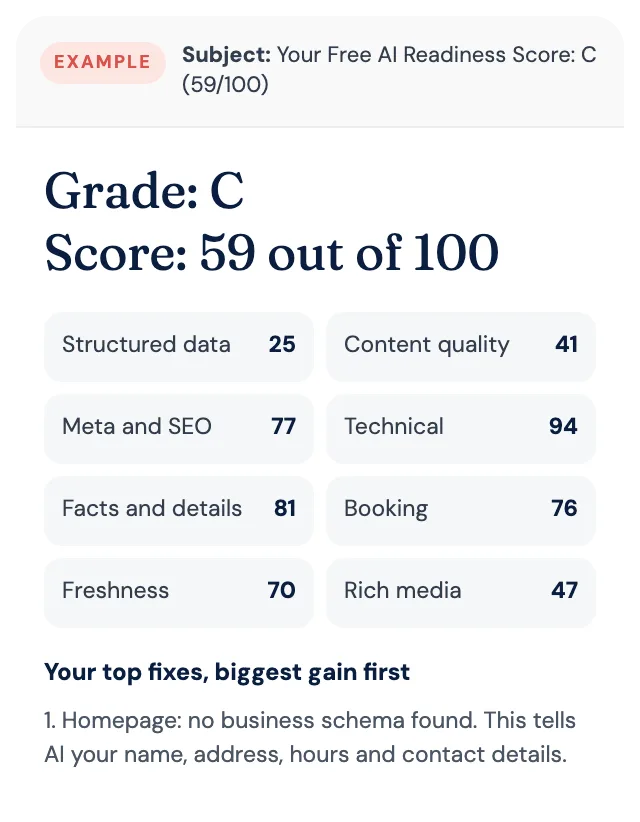
Free AI Readiness Score
Get your grade, a score out of 100 and your top fixes, by email. Free for tourism operators. No login and nothing to install.
Get access to all our training, coaching, and tools built for tourism operators who want to grow with confidence.
Explore membership