Untangling Tourism Tech — Podcast
31 March 2026
Most tourism operators have used ChatGPT. A growing number are using it regularly. But there is a big gap between “I’ve tried it” and “I’ve actually changed the way I work.” In Episode 18 of Untangling Tourism Tech, Fab and Liz map that gap — and show you what the road ahead looks like.
They use a simple analogy: getting your driver’s licence. L-plates, P-plates, open licence. It maps almost perfectly onto where the tourism industry is sitting right now — and where individuals and organisations are heading.
Liz runs face-to-face and online workshops with tourism operators across regional Australia. When she asks who is using AI, around 80% of hands go up. That is genuinely encouraging. The challenge is that most of those people are using ChatGPT for content creation or basic research, and they feel like they are getting value -which they are. But they don’t know what is possible beyond that.
Fab hears the same thing in her coaching work with councils and DMOs. Teams are using ChatGPT, some are using Gemini, but they are using the same prompts repeatedly and know they are leaving capability on the table. In some organisations, AI tools are still locked by IT policy which feels a lot like when councils refused to let staff create Facebook pages a decade ago.
Meanwhile, consumers are running 800 million-plus ChatGPT queries per week for travel planning. The gap between what visitors can do with AI and what operators are doing with it is real. That is not a scare tactic. It is just where we are.
P-plate territory is about getting more out of the tools you are already using and stretching into tools designed for specific jobs. Fab and Liz covered several practical examples:
Liz set herself a goal in January: stop using ChatGPT for everything and find the right tool for the job. She produces a lot of slide presentations and proposals, and the old habit was to copy a previous document and edit it, sometimes with ChatGPT, sometimes without.
The shift was to NotebookLM. If you have a Google account, you can use it at notebooklm.google.com. You upload all your source material: documents, webpages, previous work, brand guides — and it holds all of that in a single working context. Then you ask it to produce the output you need. Slide deck. Infographic. Document. Video. It knows your brand and your content. The outputs are sharply better than starting from scratch with a general prompt.
She also found Gamma.app useful for producing polished presentations quickly. The combination of these two tools replaced what used to take hours with something much faster and considerably better-looking.
Fab is on what they are calling the full open licence. She has AI agents running on a separate machine, doing work autonomously: coding, content, research, while she is doing something else. They report back via Telegram when they need her input.
This sounds abstract until she explains how she thinks about it. An AI agent is like an employee. If the employee doesn’t have the right skills or briefing, the output will be poor. If you give them clear skills documentation, context about the business, and well-structured tasks, they produce excellent work consistently.
The practical example: a website rebuild that would have taken a week last year took her agent 30 minutes this week. She was doing something else while it ran. She had briefed it properly. That is the point where AI stops being a tool you use and starts being a team you manage.
One thing Fab is clear on: getting there required spending time working through the process. Not watching TikToks about it. Actually doing it, failing, adjusting, and doing it again. The influencers who tell you it is easy are often just repeating what someone else said. The “how to” is what matters, and that comes from practice.
This episode finishes with a real operator problem that Fab is going to solve. A tour operator in regional Australia: 4.9 stars, hundreds of reviews, bike tours; works with inbound tour operators who book via email. Every booking requires:
Each booking takes 30 minutes of manual work. He knows this is solvable with AI and automation. He just doesn’t know where to start.
Fab’s approach: start with documentation. Record every conversation, dump all the business context into a client folder, send a content audit agent through the website, emails, and process documents. Build what she calls the “official documentation”: a clear picture of what the business does, how it works, and what the process steps are. That context becomes the briefing for any automation or agent work that follows.
Not everything needs AI. Some of the booking steps might connect directly through existing integrations. AI plays the role of checking the process, handling the variable parts (like composing a confirmation email), and flagging exceptions. The goal is to keep API usage low — every AI token costs something, so you use it where the value is clear and lean on direct integrations everywhere else.
You don’t have to be building agents to be doing well with AI. The most important thing is to stretch a little further than you are comfortable with each time you tackle a task. Ask yourself whether there is an AI tool that could help. Try it. If it doesn’t work, adjust. That is how the learning compounds.
And if you are a fast talker who doesn’t like typing: press the microphone button in whatever AI tool you are using. You will get dramatically better outputs when you speak than when you type. More expressive, more context, better results.
Tourism Tribe’s new tool, my.tourismtribe.com, is in beta. It puts Fab, Liz, and the AI toolkit in your back pocket. Free tools, access to the community’s knowledge, and practical guidance on demand. Worth checking out.
If you want a structured overview of all the AI tools and strategies discussed in this episode, the AI in Tourism Playbook lays it all out.
Listen to the full episode on Apple Podcasts, Spotify, YouTube, and Amazon Music.
The episode uses a driver licence analogy to describe three stages. L-plate users have tried ChatGPT for basic content or research. P-plate users are stretching into purpose-built tools like custom GPTs, NotebookLM, and AI video editors. Open licence users are building AI agents that run tasks autonomously and report back when they need human input.
A custom GPT (or a Gem in Google Gemini) is a set of preloaded instructions that let you repeat tasks consistently. Tourism operators use them to write review responses in their brand voice, draft social media posts with their tone, or generate marketing plans. Once set up, you skip the blank-page problem every time.
NotebookLM is a free Google tool where you upload source material such as brand guides, previous documents, and webpages into a single working context. You then ask it to produce outputs like slide decks, infographics, or documents. Because it holds all your context at once, the results are sharper than starting from scratch with a general ChatGPT prompt.
Yes, though the approach matters. The episode describes a real case where each inbound tour booking required manual steps across a website, Xero, Rezdy, and email. The recommended starting point is documenting every process step, then using direct integrations where possible and AI only where the task is variable, such as composing confirmation emails or flagging exceptions. This keeps costs low and reliability high.
Use the microphone button instead of typing. Speaking gives the AI more context, more expression, and more detail than most people type. Beyond that, the key is stretching a little further each time you use a tool. Try something new, adjust when it does not work, and build on what does. Consistent practice compounds faster than watching tutorials.
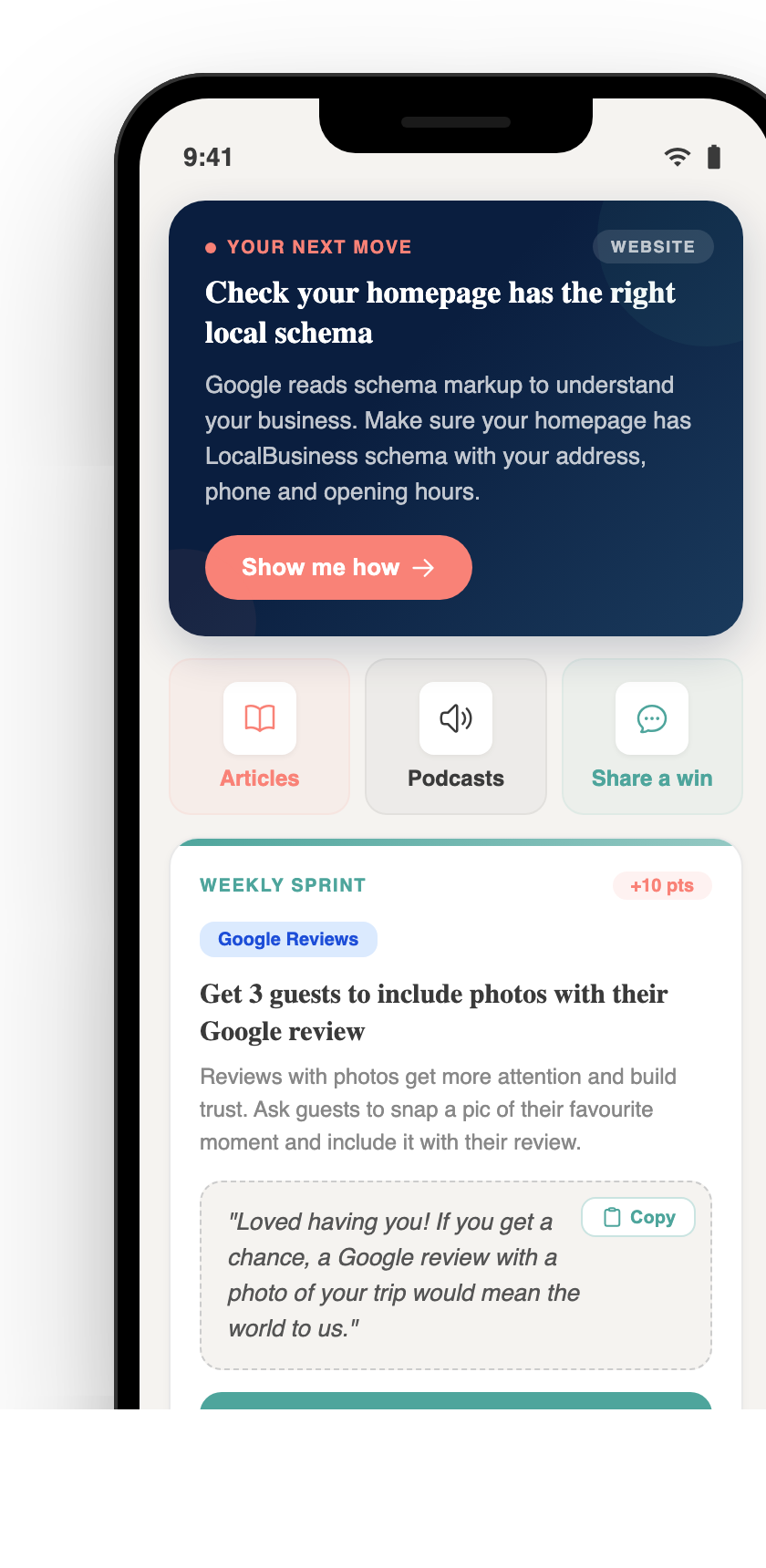
The free Pocket Rocket app gives you a personal AI marketing coach, website audit, weekly action plans and 5-minute tips. Built for tourism operators.
Get access to all our training, coaching, and tools built for tourism operators who want to grow with confidence.
Explore membership