

Let us help
Related articles
AI Tools for Tourism Operators: What to Use and How to Start
If you’ve heard you should be using AI tools but you’re not sure which one, for what, or where to find the time, you’re not alone. 71% of tourism operators have started using AI in some form. Only 19% feel confident doing it. Most haven’t had a practical walkthrough. This guide is that walkthrough.
- Why AI Tools Matter Right Now
- What the Main Tools Actually Do
- How to Use AI for Social Media and Content
- Getting Specific: Product Pages, Reviews, and Search Visibility
- Real Operators Using AI Right Now
- How to Start Without Overwhelm
Why AI Tools Matter Right Now
Tourism operators using AI tools are already producing more content, responding faster, and showing up more consistently online. The 2025 State of AI in Tourism report, based on 90 Australian tourism organisations, found 85% expect AI to positively impact their business in the next two to three years. The main barriers: technical skills (40%), privacy concerns (33%), budget (31%). The skills gap is the one you can close right now.
The content you create with AI also feeds your AI search visibility. Tools like Google Gemini and ChatGPT by OpenAI pull from social posts, reviews, and website content when answering travel queries. Fresh, specific, local content does double duty: it connects with guests and signals to AI search engines that your business is active and worth recommending. More on how AI search is changing tourism visibility.
What the Main Tools Actually Do
ChatGPT by OpenAI is the most widely used AI tool among tourism operators. It generates text: captions, email drafts, review responses, blog post outlines, social media plans, customer personas. The free version covers most use cases. Start there.
Google Gemini comes in three forms. The standalone chatbot at gemini.google.com handles long documents and PDFs well. Gemini in Google Search generates the AI summaries at the top of search results, which matters for your visibility, not just your productivity. Gemini Advanced in Google Workspace integrates with Gmail, Docs, Slides, and Sheets. If you already use Google Workspace, Gemini is already there.
Canva Magic Studio is the AI layer inside Canva. It generates images from text prompts, removes backgrounds, and drafts copy with Magic Write. For operators already using Canva for social posts, it’s the lowest-barrier entry point to AI image generation.
Veed.io turns long videos into short social clips with captions and voiceover added automatically. Upload a longer video, ask the AI to cut clips, auto-generate captions, adjust timing, export. What was a full-length recording becomes multiple posts without editing from scratch.
Custom GPTs are versions of ChatGPT pre-configured with specific instructions. Tourism Tribe’s Marketing Mate is built specifically for tourism operators. It walks you through creating a customer avatar, a unique selling proposition, content themes, and a four-week social media plan in one guided session. Gemini has its own equivalent called Gems: pre-load your audience details and brand tone, and each prompt uses those without repeating yourself.
How to Use AI for Social Media and Content
The biggest time saving is social media planning. Most operators post reactively: something happens, they grab the phone, caption it on the spot. That works, but it’s exhausting and inconsistent.
One planning session using ChatGPT or Marketing Mate gives you a clear description of your ideal guest, five to seven content themes based on your business, and a four-week posting calendar with caption starters. You do that once. Then follow the plan.
For individual posts, the workflow is: paste a rough idea or a guest comment into ChatGPT, ask for three caption variations, pick the one that sounds most like you, rewrite the parts that don’t fit. Five minutes instead of 45.
Review responses are an underused application. Write one template per scenario: a glowing review, a mixed review, a complaint. Adapt from there. Consistent tone, faster turnaround.
Content batching with Canva works well for operators with a backlog of Google reviews. Pull them into a spreadsheet, connect to a post template, and batch-create a month of review-based posts in one sitting. Each one uses your guest’s own words.
On voice: AI doesn’t write in your voice without guidance. Give ChatGPT your tone, the phrases you use, and the things you’d never say. The more context it has, the closer the output gets to your actual style. Zeynep Testoni from Soul Clay Studios has been building a custom GPT trained specifically on her brand voice so outputs arrive already sounding like her business.
Getting Specific: Product Pages, Reviews, and Search Visibility
This is the part most operators miss. AI tools, including Google’s AI Overviews in search, work at product level, not business level.
That means a dedicated page for each tour or activity, not one “experiences” page with a list. Each product page should answer the questions guests actually ask: what’s included, how long it runs, who it suits, what happens in bad weather. Those answers are what AI summarises when a traveller asks about your region.
Reviews matter at product level too. A general testimonials page doesn’t carry the same weight as reviews placed directly on each product page with schema markup. Star ratings and review counts on individual product pages start appearing in Google search results next to your listings.
Google Business Profile posts, photos, and review responses also feed directly into AI search results. Keeping your GBP active is not separate from your AI visibility strategy. It is part of it.
One specific tip from testing: when information changes, a product closes, hours update, prices change, update your page titles and meta descriptions first, not just the body copy. That’s what Gemini reads when building its AI summaries.
Real Operators Using AI Right Now
At the Country and Outback NSW AI training program, participants worked through two sessions with Liz and came out with blog post drafts, social captions, and itinerary content they’d actually built themselves. The program received a 100% satisfaction rating. Lucy White, General Manager of Destination Country and Outback NSW, described it as “superbly delivered, incredible content and detail with fantastic hands-on examples and tuition.”
Zeynep Testoni from Soul Clay Studios is training ChatGPT on her brand voice so the output sounds like her business, not a generic marketing script.
Michelle Bishop from Bangalay Luxury Villas uses AI to speed up on-brand content production. Her team spends time refining and posting, not drafting from scratch.
Alex Herlihy from Wildwood Kangaroo Valley uses ChatGPT for research and rapid product development, testing new experience ideas without investing hours in manual research.
None of them have IT backgrounds. All of them decided to start.
How to Start Without Overwhelm
Pick one tool, one use case, one week.
Go to chat.openai.com, sign up for free, describe your business, and ask ChatGPT to write five content themes and 10 caption ideas. That takes 20 minutes and gives you a real output to work from.
If you want a more structured starting point, try Tourism Tribe’s Marketing Mate at tourismtribe.ai. It’s a custom GPT built for tourism operators, free to use, and walks you through the whole content planning process step by step.
What to expect as you start:
- The first output will be generic. Rewrite it in your voice and add your specific details.
- Free versions of every tool here are enough to start. Don’t pay for anything until you know you’re using it regularly.
- Gemini is worth trying if you’re already in Google Workspace. It generates images directly in Google Slides and summarises documents without switching tools.
Tourism Tribe’s Digital Assistance Plan members work through AI tools in fortnightly Tech Sessions with live demonstrations and time to ask questions in real time. If you want to keep learning without figuring it all out alone, that’s where to start.
Frequently Asked Questions
What AI tools are most useful for tourism operators?
ChatGPT by OpenAI is the most widely used starting point for content, social media planning, and review responses. Google Gemini is worth adding once you’re comfortable with ChatGPT, particularly if you use Google Workspace. Canva Magic Studio is the easiest entry point for AI image generation if you’re already using Canva. Veed.io is the best option for turning existing video into short social clips.
Do I need to pay for AI tools to get results?
No. The free versions of ChatGPT and Google Gemini cover most starting use cases: writing captions, planning social content, drafting emails, and generating image ideas. Use the free versions until you know you’re getting regular value, then decide whether paid features suit your workflow.
Will AI-generated content sound like me?
Not immediately, but it gets closer with better input. Give ChatGPT your tone of voice, examples of how you write, phrases you use, and things you’d never say. Operators who train a custom GPT on their brand voice get usable first drafts far more consistently.
How does using AI tools affect my visibility in Google search?
Directly. Google’s AI Overviews pull from your website content, social posts, and reviews when summarising answers to travel queries. Fresh, locally specific content signals that your business is active. Product-level pages, FAQs, and reviews on individual product pages all contribute to how AI search represents your business. Read more about AI search and tourism visibility.
What is the difference between ChatGPT and Google Gemini?
Both generate text from prompts but have different strengths. ChatGPT is more flexible for content creation and has a larger library of custom GPTs, including Tourism Tribe’s Marketing Mate. Gemini integrates with Google Workspace, handles long PDFs well, and directly influences how Google’s AI search summaries are built. Start with ChatGPT and add Gemini once you’re comfortable. You don’t need both on day one.
What is Tourism Tribe’s Marketing Mate?
Marketing Mate is a free custom GPT built by Tourism Tribe specifically for tourism operators. It walks you through building a customer avatar, defining your unique selling proposition, choosing content themes, and creating a four-week social media posting plan. No prior AI experience needed. Access it at tourismtribe.ai.
The tools are accessible. Pick one thing from this post, try it this week, and build from there.
Where to from here?
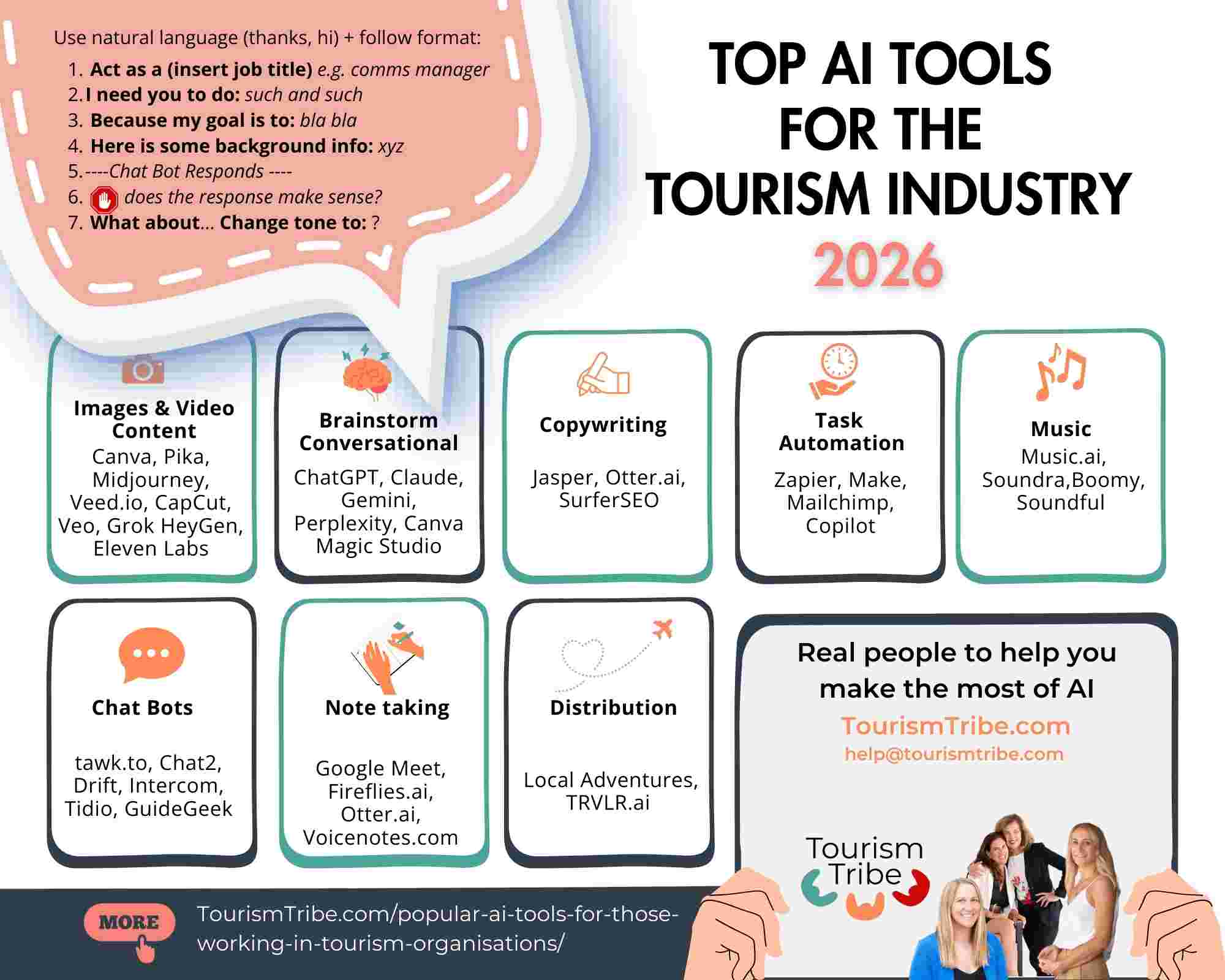
Top AI Tools for the Tourism Industry - Free cheatsheet
+ Bonus Cheatsheets & Templates
