Floods, bushfires, cyclones, storms, landslips, pandemics. No matter where you are in the world, the recent past has shown that, more than ever, tourism businesses need to be prepared to deal with a crisis when it hits. When something goes wrong, guests and potential visitors turn to the internet to work out whether it is safe to travel and what their options are. If they cannot find clear, recent information from you, they will fill the gaps with whatever they have seen in the media or on social feeds. That is when confusion and cancellations snowball and can result in sustained business losses for much longer than the actual weather event lasts.
This article started it’s life during the 2018 Australian bushfires and has now been updated to support tourism businesses globally who may be dealing with natural disasters or weather related events in their region. Our aim is to give you practical guidance about how to communicate during a crisis, so you can reassure your guests, support your local community and put your business in the best position to recover.
If you’re dealing with a crisis now, this guide will help you stabilise your communication fast. It will help you get the right information out quickly, reduce cancellations and calm the chaos. If you’re not in crisis now but you know your region is vulnerable, use this article along with our post disaster crisis management blog, 7 essentials for crisis planning quick tips and our Crisis Management course to ensure you have the plans and templates ready to use if/when you need them. Together, they form a simple path to be prepared for:
- During the crisis: what to do today if things are going wrong (covered in this article)
- Recovery phase: what to do after the event to minimise the negative impact to your business & post disaster marketing tips
- Pre-planning: what to put in place so you’re not scrambling next time: quick tips & full course)
Visit our crisis management planning area for all resources on the topic.
What this guide covers
This is a practical, business‑friendly emergency communication guide for tourism businesses that you can pick up and act on immediately if a disaster has just hit your businesses or is impacting your region. It focuses on:
- the messages you need to communicate in a crisis
- how to get those messages out quickly
- how to reduce cancellations by giving people facts, not fear
- how to support your local tourism organisation by amplifying accurate information
- what to do next once the immediate danger passes
What this guide does not cover: the full crisis planning framework, templates, decision trees, communication scripts and preparedness work – that’s all in the Crisis Management course linked above.
First communications for tourism businesses after a crisis has hit

First and foremost, you need to communicate with guests and staff currently on-site or staying with you. These people are directly affected and need to know if they are safe, whether they should travel or stay put and what you recommend. Talk to them first, calmly and clearly, in person or by phone to ensure they stay safe.
Once people in your immediate vicinity are safe, you want to quickly provide an update in places where future guests and interested parties are likely to look for answers. Your communication in the first 24 to 72 hours sets the tone for guest confidence, cancellations, media narrative and community perception. Small tourism businesses often underestimate how much of a difference timely, factual updates make, not only to your own bookings but to your entire region.
Step 1: Get Clear on the Facts
Before you post anything online, get clear on the basics: visitor safety and your businesses status. Work from verified information from emergency services, council, road authorities and your regional tourism organisation. You want to understand the situation well enough to answer the questions that are already forming in people’s minds:
- Is your business currently open, partially operating or temporarily closed
- Are roads in and out of your town open, restricted or closed
- Are there any safety issues guests need to know about, such as smoke, flooding or landslips
- Are key attractions and services around you open, reduced or closed
Step 2: Put together a short factual statement & take a photo of you with your business today
Once you have these answers, put together a short, factual statement that gives visitors a clear picture of what is going on. You will not have the brain space to craft long campaigns or clever copy. Your statement does not need to be poetry. It simply needs to be accurate and honest. For example:
“You may have seen coverage of the recent flooding near [region]. Our business in [town] is currently safe and open, and main roads into town are open. We are monitoring official updates throughout the day and will share any changes here.”
or
“Due to the current bushfire activity in our region we have temporarily closed to ensure the safety of guests and staff. If you have a booking with us between [dates], we will contact you directly to discuss your options.”
Short, clear statements like these show that you understand the situation, you are taking it seriously and you are taking responsibility for keeping your guests informed.
Then take a photo of you with your business that shows the current state of your business – an image is worth a 1000 words to give your customers an idea of if it is safe and what you are currently going through.
The next step is to put your factual statement where people are most likely to look. Start with your owned channels and the key third party channels guests use to find you. Keep it simple and you’ll be able to add updates to the following channels in less than 20 minutes.
Step 3: Share your status on your website homepage
Your homepage is often the first place people land when they search your business name. Add a clear notice at the top of the page that explains your current status, for example “Open and operating as normal” or “Temporarily closed due to [event]”. Include the date and time of the last update so visitors can see that the information is current, and link to official road or emergency information if that is relevant.
“We are glad to let you know that our business and the surrounding area has not been affected by the recent bushfires in the [Your Region] region. We are operating all our our services as usual.
To read more about the recent events in our area you can access our blog post here [Link].
For more information about travel conditions in the region please visit the following websites for the latest information:
- List relevant links
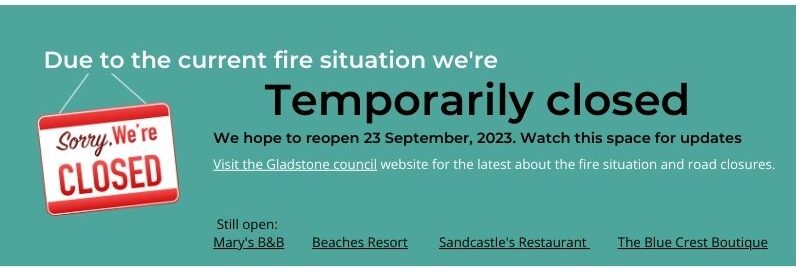
If your business is closed, be honest about that and give a rough indication of when you hope to reopen or when you will provide the next update. Guests are far more likely to stay supportive if they feel they are being kept in the loop. The banner should also provide links for them to access the latest information updates about fire warnings and road closures. See the example below:
Step 4: Share your factual statement on Google Business Profile AND check key business details are correct.
Your Google listing is a major touchpoint in a crisis. Check that your opening hours and phone number are correct. If your hours are temporarily different, update them. It sounds simple, but these small actions create a lot of confidence.
Use the “Update” or “What’s new” post function to share your status statement and photo and direct people to your website for more details.
Step 5: Share your factual statement and photo on social media
Pin a post to the top of your Facebook Page and your Instagram profile that shares your key message, along with a recent image that reflects current conditions without being insensitive. You don’t need to reinvent the wheel here, you can just use that short factual statement you created initially as discussed above along with a photo or short video with people visible – nothing reassures guests like seeing real activity in real time.
Tag your regional tourism organisation and local visitor centre so that they can reshare. This helps correct misinformation and strengthens regional consistency. Your operators and LTO will silently thank you.
Step 6: Update online travel agents and booking platforms
If you use platforms such as Booking.com, Expedia, Airbnb or regional booking engines, log in and check that your availability and content reflect your current situation. Many platforms allow you to add a short notice or message that is shown to guests during the booking process. Use that to clarify whether you are operating as normal, partially or not at all.
These actions may feel fiddly when you are stressed, but they can save you from hundreds of repetitive phone calls and emails and allow guests to make informed decisions.
Who you need to talk to first when a crisis hits near your tourism business
When a crisis hits, the easiest way to avoid overwhelm is to think in terms of priority groups and work through them. After ensuring current guests are safe and posting a short update on all of your channels you can slowly start working through guests coming soon and other people who might be looking for an update on your business’s status. Your priority groups to communicate with are:
- Guests currently staying with you
These people are directly affected and need to know if they are safe, whether they should travel or stay put and what you recommend. Talk to them first, calmly and clearly, in person or by phone. - Guests with bookings over the next 14 days
These guests are watching the news and wondering whether their trip is still a good idea. You cannot rely on people seeing social media posts. If your booking system allows bulk emails, send a short email using your factual statement and image discussed above. A simple, proactive email or message from you that explains the situation and your approach to bookings can prevent a wave of panic cancellations. Your message should:
– Reassure them if it is safe to travel,
– Give them a reliable source of ongoing updates (your social accounts or website)
– Explain that if anything changes you will contact them
Direct communication prevents knee‑jerk cancellations based on media hype or second‑hand Facebook chatter. - Your regional tourism organisation and key local partners
Your RTO or local tourism association will often be under pressure to share accurate information with media and visitors. If you provide them with clear status updates and images that show the reality on the ground, they can help amplify the truth about what is open and what is safe. - Your wider audience online
Once the immediate guests are informed, you can turn your attention to the people who are researching your business and your region online. This is where your website, Google listing and social channels come into play.
Actions to simplify communication for an ongoing crisis or crisis recovery
Once you have moved passed the first few hours of the crisis, there are a few things that you can do to greatly simplify spreading your message to anyone who is looking for answers.
Write a blog post to support the facts
A blog post gives you a permanent, shareable link with more details than a social media post. Expand your status update into a short article covering:
- what is affected in the region (and what isn’t)
- your current operations
- what visitors can still enjoy safely
- photos that show true conditions on the ground
Send this link to your LTO, VCs, operators and media contacts. It makes it much easier for them to amplify accurate information.
Keep sharing updates even after the headlines disappear
Once the danger has passed, keep communicating. Negative perceptions linger long after the event is over. Post updates about:
- the recovery progress
- new photos of regrowth
- businesses reopening
- tours resuming
- good news and positive visitor stories
Send a newsletter update
Many of your followers won’t see every social post, send a newsletter to let your contacts know the situation on the ground. It can be a short and sweet letter sending them to your blog post so you don’t have to duplicate your work.
Where to go from here
If you’re in a crisis right now, act on the steps above immediately and keep communication flowing until the situation has fully stabilised.
If your region is currently calm, now is the time to prepare properly. We’ve got more free resources for planning and post disaster recovery phases. We’ve also got a Crisis Management course to help you to fully prepare for the worst.
A strong crisis communication plan means your updates are fast, consistent and confident, not rushed together on a stressful day.
Our Crisis Management course shows you:
- what to include in your plan
- who should say what
- how to build your messaging templates
- how to coordinate with your RTO or council
- how to protect your digital assets in advance
And even better, if you’re planning ahead, this course is included as part of our Digital Assistance Plans including a full course library of support material that can help you to not only prepare for the worst, but build for resilience and growth.
Want to run a crisis preparedness and resilience program?
Regional councils, Regional Tourism Organisations and Destination Marketing Organisations can also run our structured industry resilience programs to ensure that the businesses in their regions are prepared. Check out our current and past programs and our industry training page for more information.
The goal is simple: fewer cancellations, clearer communication and stronger recovery – whether it’s today’s crisis or the next one.
Australia-wide resources
- Map of regions currently open for business from Tourism Australia: https://www.australia.com/en/travel-alerts.html
- National Bushfire Recovery Factsheet https://www.bushfirerecovery.gov.au/sites/default/files/files/tourism-factsheet.pdf
New South Wales resources
- Rural Assistance Authority disaster recovery grants available to small businesses
https://www.raa.nsw.gov.au/disaster-assistance/disaster-recovery-grants - Fire recovery information and links to available grants/funding
www.emergency.nsw.gov.au/Pages/for-the-community/disaster-assistance/disaster-assistance-for-individuals.aspx - Recovery payments and allowances for people adversely affected by and/or lost income during the bushfires
www.humanservices.gov.au/individuals/subjects/nsw-bushfires-september-2019
Queensland resources
- Bushfire recovery loans for small businesses and other information
www.business.qld.gov.au/running-business/protecting-business/disaster-resilience/bushfires - Southern Queensland bushfires (6 to 12 September 2019) grant options
www.qld.gov.au/community/disasters-emergencies/queensland-disasters/southern-queensland-bushfires - Post-crisis recovery monitoring checklist for businesses
www.business.qld.gov.au/running-business/protecting-business/risk-management/recovery-plan/monitor-recovery - Guides and information for recovery after a natural disaster
www.business.qld.gov.au/running-business/protecting-business/disaster-resilience/assistance - Recovery payments and allowances for people adversely affected by and/or lost income during the bushfires
www.humanservices.gov.au/individuals/subjects/queensland-bushfires-september-2019
www.humanservices.gov.au/individuals/subjects/eastern-queensland-bushfires-november-2019
South Australian resources
- Fire recovery information and links to available grants/funding
dhs.sa.gov.au/services/disaster-recovery - Recovery payments and allowances for people adversely affected by and/or lost income during the bushfires
www.humanservices.gov.au/individuals/subjects/south-australian-bushfires-november-2019
Victorian resources
- VTIC’s bushfire page provides contact details for tourism operators wishing to access emergency funding and other support
www.vtic.com.au/bushfires/ - Tourism business support services and options
www.business.vic.gov.au/tourism-industry-resources/Business-Tools-and-Support/crisis-management-guide/recover/resources-for-support-and-advice# - The Vic Emergency website has a relief and recovery page providing information regarding the current fire situation, links to services and general advice
emergency.vic.gov.au/relief/ - Recovery payments and allowances for people adversely affected by and/or lost income during the bushfires
www.humanservices.gov.au/individuals/subjects/south-australian-bushfires-november-2019
Emotional support resources
It is normal to experience anxiety and stress during and after a traumatic disaster event such as a bushfire. There are many free support options available including:
- LifeLine call 131 114
- Beyondblue call 1300 224 636 or use their online chat
- Mensline 1300 789 978
- Health Direct call 1800 022 222 to speak with a registered nurse regarding health-related concerns
Temporary housing
If you or your guests have been evacuated and are in need of temporary housing or other services the below organisations are connecting evacuees with hosts:
- Find A Bed www.findabed.info/
- Open Homes (Airbnb) www.airbnb.com.au/openhomes/disaster-relief/
FAQs
What should a tourism business communicate first during a disaster?
Start with a clear, factual status update. Let guests know whether you are open or closed, whether the danger is near your business, and whether access roads are open. Avoid speculation and only share what you know for certain.
How often should I update my website and social media during a crisis?
At least once per day, or immediately when conditions change. Each update should include the date and time so guests know the information is current and reliable.
Do I need different messages for guests who already have bookings?
Absolutely. Guests with upcoming bookings should be contacted directly by email, phone or SMS. Do not rely on social media alone. Direct communication reduces panic cancellations and protects revenue.
Should I stop marketing my tourism business during a disaster?
No, you should stop promotional messaging, but you must increase factual communication. Silence creates fear and cancellations. Your role during a crisis is reassurance, not selling.
What if my business is not affected but the wider region is in the news?
In this case it is more important than ever for you to communicate. Clearly state your location in relation to the affected area, confirm that you are operating, and show real-time photos/videos of normal conditions. Not communicating during this type of situation is one of the most common causes of unnecessary booking losses.