Untangling Tourism Tech — Podcast
29 April 2025
Find us on your favourite podcast provider:







The way travellers find and book tourism experiences is evolving fast — and AI search tools are leading the charge. In this episode of Untangling Tourism Tech, we explore how tourism businesses can adapt to the new AI-driven search environment, with a special focus on Google’s Gemini and the growing importance of rich, detailed product content.
The Rise of AI Search and What It Means for Tourism For the first time in a decade, Google’s market share has dropped below 90%, as users explore AI-powered search tools like Bing AI and Perplexity. However, Google’s response — the Gemini AI platform — is becoming more relevant and prominent across search results.
In this episode, we discuss why tourism businesses must rethink their SEO strategies and prepare for AI-first search behaviours.
Google Things to Do – A Gamechanger for Tours and Activities Google Things to Do extends your Google Business Profile, allowing operators to showcase products with richer information like FAQs, reviews, and direct booking options. Liz and Fabienne explain why this tool is vital for tours and activities operators, how it can help boost direct bookings, and why it’s still underused in Australia due to lack of awareness. Read more about Google Things-To-Do and Magpie.travel here.
Creating Rich Content for AI Search In an AI-driven search environment, basic business listings won’t cut it anymore. Tourism businesses need product-specific content that answers customer questions before they ask — just like how Amazon listings feature detailed FAQs and customer reviews.
Fabienne and Liz share practical tips on how operators can use AI tools to generate and optimise product content, ensuring they appear in top search results and win more bookings.
✔️ Get your products listed on Google Things-To-Do through an authorised provider such as Magpie.travel.
✔️ Build detailed product pages with FAQs, reviews, and clear booking options
✔️ Regularly create authentic, rich content using AI tools to save time
✔️ Always review AI-generated content for accuracy, brand alignment, and professionalism
The tourism businesses that succeed will be the ones who adapt their content strategies now, making themselves highly visible in the new world of AI search.
If you haven’t already, be sure to check out all of our free AI resources for tourism businesses grouped here.
Untangling Tourism Tech Episode 11, with Fabienne Wintle and Liz Ward. Each line shows who is speaking and when. Times match the video. We removed filler words and fixed mis-heard names.
[00:03] Liz Ward: Welcome to episode 11 of Untangling Tourism Tech, brought to you by Tourism Tribe. Hey Fab, how are you?
[00:10] Fabienne Wintle: Hi Liz, I’m very excited about this session. All about Google, isn’t it?
[00:14] Liz Ward: It is all about Google within the world of AI. We have been so busy trying to keep up with all of the changes, and we just had to draw breath and come together for this conversation and make this recording to share our thoughts and what we’ve discovered about what is going on in Google in this incredible transformation and how quickly things are moving with AI.
[00:41] A few weeks ago, it became clear that Google has changed enormously, if you stop and have a look at it. But the breaking news is that over the last few months, for the first time in 10 years, Google has reduced its market share in search engines down to under 90%. Whereas for the last 10 years, we have spent a lot of time training tourism operators and destination marketing organisations on best practice on Google, because it has been such an important player in tourism marketing for discovery, lead generation, organic marketing, leading to bookings. Like, it’s just been everything. Yet, it has just dropped market share for the first time in 10 years. It always sat at about 93, 94% with Yahoo, Bing, etc. having the other share of the search engine traffic.
[01:39] What does that mean? Experts are pointing to the fact that people are using other tools for search and experimenting with AI tools within the other search platforms like Bing, for example. And then what’s happened over the last year is we’ve seen the integration of Gemini, Google’s AI search tool, across Google Workspace and within Google search. So every time you open a Workspace tool, you notice another Gemini feature coming in. So, we wanted to talk about the world of Google and AI, what’s important to small tourism businesses and destination marketing organisations, just touching on a few of those things. And then, in store for you in the next episode, we’ll do a much deeper dive into some aspects.
[02:36] But Gemini search, Fab. I don’t know about you, but I’ve noticed a big shift in the search results page on Google, with Gemini sitting at the top for most queries, telling me its synthesised, rationalised thoughts that it’s put together based on the search that it’s done. And you’ve been doing some research recently about the comparison of Gemini and other search tools. What are your thoughts on it?
[03:06] Fabienne Wintle: Well, first of all, personally, I’m actually now looking at the results, because they are relevant, much more relevant than they were, you know, a couple of months ago or when they first started that business. So what’s in the back of my mind is AI tools like Grok, like, well, any bot, ChatGPT. If you remember, at the start of ChatGPT, it said, “Oh, it’s been trained up to that year,” and the more recent model, it’s been trained up to 2023 or 2024, which is ages ago in the world of AI. You know, we were talking about the other day how YouTube’s now increased the length of their Shorts to three minutes.
[03:53] So I did a test and I was told that it was just one minute. I’m like, oh my god, this is so wrong. Like, how can AI be so wrong? Unless they put that other RAG, called augmented model, on top of it, RAG, you still get the old data. So what I’m really excited about Google is Google is a search engine. They’ve got all that SEO insights. So, can they easily bring in all that latest SEO ranking beneficial factors into Gemini much faster than the other models? So, that’s what I’m looking at currently, and I’m going, huh, it’s Google, it’s SEO. All the websites that want to rank on Google have been optimising their content for years, you know, relevancy, latest date. How is Google going to trump all the other AI models and give us results that are absolutely timely?
[04:49] And don’t forget, when you’re logged in Google, you’re logged in your Google account. It’s got all this history about the things that you’ve been searching for for years. It’s tracking you on Maps. It’s tracking you everywhere. So yes, perhaps the market share has diminished, but they’re about to go take over. I’ve got that feeling, at least for the next few weeks, because things change so fast in AI. We’re bringing me things that are really relevant to me, like they always did, except using AI to do so.
[05:25] Liz Ward: So their business data, the fact that they’ve got millions and millions of business listings and all of the tourism businesses have got a Google Business Profile, their focus on Google Maps and the integration of Google Maps, location-aware searching, they really have got a very strong position to work from, haven’t they? But I guess ChatGPT and Perplexity, even Grok, they’ve been new tools that are strong for certain purposes. And I suppose ChatGPT and Perplexity might be the two most popular that Gemini would be competing with. But I’d imagine that Google has got a much more comprehensive offering that is going to be location-based and very business-integrated that we’re going to see.
[06:18] I have noticed things changing within Google besides the Gemini search results. I’ve seen within Google Business Profile a change. I can’t find, for example, the Q&A, like the frequently asked questions, at the moment. So that’s moving at the moment.
[06:38] Fabienne Wintle: In the back end, but not at the front end. Where are they going to be moved?
[06:42] Liz Ward: Yes, that’s right, and we’re seeing this more social, trying to make it more of a social platform on Google. So my view is that while this race is on between the tech giants, we have to play the field and make sure that our business information is really highly tuned for these different platforms. One of the big opportunities we’ve been talking a lot about lately in the context of Google search is Google Things to Do for tours and activities operators, and that’s become highly relevant now for organic search and also paid search. Would you mind just telling the audience a little bit about Google Things to Do, because what we’re discovering is a lot of businesses and destination marketing organisations don’t realise the power of it or how to access it?
[07:36] Fabienne Wintle: So if you think about your Google Business Profile listing, which you don’t own but you manage on behalf of Google (and then they have advertising on top that they sell, aren’t they clever?), Google Things to Do is kind of an extension of that, where you can add more information about your product. You can add rich content, many more photos about your tours, FAQs. You know, we’re talking about the single FAQs that were on your business, but you can have FAQs for each one of your product.
[08:05] But the trick with Google Things to Do is you can’t access it by logging into your account. So if you think about B2C, Google Business Profile, you can, you are the consumer, you can log in into your account, but for Google Things to Do, you actually have to go via a provider that has got an API connection. So that’s why a lot of businesses are not aware of it. If you are in Rezdy, for example, they’ve got a limited integration with Google Things to Do. So you may or may not see your products appear on Google amongst the activities and tours carousel. So not the sponsored ads, but the activities and tours carousel, if you search for “things to do Agnes Water” or “boat tour Sydney” or whatever you want.
[08:47] So you’ll see activities, you’ll see some specific products appearing in that carousel, but what you’ll see at the moment is, because the uptake is very low in Australia due to the lack of knowledge, is they’re all the Viators, the Expedias, the Pelago, all in there. And because they’re so attractive to the eye, because they’ve got your price, your pictures, people might not click on your organic listing, but they’ll click on them. And if they book, you’re up for 20%, or, you know, whatever commission you’ve got on these platforms.
[09:20] If you set up your Google Things to Do, and, for example, a tool like Magpie that we love working with, within a day your business can be up, your products can be up there amongst all the OTAs, and each one of your tour can actually be up there. So there’s five spots that rotate. So you might have two, three day tours. Suddenly the OTAs are gone and you get your direct bookings right there and there.
[09:50] Liz Ward: So when you say up there, you really mean up there, because in terms of real estate on Google search results page, looks fantastic on mobile, great on desktop, it’s pretty much at the top of the page.
[10:03] Fabienne Wintle: It all depends. Yeah, it depends where Google decides to put it. Depends. It’s a bit of a black smoke how it works. It’s quite technical, but you do have to, you have to give it the best. You got to fill in all the spots, and then you got to add your analytics tracking to actually see how much traffic you’re getting from Google Things to Do. But it’s definitely the best real estate with images, with stars, with reviews on Google for activities and tours.
[10:32] Liz Ward: Yeah, it’s tours and activities operators: Google Things to Do, it is a must, and we’re happy to share further information with anyone who would like to know more about that.
[10:41] The topic I think we should end on is, right now, what should a tourism operator be doing to be able to appeal to the AI searches? So be that coming up in Google and the power of Gemini AI search, or somebody searching in ChatGPT or Perplexity, say, “Give me some holiday ideas. I’m going to the south of Sydney and I want to know some great things I could do. I’ve got two dogs and five children with me. How will this work?” So what would be some of the things that are still really relevant from a search engine optimisation perspective, knowing that AI is part of the search? Like I said, I reckon we do a whole episode on this in a couple of weeks, but just off the top of your head, Fab, where would you start?
[11:33] Fabienne Wintle: Creating content all the time. Be relevant. Signal to Google, other search engines, or the AI tools, AI agents, that you’re constantly active, creating relevant content that’s coming from your business, that’s not being rehashed by a third party. Authenticity. And what we’ve seen from Google Things to Do, and just the way the algorithm is set up actually, is it would be good if you start considering putting reviews per product. So that’s not something that the tourism industry has been doing, but it’s something that online shops have been doing forever. Think Amazon. Every product has got a review. It’s not the brand that is reviewed, and all this rich content signals.
[12:19] So lots of, you know, add FAQs, not talking about three FAQs about where your business is located, but FAQs for each product, and reviews per product. So think per product as opposed to per business, because that uniqueness is what is being… you know, very specific content is what AI can actually retrieve. So maximise the uniqueness of everything that you do would be what I see as of, you know, the 23rd of April 2025. Might be totally different next week, but yeah, the signals that we are seeing, it based on that.
[12:58] Liz Ward: So we’ve said for the past many years, decades, that content is king. We’re now saying content is emperor, and detailed rich content has gone a whole lot deeper and at a product level.
[13:15] Fabienne Wintle: We can see that with our podcast as well. You know, Liz and I were just googling our podcast prior, and we use AI, like, we’re on Google Workspace like most small businesses in Australia. We use AI to transcribe this podcast, to break it into short videos, to create YouTube playlists with it, to create a blog post, to create audio, and all that rich content is actually appearing on Google. We don’t have just one listing. We have lots of different listings about it. So use AI to be really fast and clever and nimble about maximising your exposure and your different type of rich content.
[13:59] Liz Ward: That’s great, Fab. As I said, next episode we’ll really deep dive into this space about search engine optimisation within AI environment. But just to recap this episode, a lot is changing in Google. We need to keep playing the field across Google and these other AI search tools to make sure that our businesses are ranking and that we’re remaining relevant to the consumer.
[14:26] If you’re in the tours and activities sector, absolutely ask us about Google Things to Do and how you can participate in that as prime real estate on Google and be part of not only third-party distribution but direct business as well. Go through your product pages today. Start doing it today and just see how you can enhance them with richer, deeper content, FAQs, reviews relevant to the product. That would be a really good starting point to be able to be more appealing and relevant to AI searches. And I think that’s a wrap, Fab.
[15:06] Fabienne Wintle: Fantastic. See you next time.
[15:08] Liz Ward: All right, thanks everyone. Bye.
[15:11] Fabienne Wintle: Bye.
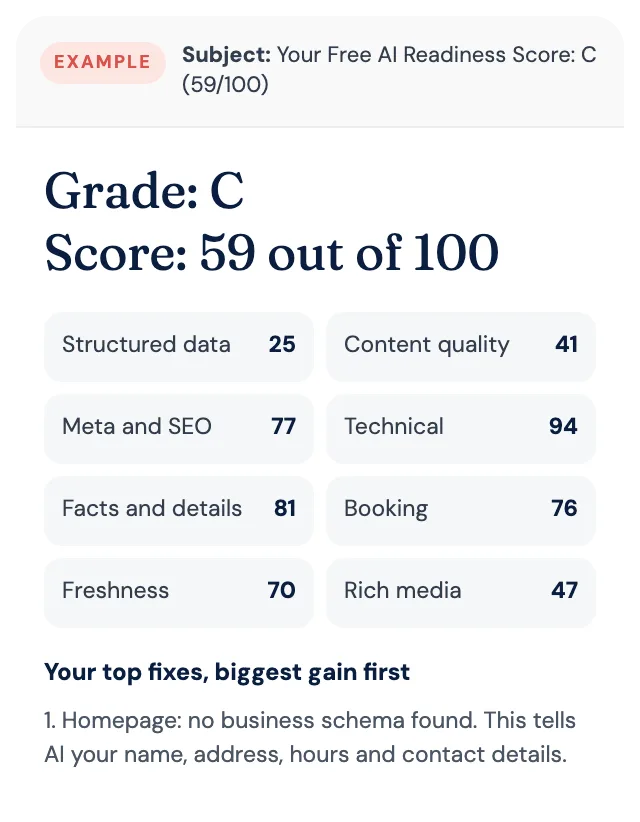
Free AI Readiness Score
Get your grade, a score out of 100 and your top fixes, by email. Free for tourism operators. No login and nothing to install.
Get access to all our training, coaching, and tools built for tourism operators who want to grow with confidence.
Explore membership